

It's 10:14 PM on a Tuesday. Sarah's water heater is leaking onto the laundry room floor. She pulls up Google, taps the first plumber she sees, fills out the contact form, and hits submit.
Now what?
If you run a service business, you already know the answer in most cases. Nothing happens. The form lands in an inbox. The owner is asleep. The on-call number, if there is one, sometimes goes to voicemail. By 7 AM the next morning, Sarah has called four other plumbers and the second one she reached has her job.
That gap between "lead submits form" and "human picks up the phone" is where most service businesses lose money they could have kept. The whole pitch for after-hours lead follow-up automation is closing that gap so you stop bleeding revenue every night your team is off the clock.
This post walks through what that automation looks like end to end, using Sarah's water heater as the example. No vague "AI will help you respond faster" stuff. Real flow, real text messages, real handoffs.
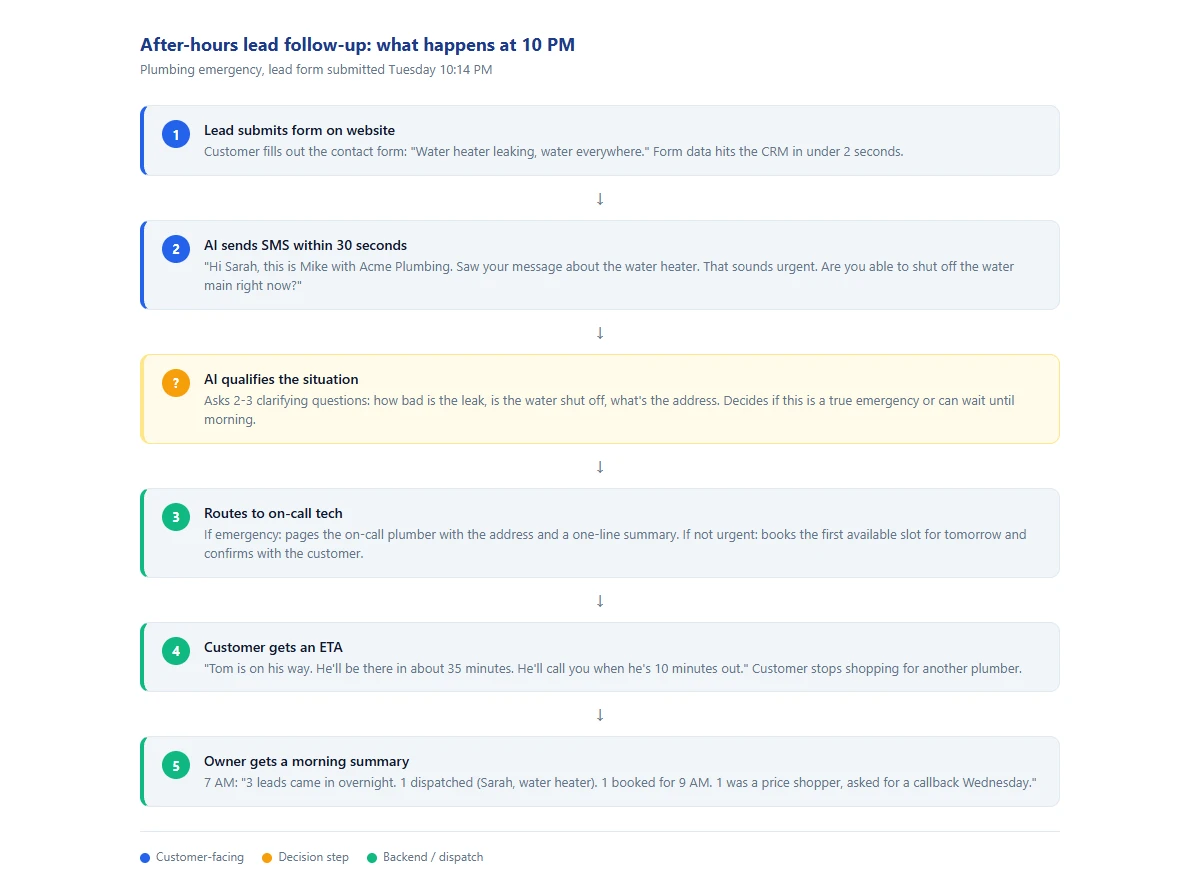
The after-hours lead follow-up flow: a lead submits a form at 10 PM, AI qualifies them via SMS, routes emergency jobs to the on-call tech, and queues non-urgent requests for morning follow-up. Download as PDF
View interactive version
The problem in numbers
Two stats worth keeping in mind before we get into the flow:
The first is response time. The studies on this all land in roughly the same place. If you respond to a web lead within five minutes, your odds of converting that lead are dramatically higher than if you respond in an hour. After an hour, conversion drops off a cliff. After a full night, you are competing with whoever the customer reached at 8 AM the next morning, and you usually lose.
The second is lead volume by hour. If you actually look at when your form fills come in, a real chunk of them land outside business hours. Evenings and weekends. Plumbing emergencies obviously skew late. But even non-emergency service inquiries cluster in the evening, because that is when people are home thinking about their house.
Put those two together and you get the basic math. You probably have a meaningful percentage of your inbound leads arriving when nobody is there to respond, and the cost of slow response on those leads is the highest of any leads you get.
What the automation does, step by step
This is the flow we'd build for Sarah's plumber.
10:14 PM. Form submission. Sarah submits the contact form. The form does what it always does: it sends an email to the office, drops a row in the CRM, maybe pings a Slack channel. Nothing here is new. The new part starts in the next 30 seconds.
10:14:30 PM. AI sends the first SMS. The system reads the form, recognizes the words "leaking" and "water heater" as urgency signals, and fires a text message to Sarah's phone:
Hi Sarah, this is Mike with Acme Plumbing. Saw your message about the water heater. That sounds urgent. Are you able to shut off the water main right now?
A few things matter here. The message is short. It uses her name. It identifies the company. It addresses her actual problem instead of saying "thanks for reaching out, we'll get back to you soon." And it asks a useful question that buys the system 30 seconds to do real work while Sarah responds.
10:15 PM. Sarah replies. "Yes I shut off the water. The whole tank is leaking from the bottom. I need someone tonight if possible."
10:15:15 PM. AI qualifies. The system reads her reply and decides this is a real emergency, not a tomorrow-morning job. It asks two more quick questions:
Got it. A couple quick things so we can get someone out: what's your address, and is the leak contained or still spreading?
Sarah replies with her address and confirms the leak is contained now that the water is off. Total elapsed time so far: about 90 seconds.
10:16 PM. The system pages the on-call plumber. Tom, the plumber on call tonight, gets a text on his phone:
EMERGENCY: Sarah, 1247 Maple St. Water heater leaking, water shut off, contained. ETA needed. Reply Y to accept.
Tom is watching TV. He looks at his phone, taps Y. The system now knows the dispatch is accepted.
10:17 PM. AI confirms with the customer. Sarah gets one more text:
Tom is on his way. ETA about 35 minutes. He'll call you when he's 10 minutes out. His truck is white with our logo on the side.
That message is the most important one in the whole flow. It is the message that tells Sarah she can stop searching. She closes the browser tab where she was about to fill out the next plumber's form. She stops calling around. She is now your customer.
10:50 PM. Tom arrives. Standard service call from here. The automation's job is done.
7:00 AM the next day. The owner gets a summary. When the owner of Acme Plumbing wakes up, there is a single text waiting:
Last night: 3 leads. 1 dispatched (Sarah, water heater, Tom). 1 booked for 9 AM today (drain clog, no rush). 1 was a price shopper, declined to schedule, asked for callback Wednesday.
The owner reads it over coffee. They know exactly what happened while they were asleep. There is no inbox to dig through, no missed messages to chase down, no panicked "we lost three leads last night" discovery at 9 AM.
What is doing the work in the background
The flow above looks simple from the outside, which is the point. Underneath, a few specific things have to happen.
The system needs to read the form submission and pull out the parts that matter. Customer name, phone number, problem description, any urgency signals. This is not magic. It is structured field parsing plus a small amount of language interpretation on the free-text problem field.
It needs to know how to score urgency. A water heater leak at 10 PM is a different situation from "interested in a quote for repiping the upstairs bathroom." The system needs rules or examples that tell it which inbound messages get the emergency flow and which get the routine flow.
It needs a real SMS conversation engine. Not autoresponders. Something that can read replies, ask follow-up questions, handle "what's your address" and "is the leak contained" naturally, and recognize when the conversation has gathered enough information to hand off.
It needs to know who is on call and how to page them. This is usually a schedule the owner sets up once, plus a fallback chain in case the first person does not respond within a minute or two.
It needs to write back to the CRM so everything is logged. The owner should be able to look up Sarah's job in the morning and see the entire transcript, the dispatch decision, and the timing.
And it needs the morning summary. That part is the easiest to skip and one of the most valuable for the owner. It is the difference between trusting the system and constantly checking on it.
When this kind of automation makes sense
Let's be honest about where this fits and where it does not.
It makes sense if you get inbound leads outside business hours and you have anything resembling an on-call rotation, or could have one. Plumbing, HVAC, electrical, water damage, locksmith, garage door, towing, tree service after a storm. If your customers have emergencies, this is for you.
It makes sense if you can quantify the cost of a missed lead. If your average job is $400 and you are losing two leads a night because nobody responds, that is real money. If your average job is $40 and the math does not work, it is fine to skip this.
It does not make sense if your work is purely scheduled in advance and customers are happy to wait until the next business day. A custom cabinet maker probably does not need this. A landscape designer probably does not need this.
It also does not replace good people. The point of the automation is not to remove humans from the loop. It is to handle the first 90 seconds of a lead conversation so a real human can do the actual work when it matters. The on-call plumber still goes to the house. The office staff still handles billing in the morning. The owner still runs the business. The automation just buys back the time between "lead arrives" and "human is ready to respond."
What it takes to set up
The honest version: a few hours of setup if you have your CRM and SMS provider in order, a couple of weeks if you are starting from scratch and need to figure out your on-call rotation, urgency rules, and message tone.
The pieces you need:
A CRM or lead capture system that can fire a webhook when a new lead comes in. Most modern systems can do this. If yours cannot, that is the first fix.
An SMS provider. Twilio or one of the wrappers around it. Costs are minimal at typical lead volumes.
A way to define urgency rules and message templates that match your business. This is where most of the real work lives. Not the technology, the decisions about which kinds of leads get the emergency flow.
An on-call schedule and a fallback chain. If Tom does not accept within two minutes, who gets paged next?
A morning summary delivery method. A simple text or email works fine.
This is the kind of system we'd build for a service business and tune over the first month based on what is actually happening in your inbox. The setup is the small part. The tuning is where the value compounds.
The version of this you can do today
If a full automation feels like too much to take on right now, you can get partway there with simpler steps:
Make sure your form fires an immediate confirmation text, even if it is generic. Just "Got your message, someone will reach out within the hour" beats silence by a wide margin.
Put a human on call for true emergencies and make sure the form flags emergencies clearly enough that you know which messages can wait.
Track what happens to your after-hours leads for two weeks. Just write down what came in, how fast you responded, and what booked. That data alone will tell you whether the full automation is worth building.
If the answer is yes, that is when you build the rest. And if you want help thinking through what that would look like for your specific business, reach out and we will walk through it with you.

About the author
Zac Spencer is an online marketing specialist and the owner of Crave Media, based in Salt Lake City, Utah. Since 2013 he has managed hundreds of Google Ads accounts across dozens of industries — with budgets from a few hundred dollars to $250K a month — and founded Crave AI to build custom AI tools and automations for local service businesses.