

How a landscaping company could track every job from quote to completion
You spent an hour walking a backyard with a homeowner in Germantown. You sketched out a patio, a retaining wall, and a planting plan. You sent over a $4,200 proposal the next day. That was three weeks ago and you haven't heard back.
This is the most common problem in the landscaping business. Not lead generation. Not pricing. Not even crew scheduling. It's the long quiet stretch between "great meeting you" and "when can you start?" — and every lost week during that stretch is a project that's drifting toward a competitor or, worse, toward nothing at all.
AI automation for landscapers can close that gap. It won't replace your design skills or your customer relationships. What it does is track every proposal and keep the conversation alive during the decision window. This is what we'd build.
The proposal tracker every landscaper actually needs
Most landscaping companies track proposals in one of three ways: a paper notebook, a spreadsheet that gets out of date by week two, or a generic CRM that wasn't designed for the way design work flows. None of them answer the question you actually care about — where are we losing deals, and why?
What we'd build is a Design Proposal Tracker. It's one screen that shows every active consultation and every proposal, organized by stage, with the numbers that matter most to a landscaping business.
The columns look like this:
- New Inquiry — someone called, filled out a form, or got referred. Nothing scheduled yet.
- Consultation Booked — you've got a site visit on the calendar.
- Designing — you did the walk-through and you're working up the plan and pricing.
- Proposal Sent — the homeowner has your number.
- Revision — they want changes before they decide.
- Approved — they said yes, scheduled for the crew.
- Completed — work is done, invoice paid.
Every proposal is a card. Each card shows the homeowner's name, the property address, the type of work (hardscaping, planting, irrigation, outdoor lighting), the estimated project value, and the full history of every call, text, email, and note from your team.
This is not a CRM with 400 features. It's the one view that tells a landscaping company owner exactly where every deal stands.
What a typical week looks like on the board
Spring in the Mid-South is when landscaping consultations pile up fast. Let's walk through a real week.
Monday morning, you open the dashboard. You see 14 active proposals across different stages. Three are sitting in "New Inquiry" — you need to call those today. Four are in "Proposal Sent" but haven't been looked at in over a week. Two are in "Revision" waiting on your final numbers. Five are approved and queued for the crew.
Right there, you know what to do with your morning. Without the board, you'd be flipping through a notebook trying to remember who you talked to last Tuesday.
By Wednesday, a homeowner in East Memphis texts back on a patio quote. Her card moves from "Proposal Sent" to "Revision" with a note that she wants flagstone instead of pavers. You update the price and push the revised proposal. Card moves back to "Proposal Sent."
By Friday, a $6,800 backyard overhaul you bid two weeks ago gets approved. The card moves to "Approved" and shows up in your crew scheduler with the estimated job duration and any material orders that need to go in. Your ops manager sees it immediately without you having to send a text.
Where the real data lives
This is where the Design Proposal Tracker earns its keep. Every card that moves through the board generates data, and the dashboard rolls that data up into the numbers you've probably never had a clear view of:
- Close rate by project type (hardscaping: 45%, planting-only: 22%, irrigation: 60%)
- Average days from proposal sent to close, by project size
- Revenue per consultation (total closed revenue / total consultations run)
- Pipeline value — what's sitting in Proposal Sent and Revision right now
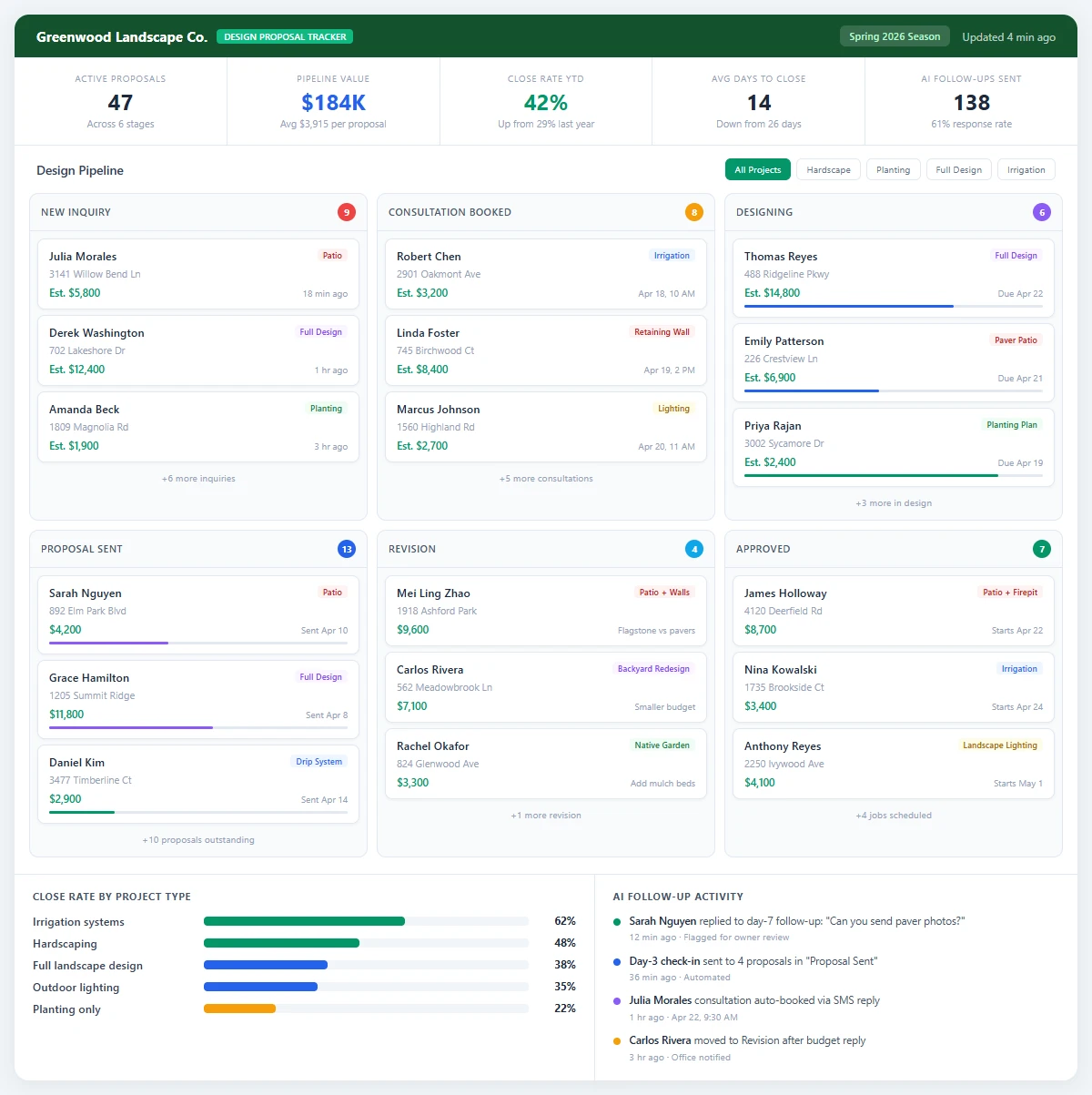
The Design Proposal Tracker dashboard we'd build for a landscaping company: every consultation and proposal tracked from first contact through approved job, with close rates by project type, pipeline value, and AI follow-up status built into each card. The data is fictional, but the pipeline stages and metrics are based on how landscaping companies actually lose and win design work. Download as PDF
View interactive version
Imagine knowing that your hardscaping proposals close at 45% but your planting-only jobs close at 22%. That's not a small difference — that's telling you where to put your marketing dollars and which consultations to prioritize when your week is full. If you've been spending the same amount of effort on every lead, you've been leaving money on the table.
Or imagine seeing that proposals under $1,500 close in about 8 days on average, but anything over $3,000 takes 23 days. That tells you how long to expect a homeowner to sit on a larger quote, and it tells you when to follow up without nagging.
These are numbers most landscaping companies have never seen. They don't exist on any spreadsheet because nobody has time to build one. They show up automatically on this dashboard.
The follow-up problem
Here's where most landscaping companies lose real money. You finish a consultation, send a proposal, and then... silence. You're busy on jobs. You forget to call back. Two weeks pass. The homeowner forgot your name. They hire the first person who follows up.
A follow-up automation built into the tracker handles that gap without your team doing a thing. Every card in "Proposal Sent" gets a sequence that looks something like this:
- Day 3: "Hey Sarah, just checking in on the backyard design. Any questions on the patio or the planting plan? Happy to walk through anything."
- Day 7: "Hey Sarah, I put together a quick photo set of similar patios we've done in East Memphis if it helps you visualize how yours would look. Want me to send it?"
- Day 14: "Hey Sarah, wanted to circle back before the May crew schedule fills up. If you're still deciding on materials or timing, just let me know what questions you have."
- Day 21: "Hey Sarah, last note from me on this one. If the timing isn't right we can revisit in the fall — just didn't want you to miss the window for a spring install."
Each message is specific. It references the project by type. It answers questions the homeowner is probably asking themselves. It feels like you texting personally, because that's the voice it's written in.
When Sarah replies "actually, I've been thinking about doing pavers instead of flagstone — how much would that change the price?", the AI flags her card for your attention and stops the automated sequence. Your team takes over from there.
Without this, that $4,200 patio sits in your outbox until you eventually remember it, usually after it's too late. With it, the conversation keeps moving through the decision window.
Seasonal automation is the secret weapon
Landscaping is a feast-or-famine business. Spring and early summer are chaos. November through February is crickets. The companies that stay profitable year-round figure out how to fill the slow months with planning work, not just wait for April to hit.
This is where the winter planning sequence earns its keep. Starting in October, the system automatically reaches out to every past customer and every proposal that didn't close from the spring season:
- Late October: "Hey, hope your summer went well. Starting to line up our spring calendar — any projects you're thinking about for next year? We offer 10% off for anyone who books before January."
- Mid November: "Quick note — we're doing free 2026 planning consultations through December. No commitment, just a walk-through and some ideas. Interested?"
- January: "Planning season is here. If you've been thinking about [the patio / the outdoor lighting / the irrigation system] we talked about last summer, we've got openings in our April schedule."
Every response pulls that homeowner back into the proposal pipeline. By the time March hits, you've got eight or ten warm leads queued up instead of starting from zero.
This is the kind of work that a three-person landscaping crew physically doesn't have time to do. Nobody's making cold calls in November when the trucks are winterized and everyone's trying to take a break. But the AI doesn't take a break. It keeps the conversation alive during the season when most landscapers disappear.
Hooking into how you already work
The tracker isn't meant to replace anything you're doing. It's meant to organize it and close the gaps.
The tool integrates with what you already use:
- Your phone system: inbound calls and texts automatically create or update cards
- Your estimating software: when you send a proposal through LMN, Jobber, Aspire, or whatever you use, the card updates and the follow-up sequence kicks on
- Your calendar: booked consultations and install dates show up on the card timeline
- Your email: when a homeowner replies to a proposal, the reply gets logged on the card
Your designers still do the consultations. Your crews still do the installs. Your office manager still handles approvals. The pipeline just makes sure nothing sits silent in the gap between those steps.
The morning routine changes from "what did I follow up on yesterday?" to "open the dashboard and see what needs attention today." The Monday sales meeting changes from "who remembers which quotes we're still waiting on?" to actually looking at pipeline value and knowing.
What happens to the leads you'd normally lose
Here's what a typical mid-sized landscaping company looks like before and after this kind of system is in place.
Before: you do about 120 consultations a year. You close roughly 30% of them, so 36 projects. Average ticket is around $2,800, putting annual revenue from design work at about $100,000. The other 84 consultations — the ones that didn't close — disappear into the follow-up void.
After: you still do 120 consultations, but now the proposal tracker and the follow-up automation are catching the ones that would have drifted. Close rate bumps to 42% because the warm ones actually come back to the table. That's 50 closed projects, 14 more than before, at $2,800 each. That's about $39,000 in additional revenue from the exact same lead volume.
That's not a hypothetical multiplier. It's what happens when you stop letting proposals go cold after day 7. The leads were already warm enough to schedule a consultation. They just needed one more touch at the right moment, and nobody had the time to do it manually.
Add in the winter planning work — say 10 projects you wouldn't have booked otherwise at $2,800 average — and you're looking at another $28,000 filling what used to be your slow months.
When an AI consultation system makes sense
Not every landscaping operation needs this. A one-person operation doing maintenance routes with no design work probably doesn't. A company doing a handful of high-end landscape architecture projects per year might already have a designer keeping the pipeline tight manually.
But if you're running a crew of 3 to 20, doing 50+ consultations a year, losing proposals to silence, and watching competitors book the jobs you already quoted — this is the problem this tool was built for.
A custom tracker like this takes a few weeks to build and connect to your existing systems. Once it's running, it handles the next 120 consultations on autopilot. Your team focuses on design, sales, and installs. The pipeline handles the parts in between.
Your competitive edge in a crowded market
Consider what you're actually up against in landscaping: the solo operator with a truck and a lawn mower has been undercutting your maintenance prices for 20 years. You're not going to beat them on price, and you shouldn't try to.
Where you win is on professionalism. On the follow-up. On actually showing up with a plan instead of a vague quote. On answering a homeowner's materials question three days after sending the proposal while your competitor hasn't called in two weeks.
That's what this tool delivers. It doesn't make you a better designer — you're already a good one. It makes sure the work you do on the design side doesn't evaporate because nobody had time to send one more text.
Most landscaping companies are still running on notepads, spreadsheets, and memory. The ones that win the next five years will be the ones that treat their proposal pipeline like the revenue engine it actually is.
If you're running a landscaping company and want to see what a Design Proposal Tracker could look like for your business, that's what we build.

About the author
Zac Spencer is an online marketing specialist and the owner of Crave Media, based in Salt Lake City, Utah. Since 2013 he has managed hundreds of Google Ads accounts across dozens of industries — with budgets from a few hundred dollars to $250K a month — and founded Crave AI to build custom AI tools and automations for local service businesses.