

The directories that feed AI search results
When someone asks ChatGPT for "a good electrician in Memphis," the model doesn't pull that name out of thin air. It's reading from somewhere. A lot of the time, that somewhere is a handful of business directories you forgot you were even listed on.
AI search directories are the data sources that ChatGPT, Gemini, Copilot, and Google's AI Overviews check when they recommend a local business. You already know some of them, like Google Business Profile and Yelp. Others quietly feed dozens of downstream listings without you ever logging in. If your information is wrong or missing on the ones that count, you don't get recommended, no matter how good your website is.
This is the unglamorous plumbing behind AI visibility. I'll walk through which directories feed AI answers, why each one matters, and how to get listed and cleaned up without spending a week on it.
Why AI models lean on directories at all
An AI model answering "who should I call for a water heater repair" has a problem to solve before it says anything: it needs to be confident the business is real, still in operation, and a reasonable answer to the question. It can't call you to check. So it does the next best thing and cross-references structured data from sources it already trusts.
Directories are built for exactly that. Each one stores your name, address, phone, hours, and category in clean, labeled fields instead of buried in website copy. When the same details show up the same way across Google, Bing, Apple, and a few aggregators, the model's confidence goes up. When the details conflict, confidence drops, and you're less likely to be the name it offers.
The other half of this is that a model's training data is stale by months or years. Live web retrieval fills the gap, and it leans on the same authoritative directories Google and Bing already index. That's why a business with clean listings can show up in an AI answer even if its website barely ranks.
The directories that matter most
Not all listings carry the same weight. These are the ones that move the needle for AI search, roughly in order.
Google Business Profile
The big one. Google Business Profile feeds Google Maps, the local pack, and Google's own AI Overview and Gemini answers directly. If you fix nothing else, fix this. Claim it, verify it, and fill every field: name, address, phone, website, hours, service area, primary and secondary categories, services, and a real description. An incomplete profile is the most common reason a legitimate business gets skipped.
Bing Places
The one almost everyone skips. ChatGPT's web browsing and Microsoft Copilot both run on Bing's index, so Bing Places quietly sits underneath a large slice of AI search. Most local owners have never claimed it. Setting it up takes about fifteen minutes, and Bing will often let you import your Google profile so you're not retyping everything.
Apple Business Connect
Apple Business Connect feeds Apple Maps and Siri, which matters more than it used to now that Siri hands a lot of questions to ChatGPT. It's free, it's fast to claim, and hardly anyone in the trades has bothered. That makes it cheap visibility while your competitors ignore it.
The data aggregators
Data Axle, Foursquare, and Localeze are the behind-the-scenes layer. You won't get customers from them directly, but they syndicate your business data to hundreds of smaller maps, apps, voice assistants, and directories. Get your record right at the aggregator level and the correction flows downstream on its own. Get it wrong, and a bad old address keeps resurfacing on sites you've never heard of, no matter how many times you fix it by hand.
Yelp
Yelp is still a heavy citation source, and Apple and other platforms license its data, so a clean Yelp listing reaches further than Yelp itself. AI models read the review text, not just the star count. Two hundred reviews that mention specific services and neighborhoods tell the model far more about what you do than a 4.8 with no detail.
Industry and local directories
Angi, Thumbtack, Houzz, the Better Business Bureau, and your chamber of commerce all add weight, especially the vertical ones that match your trade. A roofer benefits from roofing and storm-restoration directories that a hair salon never would. Pick the few that fit your industry and your city instead of carpet-bombing every directory on the internet.
A quick note on Wikidata and Wikipedia, since people ask: AI models trust them heavily, which is part of why national brands dominate "best of" style answers. For most local service businesses, the notability bar there is out of reach, so I wouldn't spend time on it. Put that effort into the claimable directories above, where you control the record.
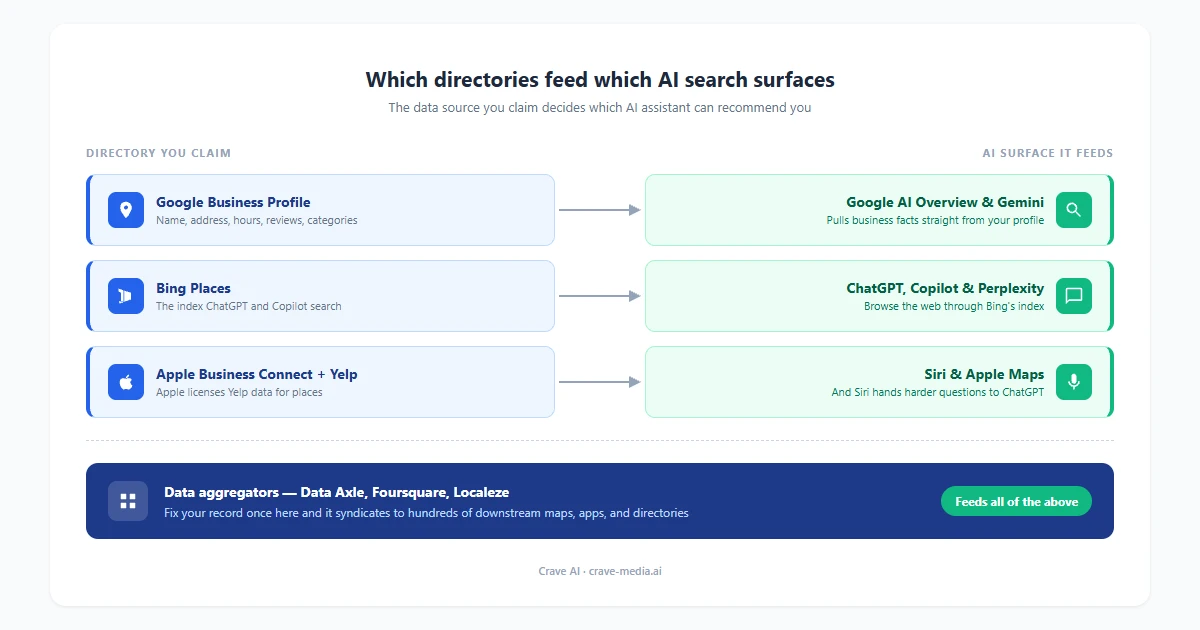
Which directories feed which AI search surfaces. Google Business Profile drives Google AI Overview and Gemini, Bing Places sits under ChatGPT and Copilot, and Apple Business Connect plus Yelp power Siri and Apple Maps, while data aggregators quietly feed all of them. Download as PDF
View interactive version
How to get listed and keep it clean
The work splits into two jobs: getting on the right directories, and keeping the data identical across all of them.
Claiming is mostly free and mostly tedious. Start with Google Business Profile, Bing Places, and Apple Business Connect, since those three sit closest to the AI surfaces people use. Then handle the aggregators and the two or three industry directories that fit your trade. Each one wants you to verify ownership, usually by phone, email, or a postcard, so expect the whole sweep to take a week of small steps rather than one sitting.
Consistency is where most businesses lose. Your name, address, and phone number need to match exactly everywhere, down to whether you write "Suite B" or "Ste B" and which phone number you list. To a person, "1420 Oak Street" and "1420 Oak St." are obviously the same place. To a model comparing records across sources, they read as a mismatch, and mismatches cost you confidence. Pick one format and use it on every listing, including your own website, where the same details should be backed up with schema markup so AI can read them without guessing.
Once you're listed, this isn't a set-and-forget job. Aggregators refresh on their own schedules, old data resurfaces, and platforms add new fields worth filling. A quick quarterly pass to confirm everything still matches keeps you from drifting back into the inconsistency that made you invisible in the first place.
Where to start if you only have an afternoon
If a week-long sweep isn't happening, do the version that gets you most of the benefit. Claim or update Google Business Profile and fill every field. Claim Bing Places and import from Google. Claim Apple Business Connect. Then open your Yelp listing and make the name, address, and phone match the other three exactly.
That's four directories and maybe ninety minutes, and it covers the sources sitting under Google AI Overview, ChatGPT, Copilot, and Siri. It's the highest-leverage hour and a half you can spend on AI search visibility right now. Everything after that is cleanup and depth, which matters, but those four are the foundation.
Where we fit in
We build AI visibility systems for local service businesses, and the directory cleanup is usually step one. We audit where your business shows up across the data sources AI models check, fix the records that conflict, get you listed where you're missing, and add the structured data on your site that ties it together.
None of it is flashy. It's the kind of detailed data work most agencies skip because it doesn't photograph well for a case study. But it's the difference between getting named when someone asks an AI who to call and never coming up at all. If you want to see where your listings stand today, we'll run a free audit and show you what's missing. Start here.

About the author
Zac Spencer is an online marketing specialist and the owner of Crave Media, based in Salt Lake City, Utah. Since 2013 he has managed hundreds of Google Ads accounts across dozens of industries — with budgets from a few hundred dollars to $250K a month — and founded Crave AI to build custom AI tools and automations for local service businesses.