

Do reviews decide who AI recommends?
Ask ChatGPT for a good plumber in your city and you get three or four names back. Not thirty. The question worth asking, if you own one of the plumbing companies that didn't get named, is what put those specific businesses on the list.
Reviews are a big part of the answer. Just not in the way most owners assume. Star rating is the number everybody watches, and it's close to the least useful signal once you clear a certain line. What moves AI recommendations for a local business is some combination of how many reviews you have, how recently they showed up, and what they say in plain English.
This post walks through which review signals feed AI answers and what a realistic fix looks like if your profile is thin.
Why the model has to pick a short list
Type a question into Google and you get a page of results. You do the sorting. Ask ChatGPT or Gemini the same question and the model does the sorting for you, then hands back a few names. That's a different job, and it's harsher on businesses. There is no page two.
To produce that list, the model has to decide which businesses it's confident enough to name out loud. It can't drive by your shop. It weighs the public evidence it can retrieve: your Google Business Profile, your website, your directory records, and your reviews.
Reviews are the only part of that pile that isn't you talking about yourself. A model reads your homepage as a claim and your 180 customer reviews as evidence. That's why they carry weight out of proportion to how much text they represent.
Volume works like a threshold
The first thing a review profile has to do is prove you're a real, operating business with enough history to be worth recommending. Volume does that. The effect is stepped: it counts for a lot up to a point, then flattens out.
Twelve reviews and 400 reviews are genuinely different. Four hundred and 600 mostly aren't. Once you're clearly established relative to the other companies in your market, more reviews stop buying you much. The businesses getting skipped are almost never at 300 reviews wishing they had 500. They're at nine.
Where that threshold sits depends entirely on your market. In a dense metro, the plumbing companies an AI names might all sit north of 200 reviews, and 40 makes you invisible. In a smaller town, 40 might be the top of the market. The number to compare yourself against is what the three companies AI names in your city have, not some universal target.
Rating only has to clear a bar
Almost every owner I talk to wants to know how to get from 4.6 to 4.9. It's the wrong project.
Ratings function like a band. Below roughly 4.0, you have a problem that will keep you out of recommendations. Between about 4.3 and 4.8, you're in the range where models treat you as a credible option and other signals decide the outcome. Above 4.9 with real volume, you start looking suspicious instead of excellent, and both platforms and models are tuned to notice profiles that look manufactured.
A 4.7 with 250 reviews across four years beats a 5.0 with 22 reviews from last spring, essentially every time. The first profile looks like a business. The second looks like a campaign.
Recency is the signal most businesses lose
You collected reviews hard during some push two years ago, hit a number you were proud of, and stopped asking. Your rating didn't move. Your visibility did.
Recency answers a question the model genuinely needs answered: is this business still open, and is it still doing the work it used to do well? A profile whose newest review is fourteen months old answers neither. A steady trickle answers both.
The practical version of this is boring and effective. A handful of new reviews every month, forever, is worth more than 60 reviews in one quarter followed by silence. It also looks organic, because it is. That steady flow is the whole reason we build automated review requests into the post-job workflow instead of running review pushes as occasional projects.
What your reviews say, word for word
This is where AI search parts ways with the local pack you're used to. Google's map ranking has historically treated your review corpus mostly as a score and a count. A language model reads the sentences.
That changes what a good review is. When someone writes "they replaced our water heater the same day we called and the price matched the quote," a model can extract several things: the service, the response speed, and pricing behavior. That review can get your business surfaced for "who does same-day water heater replacement near me," which is a query your website may not answer well at all.
Compare that to "Great service! Highly recommend." Five stars, adds nothing. It moves your count and teaches the model nothing about what you do.
That makes the wording of your request the thing worth changing, more than the number of requests you send. Ask "if you have a second, it helps other homeowners to know what we did and how it went" and you get reviews with content in them. Ask "please leave us 5 stars" and you get noise.
Two things follow from that. Reviews mentioning particular services are how you get recommended for those services. And reviews mentioning neighborhoods, suburbs, and landmarks are how you get recommended in those places, which is often more useful than a city-level listing for a company that covers a wide service area.
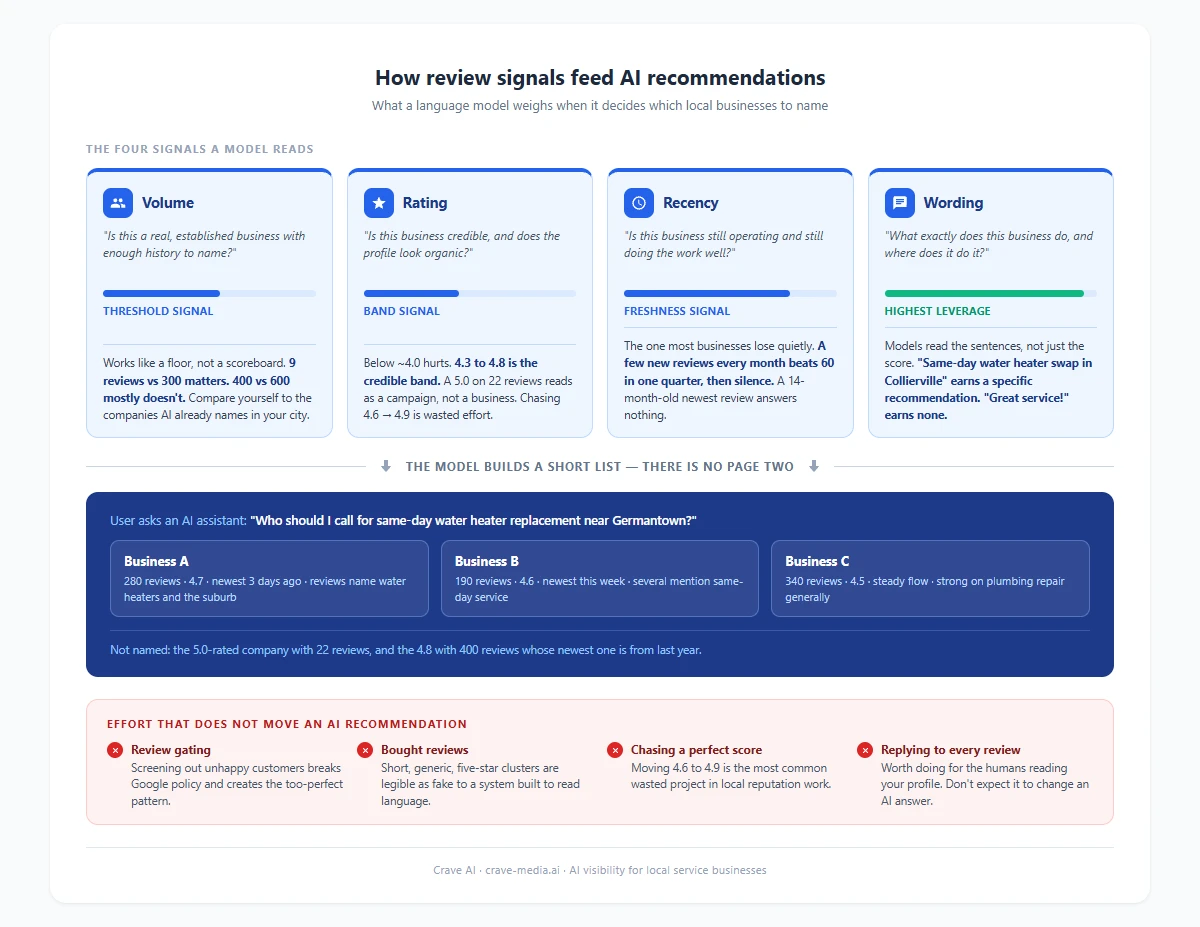
How review signals feed AI recommendations for a local business. Volume clears a threshold, rating has to sit in a credible band, recency proves you're still operating, and the wording of reviews decides which services and neighborhoods you get named for. Download as PDF
View interactive version
Google isn't the only profile being read
Most owners think about reviews as a Google project. Reasonable, since Google Business Profile carries the most weight and feeds Google's own AI Overviews and Gemini directly.
But ChatGPT's web search runs on Bing's index, and Bing leans on a broader set of sources. Apple's ecosystem pulls from Yelp. Trade-specific platforms like Angi, Houzz, and BBB get read too, and for some trades the vertical site carries surprising weight because it's where detailed, service-specific language lives.
A business with 300 Google reviews and nothing anywhere else has a lopsided profile. It'll do fine in Google's AI answers and go missing in others. Spreading a portion of your requests across a second platform costs nothing extra and covers a gap you can't otherwise see. Which platforms feed which AI surfaces is worth understanding on its own; we mapped it in the post on the directories behind AI search results.
Things that don't work
Review gating, where you screen customers and only route the happy ones to the public form, violates Google's policy and can get your reviews stripped or your profile penalized. It also produces exactly the too-perfect pattern that reads as manufactured.
Bought reviews are worse. Platforms filter them, and models are reading text patterns as well as counts. A cluster of short, generic, five-star reviews posted in the same week is legible as fake to a system built to read language.
Responding to every review is worth doing, but not for AI. It's good customer service and it helps humans reading your profile. Nobody should expect it to move an AI recommendation on its own.
And chasing a perfect rating remains the most common wasted effort in this whole category. If you're sitting at 4.6, don't spend the quarter trying to reach 4.9. Spend it collecting newer reviews that say something specific.
What to change this month
Start by looking at the date on your newest review. If your rating sits in the credible band and that date is more than a couple of months back, you have a flow problem, and the fix is a request that fires automatically after every completed job in a channel your customers reply to.
Reviews coming in but all one-liners? Change the ask. Point people at what to describe: what the job was and how it went. Specific reviews earn you specific recommendations.
And if everything you have is on one platform, split your next 30 requests so some of them land somewhere else.
Where we fit in
We build AI visibility systems for local service businesses, and the review layer is usually one of the first pieces. That means a review request that fires on job completion instead of whenever someone remembers, phrasing that produces useful sentences instead of "great service," routing across the platforms that feed the AI surfaces your customers use, and monitoring of what ChatGPT and Gemini currently say when someone asks for a business like yours in your city.
Most owners have never run that last check. It takes about five minutes and it's uncomfortable, because you find out whether you're in the answer or whether your competitor is. If you want us to run it for you and show you what your review profile looks like from a model's side, get in touch and we'll put it together.

About the author
Zac Spencer is an online marketing specialist and the owner of Crave Media, based in Salt Lake City, Utah. Since 2013 he has managed hundreds of Google Ads accounts across dozens of industries — with budgets from a few hundred dollars to $250K a month — and founded Crave AI to build custom AI tools and automations for local service businesses.