

AI photo quoting for a junk removal company
Junk removal has the shortest customer attention span of any trade we build for. Nobody plans a garage cleanout three weeks ahead. Somebody wakes up on a Saturday, decides today is the day the sectional and the broken treadmill leave the house, and starts calling around. Whoever gives them a price and a pickup time first usually gets the job. Not the best price. The first one.
Most junk removal companies still answer that moment with "we'll swing by tomorrow and take a look." That free on-site estimate feels like good service, and it costs you the job, because your competitor quoted from a photo while your truck was still driving over to look at a couch. The AI tools a junk removal business gets the most out of are built around exactly this: turn a text message with a photo into a priced, booked, routed pickup in a few minutes, with no human in the loop until the crew shows up. Below is the version we'd build, with a mockup of the dispatch side on a Friday morning.
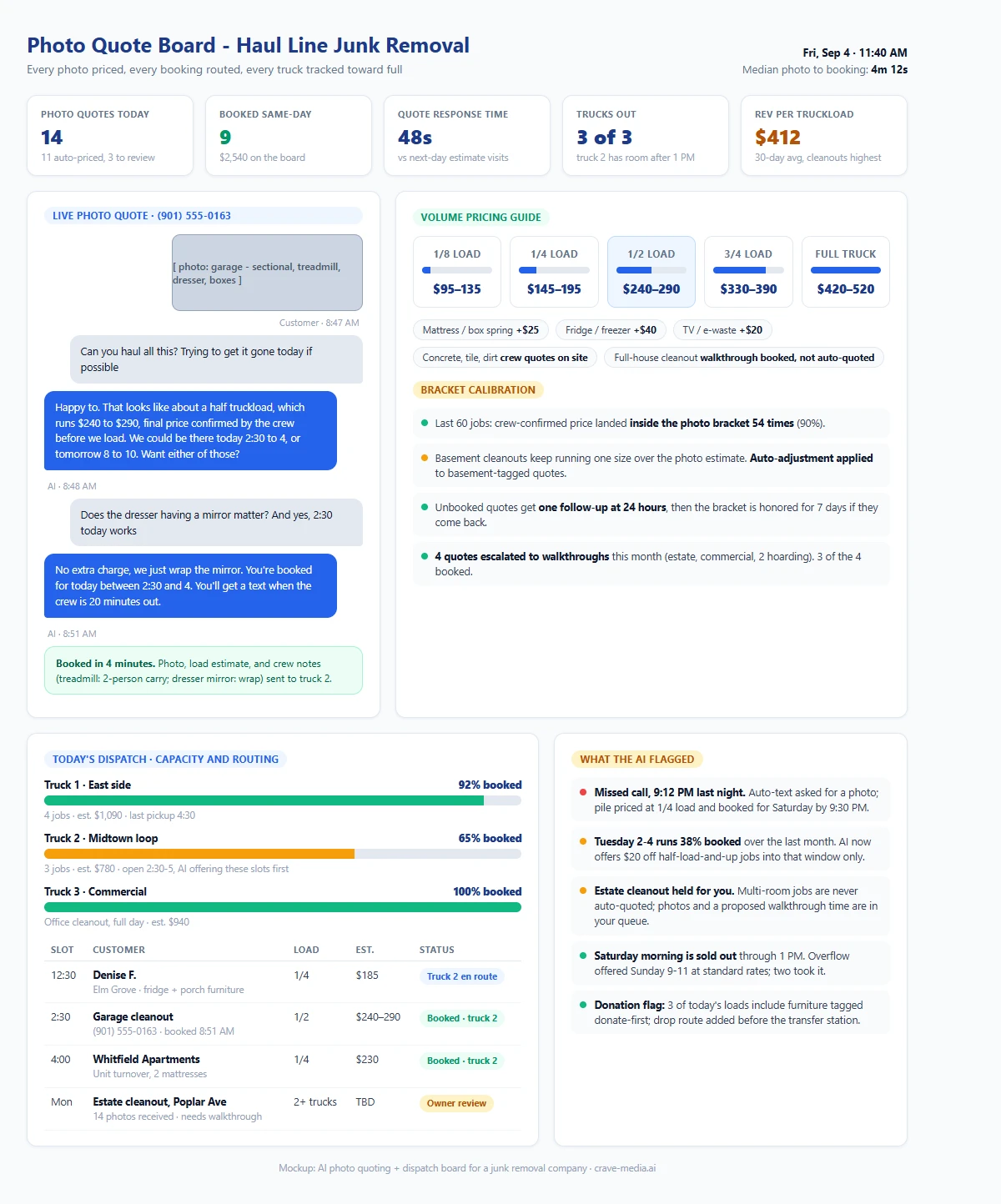
The photo quoting flow next to the board it feeds: a customer's garage photo priced as a half load in under a minute, same-day slots offered and booked, and the dispatch view tracking how full each truck is as the bookings land. Download as PDF
View interactive version
The estimate visit is where jobs go to die
Walk through what the on-site estimate really costs. The customer calls at 9 AM. You're on a job, so it goes to voicemail, and about a third of junk removal inquiries come in outside working hours anyway. You call back at noon, set up a look for tomorrow between 2 and 4. Tomorrow at 3 you quote $280. The customer says they'll think about it. You've now spent a callback, a drive, and a day of lead time to deliver a number, and somewhere in that day the customer got a price from someone else by texting a photo.
The math on the other side is brutal in a good way. When the price and the time slot arrive while the customer is still standing in the garage looking at the pile, the job closes at the peak of their motivation. There is no second round of bids because there was never a first round. Speed doesn't just win the comparison. It prevents the comparison.
That's the whole thesis of the build: collapse quote, booking, and dispatch into one text thread.
How the photo quote flow works
The customer texts a photo of the pile to your business number, or uploads it through a widget on your site. The AI does three things with it.
First, it estimates volume. Junk removal pricing is really truckload-fraction pricing, an eighth, a quarter, a half, a full truck, and a photo of a garage corner is enough to place a pile in a bracket with a little margin on either side. Second, it flags the items that change the price: mattresses and box springs, appliances with refrigerant, TVs and e-waste, anything visibly heavy like concrete or tile. Those carry surcharges or disposal fees in most markets, and the AI prices them from your fee list, not a guess. Third, it checks your trucks. Not a generic calendar, your actual remaining capacity today and tomorrow, because a half-load booking only helps if there's half a truck left to put it in.
Then it replies with the two things the customer wanted when they picked up their phone: a price range and a pickup time. Something like: "That looks like about a half truckload, which runs $240 to $290 including the mattress fee. We have a crew that could be there today between 2 and 4, or tomorrow morning 8 to 10. Want either of those?" The customer picks one, gets a confirmation, and your crew gets the address, the photo, the estimated load, and the flagged items before they roll.
The pattern is the same quote-from-inputs engine we walked through in the kitchen remodeling quote blueprint, with one big difference: a remodel quote feeds a weeks-long sales cycle, and a junk quote feeds a same-day dispatch decision. The plumbing connects to whatever you already run your day on. Jobs land on the calendar or job board you already use, the same way our custom automations usually ride on top of existing tools instead of replacing them.
Four minutes on a Saturday morning
Play the scenario out. At 8:47 on a Saturday, a homeowner in the middle of a garage purge texts a photo: old sectional, treadmill, a dresser, maybe fifteen boxes and bags. The AI sizes it as a half load, catches the treadmill (heavy, two-person carry, no fee but it affects crew notes), and sees that truck two has a gap after its 1 PM job in a neighborhood twelve minutes away.
At 8:48 the homeowner has a range and two slot options. At 8:51, after one clarifying question ("does the dresser have a mirror?"), they book the 2:30 slot. The crew gets the photo and the notes at 8:51. The homeowner never talked to a person, and you find out about the job the way you should: as a filled slot on the board, not as a voicemail you owe a callback.
Total elapsed time, four minutes. The competitor running "free estimates" would have arrived Monday to quote a garage that's already empty.
The photo thread also catches the leads that would have slipped through entirely. A missed call at 9 PM gets the same treatment: an automatic text back asking for a photo of the pile, which is the junk removal version of the missed-call text back we've written about before. Since a big share of these decisions happen on evenings and weekends, the after-hours photo thread quietly becomes one of your best salespeople. It's the same always-on layer we build into lead follow-up systems, except here it can finish the whole sale instead of just holding the lead.
Ranges beat fake precision
An objection we'd raise ourselves: a photo isn't a walkthrough, and an AI that pretends it can price a pile to the dollar from one angle is lying to your customer. The honest version quotes a bracket and tells the crew to confirm on arrival. "$240 to $290, final price confirmed by the crew before we load a single item" is a promise you can keep every time.
What makes the bracket trustworthy is your own history. Every completed job feeds back the photo, the estimate, and what the load turned out to be, so the brackets tighten over time in your market with your customers' garages. If your crews keep finding that photos of basement cleanouts run a size bigger than they look (they do, basements hide depth), the model learns your correction instead of repeating the mistake.
And some jobs should still get a human look. A full-house cleanout, a hoarding situation, anything commercial with a dumpster question, those get routed to you with the photos attached rather than auto-quoted. The AI's job on those is to gather the photos and book the walkthrough, not to fake a number. Knowing which conversations it shouldn't finish is most of what separates a system you trust from one you babysit.
The dispatch board makes speed profitable
Instant booking has a catch. If the AI books pickups without knowing what's on your trucks, you end up with a Tuesday truck crossing town four times to collect three quarter loads. Speed wins the job; routing decides whether the job was worth winning.
So the other half of the build is the board in the mockup: each truck as a capacity bar filling toward full, jobs grouped by area, and revenue per truckload tracked by job type. When the AI offers slots, it isn't offering random openings. It offers the slots that put this half load near that quarter load in the same part of town, which is how a two-truck company gets three trucks' worth of revenue out of a day.
The same data answers the pricing questions owners usually guess at. If Saturday mornings sell out by Thursday and Tuesday afternoons run half empty, your Tuesday slots should cost a little less, and the AI can offer that discount only when a truck actually needs filling. Volume-based pricing meets volume-based scheduling, and both come from data you were already generating one job at a time.
What it takes and when to skip it
The build sits on four pieces: a business texting number, a vision model tuned on load photos, your fee list and service area, and a connection to whatever calendar or job board runs your trucks. Figure a few weeks of setup, most of it spent importing old job photos to calibrate the brackets and getting the message templates to sound like you instead of a robot. Ongoing cost is mostly texting and model usage, small against a single extra half-load job a week.
If you're a one-truck operation doing three jobs a day booked by the owner's cell phone, you don't need this yet. A fast thumb and a Google Voice number get you most of the benefit at your volume. The build starts paying for itself when quoting is what you do between jobs, which for most junk removal companies is somewhere around the second truck, when the missed calls start outnumbering the answered ones and the estimate drives start eating billable hours. The rest of what we'd put together for this trade is on our AI for junk removal companies page.
Gone by dinner
The customer who texts you a photo of their garage has already made the decision. They don't want a consultation, a callback, or a visit. They want a number they can say yes to and a truck in the driveway before they change their mind. A photo quoting flow gives them both while your competitors are still scheduling estimates, and the dispatch board underneath it makes sure the yes lands on a truck that had room for it.
If your quote process still involves driving out to look at a couch, tell us about your junk removal business and we'll sketch the photo-to-booking flow that fits it.

About the author
Zac Spencer is an online marketing specialist and the owner of Crave Media, based in Salt Lake City, Utah. Since 2013 he has managed hundreds of Google Ads accounts across dozens of industries — with budgets from a few hundred dollars to $250K a month — and founded Crave AI to build custom AI tools and automations for local service businesses.