

More people are skipping Google and asking ChatGPT, Gemini, or Google's AI Overview for recommendations. "Who's the best plumber near me?" "Top-rated HVAC company in Nashville." "Affordable house cleaning in Dallas." These queries are sending real traffic to real businesses now, and AI search visibility for local businesses is starting to determine who gets the call.
The problem is that most local service businesses are invisible to these tools. Not because they're bad at what they do, but because AI models don't know they exist. The information AI needs to recommend your business either isn't online or isn't structured in a way that AI can read.
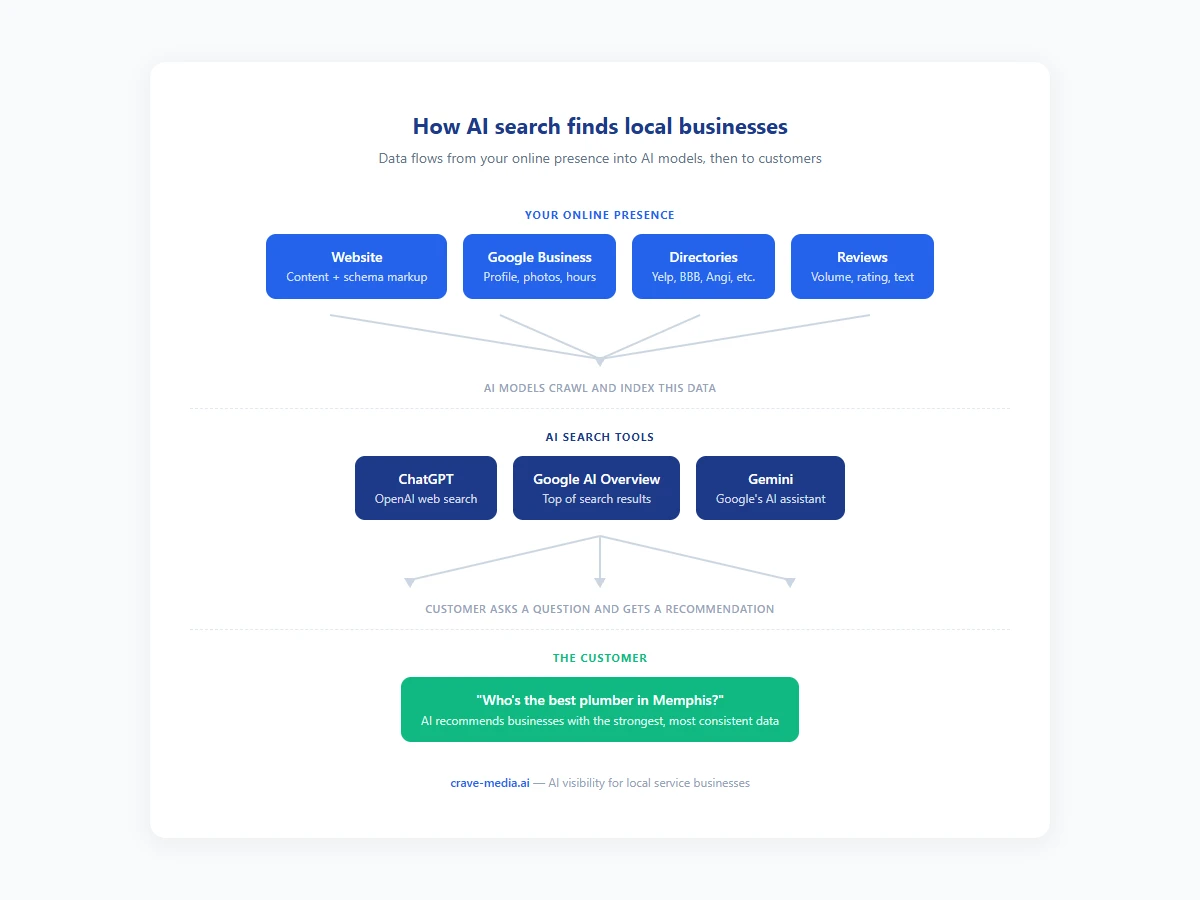
How data from your website, business directories, and review platforms feeds into AI search models to generate business recommendations. Download as PDF
View interactive version
How AI answers local questions
When someone asks ChatGPT "who's the best roofer in Memphis," the model doesn't have a secret list of roofers. It builds an answer from the data it was trained on and, more and more, from real-time web searches.
That data comes from a few places:
- Directory listings like Google Business Profile, Yelp, BBB, Angi, and HomeAdvisor
- Review sites and the actual text of customer reviews
- Your website content, including how it's structured
- Schema markup (structured data that tells AI exactly what your business does)
- Third-party mentions, like articles, local news, or industry directories
Google's AI Overview works similarly but pulls directly from Google's own search index. If you rank well in traditional search, you have a better shot at appearing in AI Overviews too. But AI Overviews also prioritize structured, direct answers, which changes what kind of content gets cited.
Gemini pulls from Google's ecosystem as well, so your Google Business Profile matters there too.
Across all of these, AI models prefer information that's consistent, structured, and spread across multiple trusted sources. A business with a complete Google Business Profile, matching directory listings, 200+ reviews, and schema markup on their website is going to show up. A business with a five-year-old website and a half-filled Yelp page probably won't.
Why this hits local businesses hardest
National brands have teams dedicated to SEO and structured data. Local service businesses typically don't. Most local business websites were built years ago by a web designer who delivered a nice-looking site but didn't add schema markup, didn't optimize for question-based searches, and didn't think about how AI models would read the content.
That's not a knock on the designer. Schema markup for local businesses wasn't a priority until recently. But the gap it creates is real.
Think about what happens when a homeowner asks ChatGPT for a plumber recommendation. ChatGPT needs to pick 3-5 businesses to mention. It's going to choose the ones it can confidently describe: businesses with clear service areas, consistent contact information, a strong review profile, and content that directly answers common questions.
If your website says "We offer plumbing services" and nothing else, there's not much for AI to work with. If your competitor's site lists every service they offer, covers every city they serve, answers FAQs, and has schema markup telling AI all of this in a machine-readable format, they're getting the recommendation.
What makes a business visible to AI
Four things separate the businesses showing up in AI results from the ones that don't.
Consistent directory listings. Your business name, address, and phone number (NAP) need to match everywhere. Google Business Profile, Yelp, BBB, Angi, HomeAdvisor, Facebook, and any industry-specific directories. AI models cross-reference these sources. When they find conflicting information, they lose confidence and skip you.
A common issue: you moved offices three years ago, updated Google, but your Yelp listing still has the old address. Or your BBB page has a different phone number because you changed your main line. These mismatches seem minor, but they tell AI models that the information about your business is unreliable.
Schema markup on your website. Schema markup is code on your website that tells search engines and AI models what your business is, what services you offer, where you're located, and what areas you serve. It's not visible to people visiting your site. It's a layer of structured data that machines read.
Most local business websites don't have it. You can check yours right now: go to Google's Rich Results Test, enter your URL, and see what comes back. If there's no LocalBusiness, Service, or Organization schema, AI models are getting less information about your business than they could be.
Good schema markup for a local service business includes your business name, address, phone, service area (every city and zip code you cover), the specific services you offer, your hours, and links to your review profiles. Some businesses also add FAQ schema for common questions, which can get you into Google's AI Overviews directly.
A strong review profile. AI models cite businesses with strong, consistent reviews. Both volume and recency matter. A plumbing company with 300 reviews averaging 4.8 stars is going to get mentioned before one with 15 reviews averaging 5 stars. The volume signals that the business is established and active.
The content of reviews matters too. When reviewers mention specific services ("replaced our water heater same day," "fixed a slab leak"), that text feeds AI's understanding of what you do. A business with hundreds of reviews mentioning specific services gives AI a much clearer picture than one with generic "great service" reviews.
Getting more reviews is one of the simpler wins. The businesses doing it well send an automated text after every job asking for a review. It compounds over time.
Content that answers questions. AI models are built to answer questions. Your website content should be too.
Instead of a generic services page that says "We offer residential and commercial HVAC services," you need pages that answer specific questions: What does an AC tune-up include? How much does it cost to replace a furnace in a 2,000 sq ft house? How often should you service your heat pump?
When ChatGPT or Google's AI Overview gets asked one of these questions, it looks for content that directly provides the answer. If your website has a page that answers "how much does a new roof cost in Dallas" with real price ranges and factors that affect cost, you're in the running to be cited.
This is where most local businesses have the biggest gap. They have a homepage, an about page, a services page, and a contact page. That's it. The businesses getting AI visibility have 20-50 pages of content covering every service, every service area, and every common question their customers ask.
Five things to check today
You don't need to overhaul everything at once. Start with these five checks and you'll know exactly where you stand.
1. Ask ChatGPT about your business. Open ChatGPT and search for your business by name. Then search for your service in your city ("best electrician in [your city]"). See what comes up. If ChatGPT doesn't mention you at all, that tells you everything about your current AI visibility.
2. Look at your Google Business Profile. Is every field filled out? Do you have recent photos (from the last 6 months)? Are your hours current? Are your service areas listed? Is your business description specific about what you do? A half-complete profile is a missed signal.
3. Audit your directory listings. Check Yelp, BBB, Angi, HomeAdvisor, Facebook, and any industry-specific directories. Is your name, address, and phone number the same everywhere? Are any listings claimed by someone else or showing outdated information?
4. Check for schema markup. Go to Google's Rich Results Test and enter your website URL. If the results show no structured data detected, your site is missing schema markup entirely. That's fixable, but it usually requires a developer or a tool built for it.
5. Read your website like a customer would. If someone landed on your site wanting to know how much a service costs, what areas you cover, or what's included in a specific job, would they find the answer? If your site reads like a brochure instead of a resource, AI models will treat it the same way.
Where this is going
AI search isn't replacing Google tomorrow. But the trend line is clear. More people are using AI to find service providers, and Google itself is putting AI-generated answers at the top of search results through AI Overviews.
The businesses that set up their online presence correctly now are going to have a real advantage as this shift continues. And most of the work isn't flashy. It's cleaning up directory listings, adding schema markup, building out content, and keeping your review pipeline active. Boring stuff that compounds.
We recently walked through what a custom AI dashboard could look like for an HVAC company, and one of the data points it tracks is exactly this: how visible is the business in AI search results, and what's feeding that visibility. That's the kind of thing we build at Crave AI.
If you want to see where your business stands with AI search visibility or get help fixing the gaps, that's what our visibility service covers. We audit your current presence, identify what's missing, and build the structured data and content that AI models need to recommend you. No long-term contracts, no vague promises about "digital transformation." Just the technical work.

About the author
Zac Spencer is an online marketing specialist and the owner of Crave Media, based in Salt Lake City, Utah. Since 2013 he has managed hundreds of Google Ads accounts across dozens of industries — with budgets from a few hundred dollars to $250K a month — and founded Crave AI to build custom AI tools and automations for local service businesses.