

Automated review requests for carpet cleaning companies
Google reviews run the carpet cleaning business. When someone searches "carpet cleaning near me," the companies with 50+ reviews and a 4.7 rating get the calls. The ones sitting at 12 reviews from 2023 don't. The gap between those two companies usually isn't quality of work. It's whether anyone remembered to ask.
Most carpet cleaners know they should request reviews after every job. But "should" rarely turns into "did" when you're loading equipment back into the van at 5 PM. The ask gets skipped, the customer forgets, and the review never happens. Automated review requests for carpet cleaning fix that by taking the ask off your plate entirely.
We'd build a system that sends a personalized text within minutes of a completed job, routes happy customers straight to your Google Business Profile, and catches unhappy ones before they post something public. This post walks through what that looks like and how it would plug into the way you already run jobs.
Why reviews slip through the cracks
It comes down to timing. A customer is most likely to leave a review within about two hours of a completed job. They're still looking at their clean carpets, still feeling good about the money they spent. By tomorrow morning, they've moved on to something else.
The manual approach breaks down fast. Your tech finishes a job, hands the customer a business card, and drives to the next appointment. The customer sets the card on the kitchen counter and forgets about it by dinner. Even if you follow up with an email that evening, the window has already started closing.
Some companies try batching review requests at the end of the week. By Friday, the customer from Tuesday's pet stain job barely remembers your company name. The conversion rate on a five-day-old request drops off compared to what you'd get at the two-hour mark.
Carpet cleaning is a volume business. At $150 to $400 per job with thin margins, you can't outspend franchise companies on advertising. But you can outrank them in local search with a steady stream of recent reviews. The companies that figure out review collection tend to pull ahead in their market within a few months.
What automated review requests look like
The system we'd design for a carpet cleaning company connects to your existing field software and watches for completed jobs. When your tech marks a job done in Jobber, Housecall Pro, or whatever you're using, the sequence starts on its own.
Within two minutes of job completion, the customer gets a text message. Not a generic "please review us" blast, but a personalized message that references the service they booked. Something like: "Hi Sarah, thanks for having us out for the pet stain treatment today. How did everything turn out?"
If the customer responds positively, they get a direct link to your Google Business Profile review page. One tap and they're writing the review. No searching for your company, no navigating Google Maps, no extra steps.
If the response is negative or neutral, the system routes them to a private feedback form instead. The unhappy customer gets heard, you get a chance to make it right, and the complaint stays between you and them. No public one-star review.
There's also a dashboard where you can see how many requests went out, how many converted to reviews, and your average response rate by tech and by service type. Over time, you can spot which techs generate the most positive responses and which services tend to produce the best reviews.
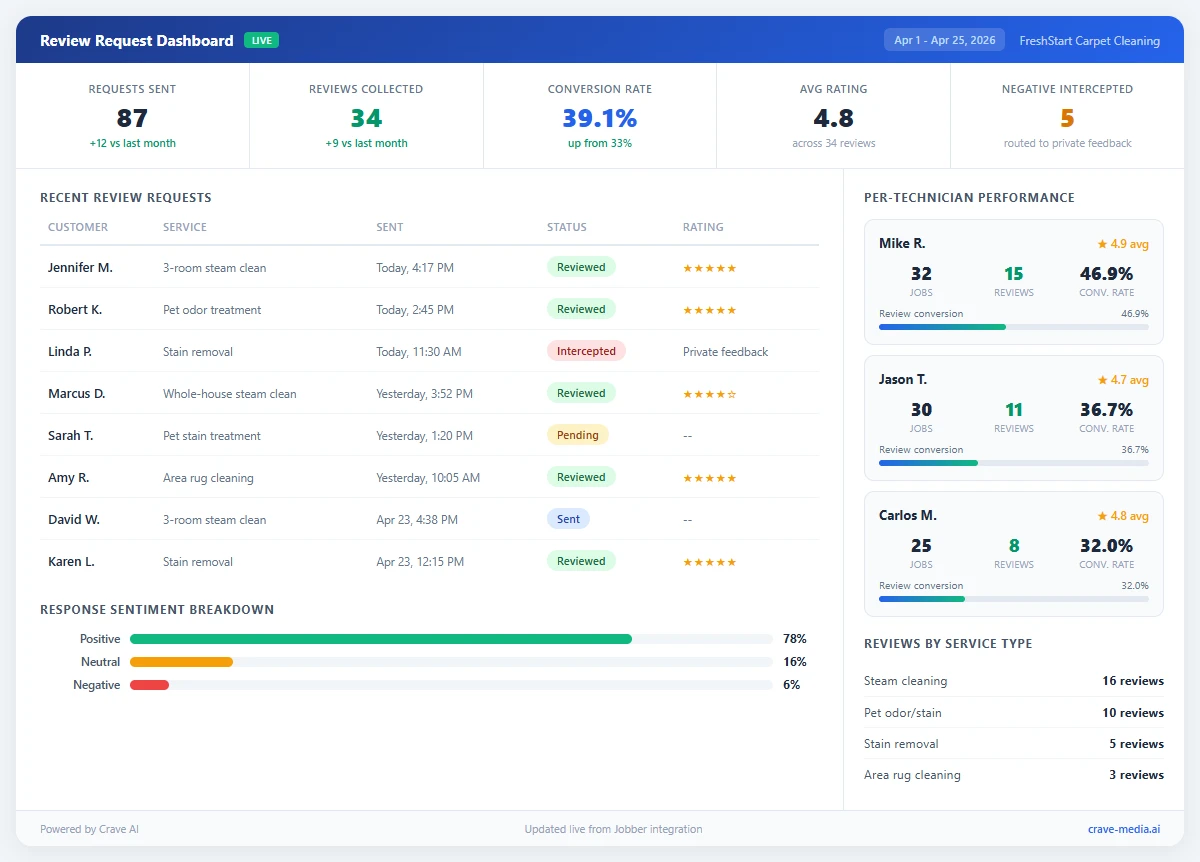
A review request dashboard designed for carpet cleaning companies, showing conversion rates, recent review requests with sentiment routing, and per-technician performance. Download as PDF
View interactive version
A Tuesday afternoon with the system running
Your tech finishes a three-room steam cleaning at a house in the suburbs around 4:15 PM. He marks the job complete on his phone, loads the equipment, and heads to the next appointment.
By 4:17, the homeowner has a text on her phone: "Hi Jennifer, thanks for booking with us for the steam cleaning today. How do the carpets look?"
She's standing in her living room looking at the results. The carpets look great. She texts back "They look amazing, thank you!"
The system picks up the positive response and sends a follow-up within 30 seconds: "That's great to hear! If you have a minute, we'd appreciate a quick Google review." A link takes her straight to your review page. She writes two sentences, gives you five stars, and goes on with her evening.
Your tech didn't do anything beyond marking the job done. You didn't send anything. By Friday, four or five jobs have gone through the same sequence, and you've picked up three or four new Google reviews without a single phone call from your office.
Now compare that to handing out business cards with a "please review us on Google" message. Even your most reliable techs forget half the time, and customers who take the card rarely follow through.
How it connects to your workflow
The first question we usually get from carpet cleaning owners is whether this means changing how they run jobs. It doesn't. The whole point is that the system sits on top of what you already use.
If you're on Jobber or Housecall Pro, the integration watches your job status field. When it flips to "complete," the sequence fires. Your techs don't open a new app or fill out a new form. They keep doing exactly what they're already doing.
If you're running things through a spreadsheet or a simpler setup, the trigger can be a quick form your tech fills out on their phone after each job. Name, phone number, service type, done. Takes about ten seconds.
The text messages go out from your business number, so the customer sees a message from the company they hired. And because the system handles sentiment routing on its own, you don't need someone sitting at a desk monitoring responses.
This is the same kind of post-job automation we'd build for other service businesses. The landscaping version tracks proposal follow-ups across a longer decision window. The plumbing version handles emergency lead response after hours. For carpet cleaning, the highest-value automation is the review request, because reviews are what drive the next booking.
What more reviews do for local ranking
Google's local search algorithm weighs relevance, distance, and prominence when deciding which businesses show up in the map pack. Prominence is largely about reviews: how many you have, how recent they are, and your average rating.
A carpet cleaning company adding three to five new reviews per week will see movement in local rankings within 60 to 90 days. Review velocity (how fast new reviews come in) is a ranking signal Google has been fairly open about, and most local competitors aren't generating reviews consistently.
And it compounds. More reviews push you up in local rankings. Higher rankings bring more calls. More calls mean more jobs, and more jobs mean more review requests going out. The carpet cleaners who get this loop running tend to stay there, because every month feeds the next one.
Most competitors in this space still rely on Yelp profiles and word of mouth. Almost nobody in carpet cleaning has automated review follow-up. Right now, even a basic system puts you ahead of most of your local market.
When this makes sense (and when it doesn't)
If you're running fewer than five jobs a week, you can handle review requests yourself. Set a reminder on your phone, send the text manually, save the money. A system like this earns its keep when the volume makes manual follow-up unreliable.
For companies running 15 to 30 jobs a week, which is typical for carpet cleaning operations with two or three techs, the manual approach falls apart. That's 60 to 120 opportunities per month where someone needs to remember to follow up. The difference between two reviews a month and 15 usually comes down to whether the process is automated or dependent on memory.
If you're weighing this against off-the-shelf software that includes a review request feature, the question is how much control you need. Most generic tools send the same template to every customer regardless of service type or job outcome. A custom system routes based on sentiment, personalizes by service, and tracks what's working. For some companies the generic version is enough. For others, the routing and personalization make a real difference in conversion rates.
Getting started with carpet cleaning review automation
The review request system is one of the simpler automations we build. It connects to your existing field software within a couple of weeks, and you can have requests going out after every job from day one.
For most carpet cleaning companies, this is where we'd start. It pays for itself faster than any other automation we build, and you'll know within the first month whether it's working because the numbers are right there in your Google profile. Once the reviews start stacking up, everything else gets easier.

About the author
Zac Spencer is an online marketing specialist and the owner of Crave Media, based in Salt Lake City, Utah. Since 2013 he has managed hundreds of Google Ads accounts across dozens of industries — with budgets from a few hundred dollars to $250K a month — and founded Crave AI to build custom AI tools and automations for local service businesses.