

AI answering services vs. AI lead follow-up: what's the difference?
If you've been shopping for a way to stop losing jobs, you've probably run into two kinds of pitches that sound almost identical. One promises an AI that answers your phone so calls never go to voicemail. The other promises an AI that follows up with leads so they don't slip through the cracks. Both say they'll save you money. Both use the word "AI." And it's genuinely hard to tell them apart from the outside.
But they solve two different problems, and picking the wrong one means you spend money on a tool that doesn't touch the place you're actually bleeding. The AI answering service vs lead follow-up question comes down to one thing: is your problem that calls aren't getting answered, or that leads aren't getting worked? Those are not the same problem, and this post walks through how to tell which one is yours.
We build the follow-up side, so we have a bias and we'll own it. But an answering service is the right call for plenty of businesses, and we'll say so where it's true. This is the honest version.
What an AI answering service does
An AI answering service picks up in real time. Somebody calls your business, and instead of ringing out to voicemail, an AI voice answers, sounds reasonably human, and handles the conversation. It can answer common questions ("do you service my area," "what are your hours," "do you charge for estimates"), take a message, and often book an appointment straight into your calendar. Some do the same thing over web chat on your site.
The whole point is the moment of contact. It's an inbound tool. When someone reaches out live, the answering service makes sure a real conversation happens instead of a dead end. It works around the clock, so the 2 AM call gets picked up the same as the 2 PM one.
For a business drowning in calls it can't answer, that's worth a lot. If you're a plumber running six trucks and your office manager is missing a third of the phone calls because she's also doing dispatch and billing, an answering service plugs a real hole. Those missed calls are missed jobs, and a tool that catches them pays for itself fast.
The good news on this side: there are decent off-the-shelf options. This is a solved-enough problem that you don't need anything custom to get started. You sign up, you point your phone number at it, you tune the script, and it runs. Prices land in the low hundreds a month for most small operations.
What AI lead follow-up does
AI lead follow-up is a different job entirely. It's not about the moment someone reaches out. It's about everything that happens after.
A lead comes in, whether from a web form, a missed call, a Google profile, or a marketplace like Angi. The follow-up system fires back within seconds with a real text message, starts a conversation, asks the couple of questions you need to qualify them, and then keeps following up over the next days and weeks until the person either books or clearly says no. It's the persistence layer. It works the leads that didn't get answered live, and the ones that went cold after the first hello.
That last part is where most of the money hides. A lead that fills out your form at 9 PM and never hears back until noon the next day is usually gone. A homeowner who got a quote three weeks ago and never got a second text has almost certainly hired someone else. Nobody in your office is sitting there at 9 PM, and nobody has time to chase a three-week-old quote by hand. So those leads just quietly leak out, and you never see them in a report because you never knew they were winnable.
We got into the mechanics of this in our post on why lead response time decides who wins the job, but the short version is that speed and persistence together do the heavy lifting. Fast enough to catch them while they're still interested, patient enough to stay in the conversation until they're ready. This is the core of what we build with automated lead follow-up.
Different problems, often on the same job
The easiest way to see the difference is to watch them on the same lead.
Say it's 10 PM and Sarah's water heater is leaking. She calls the first plumber she finds. An answering service picks up, confirms it's an emergency, and either books her or pages the on-call tech. That's the answering service doing exactly what it's built for: catching a live inbound call at an hour nobody's in the office.
Now say Sarah doesn't call. She fills out the web form instead, because that's what a lot of people do at 10 PM. There's no live call to answer. An answering service does nothing here, because nothing rang. This is where follow-up takes over: the system texts her back in thirty seconds, asks if the leak is contained, figures out it's urgent, and gets a human in the loop. Same customer, same emergency, completely different tool doing the work. We walked through that full flow in our breakdown of what happens when a lead comes in at 10 PM.
So they're not competitors so much as two halves of the same coverage. The answering service handles live contact. Follow-up handles the leads that arrive without a live conversation, plus every lead that needs a second, third, or fifth touch before it closes. A lot of businesses eventually run both. But if you can only fix one right now, you need to know which gap is the expensive one.
How to tell which one is bleeding you money
You can usually figure out your own answer with a couple of honest looks at your own business.
Start with your phone. Pull your call logs for the last month and count how many inbound calls went unanswered or rolled to voicemail. If that number is ugly, and especially if a chunk of it is during business hours, your problem is answering. You have demand walking up to the front door and nobody opening it. An answering service is the direct fix.
Now look at your web leads and quotes. How many form fills, marketplace leads, and quote requests came in? Of those, how many got a reply within five minutes? How many got a second follow-up if they didn't respond the first time? If leads are coming in fine but a lot of them never get a fast reply, or never get worked past the first attempt, your problem is follow-up. The leads exist. They're just dying on the vine.
A rough gut check: if people are trying to reach you live and can't, buy answering. If people are reaching you fine but you're slow to respond and bad at persistence, buy follow-up. Most owners already know in their gut which sentence describes them. The call logs just confirm it.
Put a dollar figure on it while you're at it. A roofer after a storm might get 80 leads in a single morning. If the office can personally call back maybe 30 of them that day and the rest sit until tomorrow, that's 50 leads going cold, and at a few thousand dollars a roof, the math gets loud fast. No answering service fixes that, because those weren't unanswered calls. They were unworked leads. That's a follow-up problem wearing a volume costume.
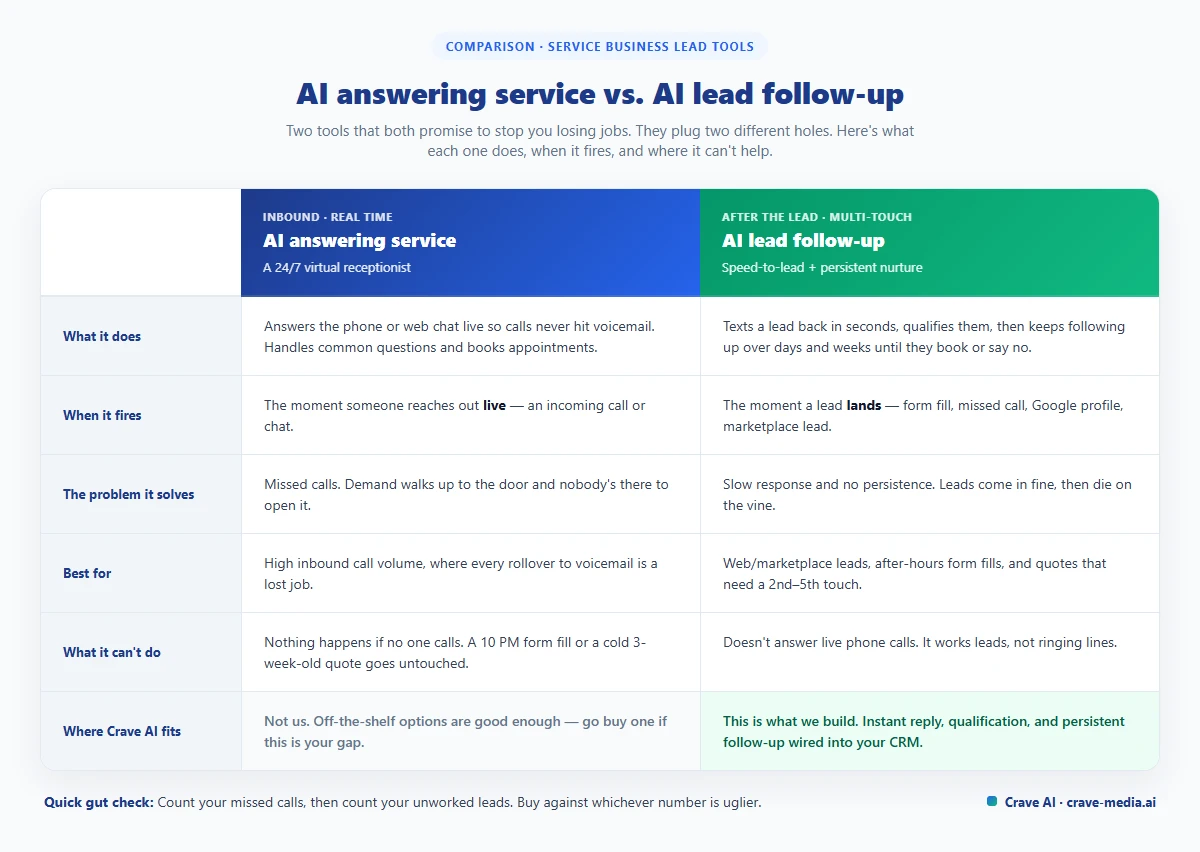
A side-by-side of AI answering service vs lead follow-up: what each tool does, when it fires, the problem it solves, and what it can't do. Download as PDF
View interactive version
What to look for in an AI answering service
If answering is your gap, a few things separate a good service from one that makes you sound worse than voicemail would.
Listen to it before you buy. The voice quality on these ranges from surprisingly natural to obviously robotic, and a stilted AI voice will lose you the exact emergency calls you're trying to save. Ask for a live demo number and actually call it a few times with real questions.
Check that it can book, not just take a message. A service that only writes down "Sarah called, wants a callback" is barely better than voicemail. You want it dropping appointments into your real calendar and confirming them with the customer.
Make sure it hands off cleanly on the stuff it can't handle. No AI answers every question well. The good ones know when they're out of their depth and route the call to a human or take a detailed message instead of guessing. And confirm it can flag a true emergency for an immediate callback rather than booking it for Tuesday.
What to look for in AI lead follow-up
If follow-up is your gap, the checklist is different because the job is different.
Speed first. The first text needs to fire in seconds, not minutes, because the odds of connecting drop off a cliff after the first five minutes. Ask exactly how fast the first response goes out.
Then persistence. A single auto-reply isn't follow-up. You want a system that follows up a few times over days or weeks, spaced sensibly, and then stops so nobody gets pestered. Ask what the follow-up cadence looks like and whether it stops on its own.
The messages have to sound like your business, not a vending machine. If the texts read like generic autoresponders, customers tune them out and you're back to silence. We got into how to keep that human in our post on AI SMS follow-up that doesn't sound like a robot.
And it has to qualify and hand off, not just chat. The goal is a real appointment or a clear "not interested," passed to a human at the right moment with the context already gathered. Follow-up that generates conversations but never books anything is a treadmill.
Where Crave AI fits
We build the follow-up side. Not the answering service, and we'll happily tell you when an off-the-shelf answering tool is the right first buy for your business. If your problem is unanswered live calls, go get one, they're good enough and you don't need us for that.
What we build is the layer that catches the leads a live answer can't: the 10 PM form fill, the 80-lead storm morning, the quote that needs a second and third touch before it turns into a signed job. Instant reply, qualification, and persistent follow-up that runs on its own until the lead books or bows out, wired into your CRM and your calendar. It's the same idea as our broader service business automations, pointed specifically at the leads that slip through after they come in.
Answer the phone, work the lead
An AI answering service and AI lead follow-up sound like the same product because they both promise to stop you losing jobs. They just stop different jobs from leaking out. One makes sure a live call becomes a conversation. The other makes sure a lead becomes an appointment, even when there was no live call and even when it takes five tries.
Figure out which gap is yours before you spend a dollar. Count your missed calls, then count your unworked leads, and buy against whichever number is uglier. If it's the missed calls, an answering service is your move. If it's the leads coming in fine and then going quiet, that's the part we'd build for you.

About the author
Zac Spencer is an online marketing specialist and the owner of Crave Media, based in Salt Lake City, Utah. Since 2013 he has managed hundreds of Google Ads accounts across dozens of industries — with budgets from a few hundred dollars to $250K a month — and founded Crave AI to build custom AI tools and automations for local service businesses.