

What Gemini and ChatGPT Know About Your Business (You Might Be Surprised)
Try this before you finish your coffee. Open ChatGPT or Gemini and type: "Tell me about [your business name] in [your city]." Then ask a follow-up a real customer would ask, something like "Who's a good plumber near [your neighborhood]?" or "Is [your business] open on weekends?"
Whatever comes back is what a growing slice of your customers are seeing too. And for a lot of local businesses, the answer is some mix of outdated, vague, or flat-out wrong. Wrong hours. An old phone number. A service you dropped two years ago, or one you've offered forever that never gets mentioned. Sometimes the AI just shrugs and recommends a competitor instead.
People treat these tools like they're pulling from some perfect, current database. They're not. They're assembling an answer from whatever they can find about you online, and if that information is thin or stale, the answer is too. So let's do the check properly, figure out where the AI is getting its facts, and fix the ones that are costing you.
Run the check on yourself first
Don't guess at what AI says about you. Go look. Open a fresh chat in both ChatGPT and Gemini, and while you're at it, run a normal Google search and read the AI Overview at the top. Those are three different systems and they don't always agree, which is the first thing worth knowing.
Ask them the questions your customers actually ask:
- "Tell me about [business name] in [city]."
- "What are [business name]'s hours?"
- "Who's the best [your trade] near [neighborhood or city]?"
- "Does [business name] do [specific service]?"
Then read the answers like a skeptical customer, not like the owner who knows the truth. Are the hours right? The phone number and address? Does it describe what you actually do, or a fuzzy version of it? When you ask for a recommendation without naming yourself, do you come up at all, or does it name three competitors and leave you out?
Write down what's wrong. That list is your to-do list.
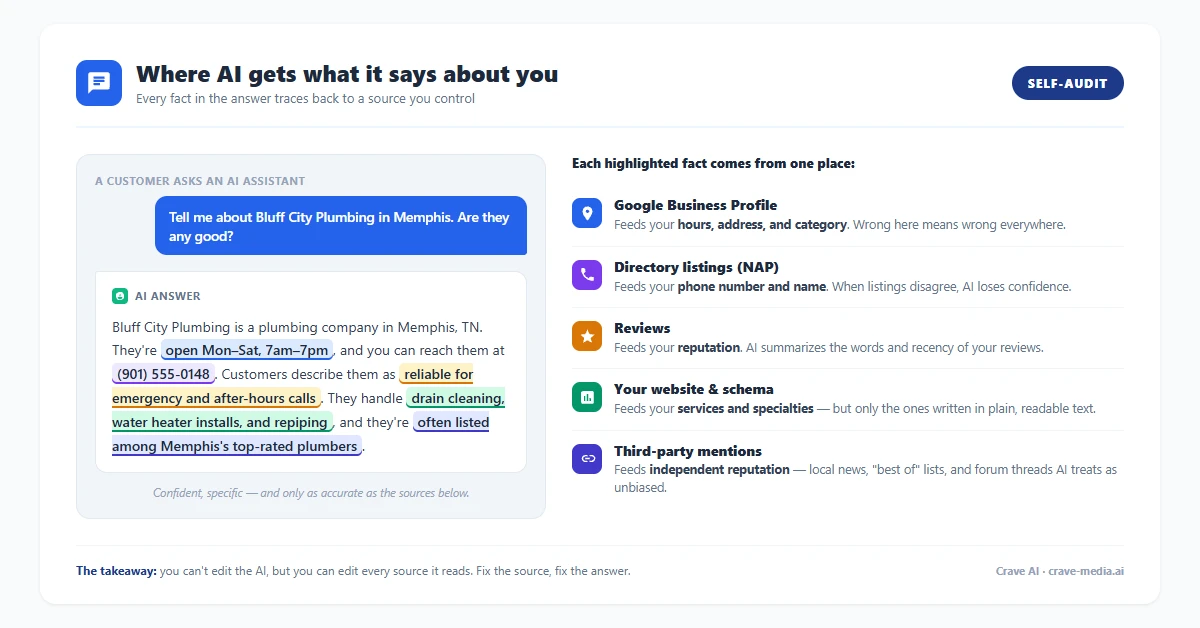
Every line in an AI's answer about your business comes from somewhere. Hours and address trace back to your Google Business Profile, the phone number to your directory listings, the "good reputation" to your reviews, and the service list to your website. Fix the source and you fix the answer. Download as PDF
View interactive version
Where the AI gets its answers
Once you see something wrong, the natural next question is "wrong according to what?" AI tools don't invent facts about your business out of nowhere. They stitch together an answer from a handful of sources, and almost every one of them is something you can influence.
Your Google Business Profile does a lot of the heavy lifting. Hours, address, category, phone number, the photos, the Q&A, the reviews attached to it. When an AI states your hours confidently, that's usually where it got them. If your profile says you close at 5 but you're really open till 7, the AI will repeat the lie all day.
Directory listings are next, and this is where consistency wins. Your name, address, and phone number, what the industry calls NAP, are scattered across Yelp, Angi, the Better Business Bureau, industry directories, data aggregators, and dozens of sites you've never visited. When those all match, the AI sees one clear, agreed-upon set of facts and trusts it. When half of them list an old number from three offices ago, the AI gets conflicting signals and either picks wrong or hedges.
Reviews shape the part of the answer you can't fake: your reputation. When an AI says a business is "well-regarded for fast emergency service," it's summarizing review language. The volume, the recency, and the actual words people use all feed that. A business with 200 recent reviews mentioning "on time" and "fair pricing" gives the AI something concrete to repeat. A business with nine reviews from 2022 gives it nothing.
Your website is where the AI learns what you do, especially if the important facts are written in plain text and backed by structured data. If your service pages clearly say you do tankless water heater installs in Bartlett, that's a fact the AI can lift. If that service is buried in a photo caption or a PDF, it may as well not exist. This is exactly what schema markup does for a service business: it hands the machines your facts in a format they can read without guessing.
And then there are third-party mentions, the stuff written about you rather than by you. Local news, blog posts, forum threads, "best plumbers in Memphis" roundups. AI leans on these because they read as independent. Getting named in the lists and directories that these tools trust is its own piece of work, and we broke down which directories actually feed AI search separately.
Why AI gets it wrong so often
Here's the uncomfortable part. When the AI gives a bad answer about your business, it's rarely the AI's fault. It's reporting what's out there.
The most common problem is stale information the business never cleaned up. You moved, or changed your hours, or rebranded, and you updated your website but not the fifteen directories that still carry the old details. The AI finds the old details and repeats them. Multiply that across enough sources and the wrong answer outweighs the right one.
The second problem is thin information. If barely anything exists about your business online, the AI has nothing solid to work with, so it either stays vague or fills the gap with a competitor it knows more about. That's the version that really costs you, because a customer asking "who's a good electrician near me" and getting three names that aren't yours never even knew you were an option. If that's happening to you, it's the same issue we cover in why your business isn't showing up in ChatGPT.
The third is inconsistency. Conflicting facts across your listings don't just risk the wrong answer, they lower the AI's confidence in you overall. A business the machines aren't sure about is a business they're less likely to recommend.
How to fix what you found
Work your list from the source backward. It's more satisfying than it sounds, because a fix in the right place cleans up the answer everywhere.
Start with your Google Business Profile, since it feeds so much. Claim it if you haven't, then go line by line: hours, address, phone, categories, services, description. Add real photos. Answer the questions in the Q&A. This is the single highest-leverage hour you'll spend.
Then hunt down your directory listings and make the NAP identical everywhere. Same business name, same address format, same phone number, on every site that carries you. Where you find old info, correct it or claim the listing. This is tedious, which is exactly why most of your competitors haven't done it, and why it works.
Keep the reviews coming, steadily and for real. Ask happy customers, make it easy, and respond to what comes in. You're not gaming anything, you're giving the AI current, specific language to describe you.
Make your website say what you do in plain words, and add structured data so the machines can read it cleanly. Spell out your services, your service area, and your specialties in actual text on the page. The full version of this, from profile to schema to monitoring, is laid out in our 2026 AI search optimization checklist if you want to work straight down a list.
Then check again in a few weeks. AI answers don't update the instant you fix a listing, but they do catch up as the underlying sources refresh. This isn't one-and-done. It's worth rerunning the whole self-check a few times a year, because your info drifts and the tools keep changing what they pull from. The same thing is happening inside Google's AI Overviews, which draw on a lot of the same signals.
What this really comes down to
The businesses that win in AI search aren't the ones with the fanciest technology. They're the ones whose information is clean, consistent, and current everywhere the AI looks. That's it. The AI is just a very fast, very confident summary of your online footprint, and you have more control over that footprint than it feels like when you're staring at a wrong answer on the screen.
Run the check. If you don't like what ChatGPT and Gemini are saying about you, that's not a reason to panic, it's a to-do list with a clear starting point.
If you'd rather not chase down thirty listings and wrestle with schema yourself, that's what we do. Our AI visibility service audits exactly what the AI tools currently say about your business, finds where the bad information is coming from, and cleans it up at the source. We'll even run the check for you for free and show you what's there. Given how many of your customers are already asking an AI instead of scrolling Google, it's worth knowing what it's telling them.

About the author
Zac Spencer is an online marketing specialist and the owner of Crave Media, based in Salt Lake City, Utah. Since 2013 he has managed hundreds of Google Ads accounts across dozens of industries — with budgets from a few hundred dollars to $250K a month — and founded Crave AI to build custom AI tools and automations for local service businesses.