

How a Tree Service Company Could Use AI to Manage Storm Season
A line of storms comes through Memphis overnight. Straight-line winds, a couple hours of it, and by the time the sky clears there are limbs down across half the county. You wake up to a phone that's already ringing, and it does not stop. Tree on a roof in Germantown. Big oak split over a driveway in Collierville. Twenty people with a hanging limb they want gone today. Your office manager has forty voicemails before her first cup of coffee.
This is the paradox of running a tree service. The storm that buries you in work is also the moment you're least able to handle the work. For a few days demand jumps to five or ten times normal, and then it's gone. You can't staff for that peak, and you can't afford to miss it. So most of it slips through, to whoever picked up.
The gap between the call coming in and someone answering it is where a tree company's biggest revenue week quietly leaks away.
The whole game is triage and speed
A storm surge isn't one kind of job. It's a trapped, dangerous emergency and a routine cleanup landing in the same hour, mixed together in your voicemail with no order to them.
A tree lying across someone's bedroom is a call you need to see in the next five minutes. A limb hanging over a fence can wait until Thursday. A branch down in the yard can go on the schedule for next week. The problem during a storm isn't that you lack work. It's that the emergencies and the can-waits come in jumbled together, faster than anyone can sort them by hand, and the dangerous ones are buried in the pile.
So the competitive question for a tree service in storm season comes down to two things. Did you capture every call and form while the phones were melting down? And did you pull the real emergencies to the top and get a crew moving before the customer called the next company on the list? Storm work is where the margins are, with removals running from a few hundred dollars for a modest job into the thousands for a crane pick off a house. Fumble the surge and you've handed a week's worth of revenue to somebody else.
Why this is genuinely hard for a tree crew
You're not losing those calls because you don't care. You're losing them because of where you and your people physically are when the storm hits.
Your crews are in the field with chainsaws running, sixty feet up in a bucket, or roping down a limb that could hurt someone if their attention drifts. Nobody on that crew can stop to answer a ringing phone, and you wouldn't want them to. If you're the owner, you're probably running a saw yourself. The office is one or two people trying to answer a hundred calls with two hands. And storms don't keep business hours. The worst of it lands overnight, on a Saturday, at 5 a.m., exactly when there's no one at a desk.
Then there's the competition you don't usually have. After every major storm, out-of-town crews roll in, the storm chasers, flooding the area and answering phones around the clock because chasing the surge is their whole model. They're not better than you. They're just reachable at 6 a.m. when your local shop isn't. That's the matchup during the one week your own market needs you most.
What the storm-season dashboard would track
We don't build "an AI." We build a specific tool that does one job well, and for a tree service that job is catching the storm surge and sorting it before it buries you. What would be on the screen:
Every call, text, and web form captured around the clock, whether or not anyone was at a desk. During a storm nothing rings out into a void. If it came in, the system has it, with the address and a timestamp.
An AI intake step that asks what a sharp estimator would ask, in plain language: what's the situation, is a tree on a house or a car, is anything blocking the only way out, are there power lines involved, and can you send a photo. That photo matters more than almost anything else, because it lets the job get sized before a truck ever rolls.
A triage layer that turns those answers into urgency tiers, so a tree through a roof jumps straight to the top while "a few branches down in the back yard" drops into next week's schedule without a human touching it.
Crew routing by zone, so the emergencies get matched to the nearest available crew instead of sending a bucket truck clear across the metro, plus the response clock running on every lead so you can see how fast you're actually reacting during the chaos. And a follow-up queue for every estimate you couldn't get to in the rush, because in a storm week the jobs you never called back are the ones that vanish.
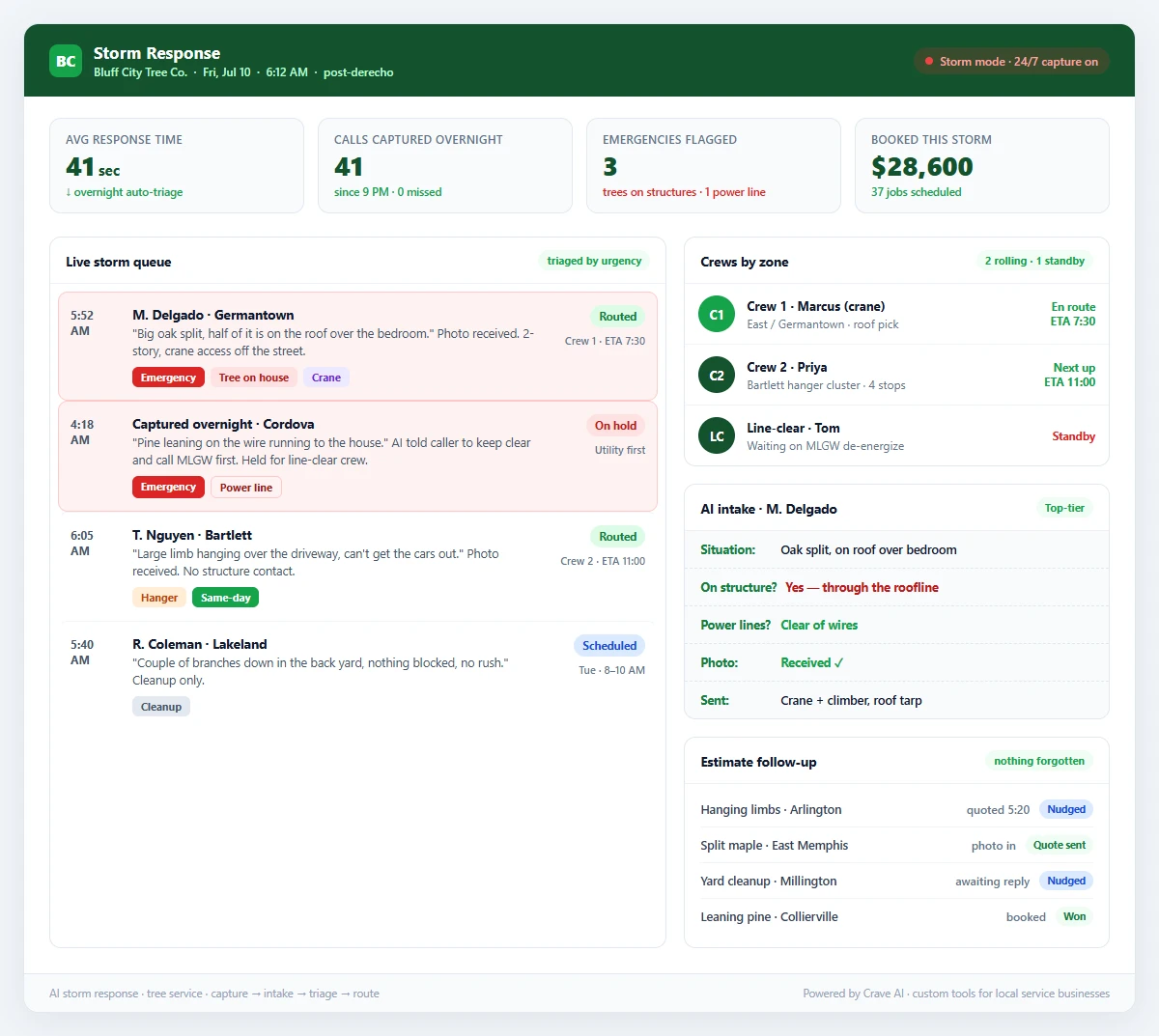
An AI storm-response dashboard for a tree service, showing the live storm queue triaged by urgency, AI intake with a photo and a downed-power-line safety flag, crew routing by zone, and the estimate follow-up list. Download as PDF
View interactive version
The sequence that runs while you're on the ropes
The point of all of this is that it works while every hand you've got is busy clearing trees.
A call comes in during the surge and rings out. Instead of dying in a voicemail box nobody will reach for two days, the system texts the caller back within seconds: a real-sounding message that acknowledges the storm, asks what happened, and asks for a photo. People will text and send a picture at 6 a.m. standing in their wrecked yard, even when they'd never leave a voicemail. It's easier, and they're already holding the phone.
The AI reads the answers and the photo, scores the urgency, and acts. A tree on a structure, a blocked exit, or anything near power lines gets flagged and pushed to your on-call crew lead with the address and the picture attached. A routine cleanup gets offered a realistic window and dropped onto the schedule. When there's a downed-line risk, it tells the customer to stay clear and call the utility first, and marks the job so only the right crew takes it. And every estimate that's still open gets a follow-up nudge instead of being forgotten in the noise.
By the time you climb down and check your phone, the overnight chaos is already a sorted list: the emergencies routed, the cleanups scheduled, the dangerous ones flagged. This is the same speed-to-lead idea we broke down in why lead response time decides who wins the job, aimed at the one week it matters most.
Friday, 6 a.m., after the derecho
Picture a derecho that tore through Thursday night. You wake up Friday to forty-one new calls and messages since 9 p.m., which a year ago would have meant a morning of triage before a single crew moved.
Instead, it's already handled. Overnight the system captured all forty-one, asked each one what happened, and pulled photos from most. Three are trees on houses, flagged top-tier with addresses and pictures ready for your climber. One shows an oak resting on a service line, tagged with a note that the customer was told to call the power company and keep back. A dozen are urgent hangers over driveways and fences, sorted by neighborhood. The remaining twenty-five are cleanup jobs already booked into the next two weeks with honest timelines.
You start the day by sending Marcus and the crane to the worst of the three roof jobs, route the second crew through a tight cluster of hangers in Bartlett, and let the office confirm the scheduled cleanups over coffee. The out-of-town chasers who blew into town overnight got the calls you didn't answer, which this time is almost none of them. This is the same after-hours capture idea from our piece on catching leads at 10 p.m. when nobody's watching, scaled up to a storm.
How it fits what you already run
A fair worry is that this means throwing out your systems and learning some new platform in the middle of your busiest week. It doesn't.
It sits on top of the phone number you already advertise, so customers call the same number on the truck and the yard sign. It hands qualified, scheduled jobs into whatever you already run, whether that's Arborgold, SingleOps, Jobber, or a whiteboard and a group text. We build the tool around your operation, not the reverse. And if your office already answers every call on the second ring on a normal Tuesday, you may not need any of this for normal Tuesdays. The value is the surge, and the nights and weekends nobody's covering. This is the same dashboard-and-automation approach behind what an AI dashboard does for water damage restoration, another trade where the emergency arrives on its own schedule.
What changes when you stop losing the surge
The shift is straightforward. Right now, a big chunk of your storm demand goes to whoever happens to be awake and reachable, which after a major storm is often the chaser crew with a call center, not the established local company. Miss enough of those calls and you're effectively subsidizing your competition during your best week of the year.
When something is capturing and triaging around the clock, you stop giving that away by default. You keep your own market's storm work, you get to the dangerous jobs faster, and the customer who got a text back at dawn and a crew that showed up when they said they would is the one who calls you next time a limb comes down, and tells their street to call you too. That reputation, earned in the chaos, is what carries a tree service through the quiet months.
Where we'd start
We wouldn't try to automate your whole operation before the next storm. We'd wire up the one thing that costs you the most, which is the call that comes in during the surge and never gets answered.
The first build would be instant text-back with AI intake and photo capture on missed calls, pointed at your existing number and routing to one on-call lead, with a simple emergency-versus-cleanup triage. That alone tends to recover a real slice of storm demand on the very next event, and it gives us live data to tune the urgency tiers and crew routing against. From there we add the full dashboard, the zone routing, the estimate follow-up queue, and source-level tracking.
If you run a tree service and you know the storms bring in more than you can catch but can't say how much you're missing, that's the number worth measuring first. You can see the kind of tooling we'd build on the tree service AI page, or look at how we handle after-hours lead capture and follow-up for local service businesses. Tell us how your calls come in when the weather turns, and we'll show you what catching the whole surge would look like.

About the author
Zac Spencer is an online marketing specialist and the owner of Crave Media, based in Salt Lake City, Utah. Since 2013 he has managed hundreds of Google Ads accounts across dozens of industries — with budgets from a few hundred dollars to $250K a month — and founded Crave AI to build custom AI tools and automations for local service businesses.