

Why lead response time decides who wins the job
A homeowner with water spreading across the kitchen floor is not going to wait patiently for a callback. They fill out your form, and if they don't hear back in a couple of minutes, they're already dialing the next company on the list. Whoever answers first usually gets the job. Everyone else is competing for a lead that's already gone.
That's the uncomfortable truth about lead response time. It rarely shows up in a sales report, because you never see the jobs you lost by being second. But for most home service businesses, the speed of that first reply decides more deals than pricing, reviews, or which company has the nicer website.
The good news is that response time is one of the few things you can fix without changing your prices, your crews, or your ad budget. You just have to make sure every lead gets an answer before they move on, and that's exactly the kind of thing software is good at.
The first five minutes do most of the work
There's a well-known Harvard Business Review study, "The Short Life of Online Sales Leads," that tracked how quickly companies followed up on inbound leads. Firms that reached out within an hour were far more likely to have a meaningful conversation with the lead than those that waited even a little longer. Later research into lead response put finer numbers on it: the odds of actually connecting with a new lead drop sharply once you're past the first five minutes, and they keep falling from there.
The reason is basic human behavior. When someone reaches out about a service, they're at peak intent in that moment. They're sitting there, phone in hand, problem on their mind. Reach them then and you're talking to a motivated buyer. Wait an hour and they've moved on with their day. Wait until tomorrow morning and they've already booked someone else and forgotten they ever contacted you.
So the window that matters most isn't the day the lead comes in. It's the first few minutes. And that's the window service businesses are worst equipped to cover, through no fault of their own.
Why service businesses keep losing the race
Think about where your best people are during business hours. Your techs are on a roof, under a sink, or driving between jobs. Whoever handles the phone is often doing three other things. Nobody is sitting by the inbox waiting to pounce on a web form the second it lands.
Then there's everything outside of 8 to 5. A huge share of service leads come in during evenings and weekends, when a homeowner finally has time to deal with the problem they've been ignoring. If those go to voicemail or an unwatched inbox, they sit untouched for twelve hours or more, which is a lifetime in lead-response terms. We walked through exactly this scenario in our piece on what happens when a lead comes in at 10 PM, and the pattern is always the same: the lead was real, the work was there, and it went to whoever replied first the next morning.
None of this means your team is slow. It means responding in seconds, every time, at any hour, is not a realistic thing to ask a human to do while they're also running a business. It's a job for a system.
Answering fast isn't enough on its own
Here's the part people miss when they hear "respond faster." Speed only helps if the response actually moves the job forward. A one-word "we'll call you back" text buys you a little goodwill, but it doesn't qualify the lead, doesn't get anything on the calendar, and doesn't stop them from calling around while they wait.
A good first response does three jobs at once. It acknowledges the person immediately so they stop shopping. It asks the couple of questions you need to know whether this is a job you want and how urgent it is. And it moves them toward the next step, whether that's booking a time, confirming the service area, or flagging a true emergency for an immediate call. Do all three in the first message and you've turned a cold web form into a warm, half-qualified appointment before a competitor has even seen their copy of the lead.
That's a lot to ask of a rushed human typing between jobs. It's straightforward for an automation that's built to do it.
How to answer every lead instantly without hiring anyone
The fix is an automated first-response flow that sits on top of your existing lead sources. A form submission, a missed call, a message from your Google profile, all of it triggers the same thing: an instant, personalized reply that starts the conversation while the lead is still hot.
Done well, it doesn't read like a robot. It uses the person's name and the service they asked about, sounds like your business, and asks real questions instead of firing off a generic auto-reply. When they answer, it can qualify them, book them into an open slot, and hand a ready-to-work appointment to your team. When someone doesn't respond, it follows up a time or two on its own and then stops, so nobody gets pestered. We got into how to keep that conversation sounding human in our post on AI SMS follow-up that doesn't sound like a robot.
The point isn't to replace your team. It's to cover the gap between the moment a lead comes in and the moment a human can actually get to them, which is precisely where jobs leak out. This is the core of what we build with automated lead follow-up: the system catches the lead in seconds, does the early qualifying, and only pulls in a person when there's a real appointment to close.
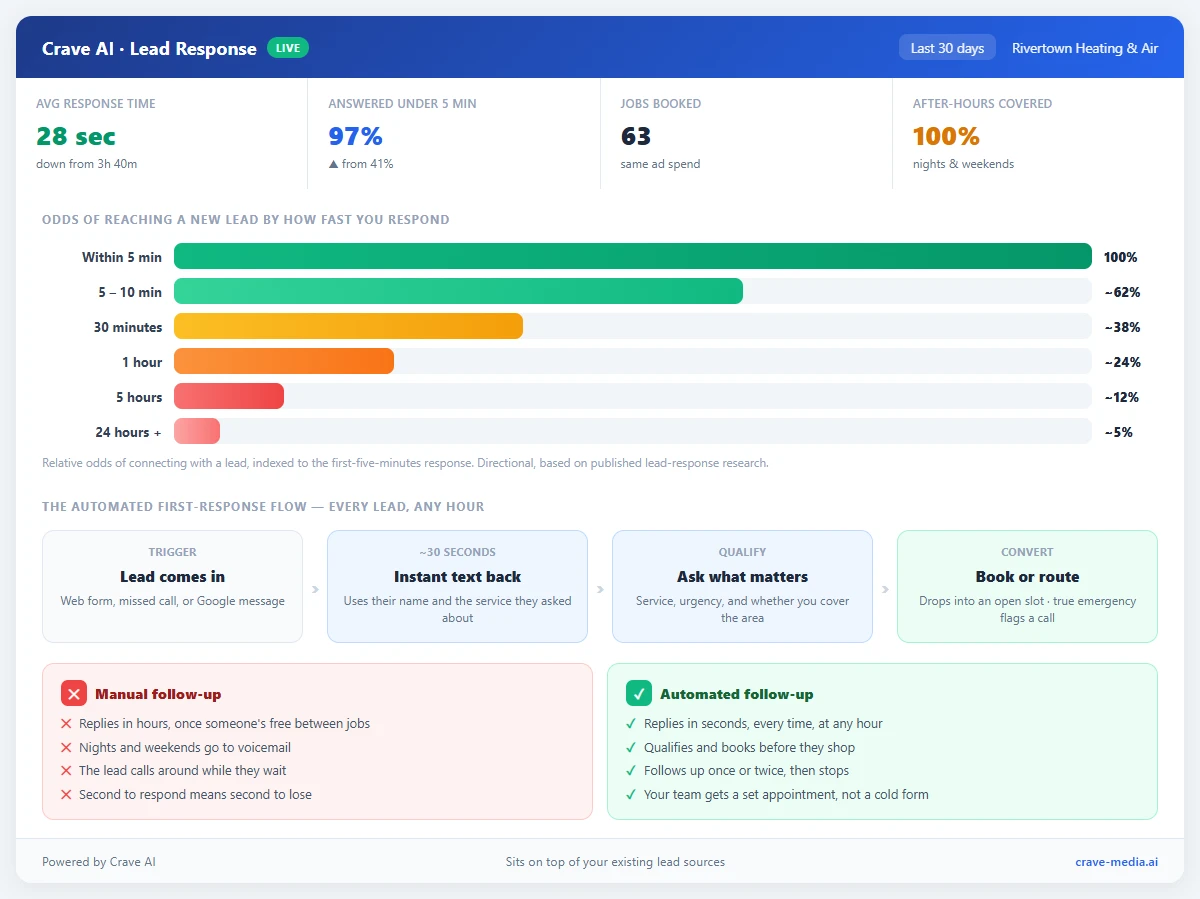
Speed-to-lead in one view: the odds of connecting drop fast after the first five minutes, so the automated flow answers within seconds, qualifies the lead, and books it, while the dashboard tracks how many leads got a reply inside that five-minute window. Download as PDF
View interactive version
What this looks like once it's running
When speed-to-lead is handled, a few things change that you can actually measure. Your average response time drops from hours to seconds. The share of leads that get a reply inside that first five-minute window goes from a coin flip to nearly all of them. And the number that matters most, booked jobs from the same amount of ad spend, climbs, because you stopped donating leads to whoever happened to be quicker.
It also takes pressure off your team. Nobody's refreshing the inbox or feeling guilty about the form that sat for three hours during a busy afternoon. The routine first contact runs itself, and your people spend their time on the appointments that are already set instead of chasing the ones that got cold.
You don't need a bigger crew or a call center to compete on speed. You need a system that never gets busy, never goes home at five, and treats every new lead like it's worth answering right now, because it is.
Answer first, win first
Most service businesses are one automation away from stopping the slow, invisible leak of leads they never knew they lost. The company that replies in thirty seconds isn't smarter or cheaper than the one that replies in three hours. It just got there first, and in this business, first is usually enough.
If you want to see where your leads are slipping and what an instant-response flow would look like for your company, let's map it out together. The jobs are already coming in. The only question is whether you're the one who answers.

About the author
Zac Spencer is an online marketing specialist and the owner of Crave Media, based in Salt Lake City, Utah. Since 2013 he has managed hundreds of Google Ads accounts across dozens of industries — with budgets from a few hundred dollars to $250K a month — and founded Crave AI to build custom AI tools and automations for local service businesses.