

An AI inspection scheduler for a chimney sweep business
Chimney work has the strangest demand curve in the trades. Nobody thinks about their flue in June. Then the first cold weekend hits, half the county remembers it owns a fireplace, and a two-truck sweep company absorbs six weeks of calls it can't answer. By Thanksgiving you're booked past the point where booking helps, and the people you turn away either hire whoever picks up or light a fire in a chimney nobody has looked at.
The AI tools a chimney sweep business needs have nothing to do with finding customers. October finds them for you. Your fall demand is sitting in last year's invoices, because a sweep and inspection is an annual service by the book; NFPA 211, the standard certified sweeps work from, calls for a chimney inspection every year. Every customer you served last fall is due this fall, on a schedule you could have printed in January.
What we'd build is an inspection scheduler with three jobs: fill the fall calendar from last year's customer list before the rush starts, pace the season so the calendar fills in the right order, and chase every safety finding your techs write down until it becomes a repair or a documented "no thanks." That third job is the one almost no software does, and it's where both the money and the liability live.
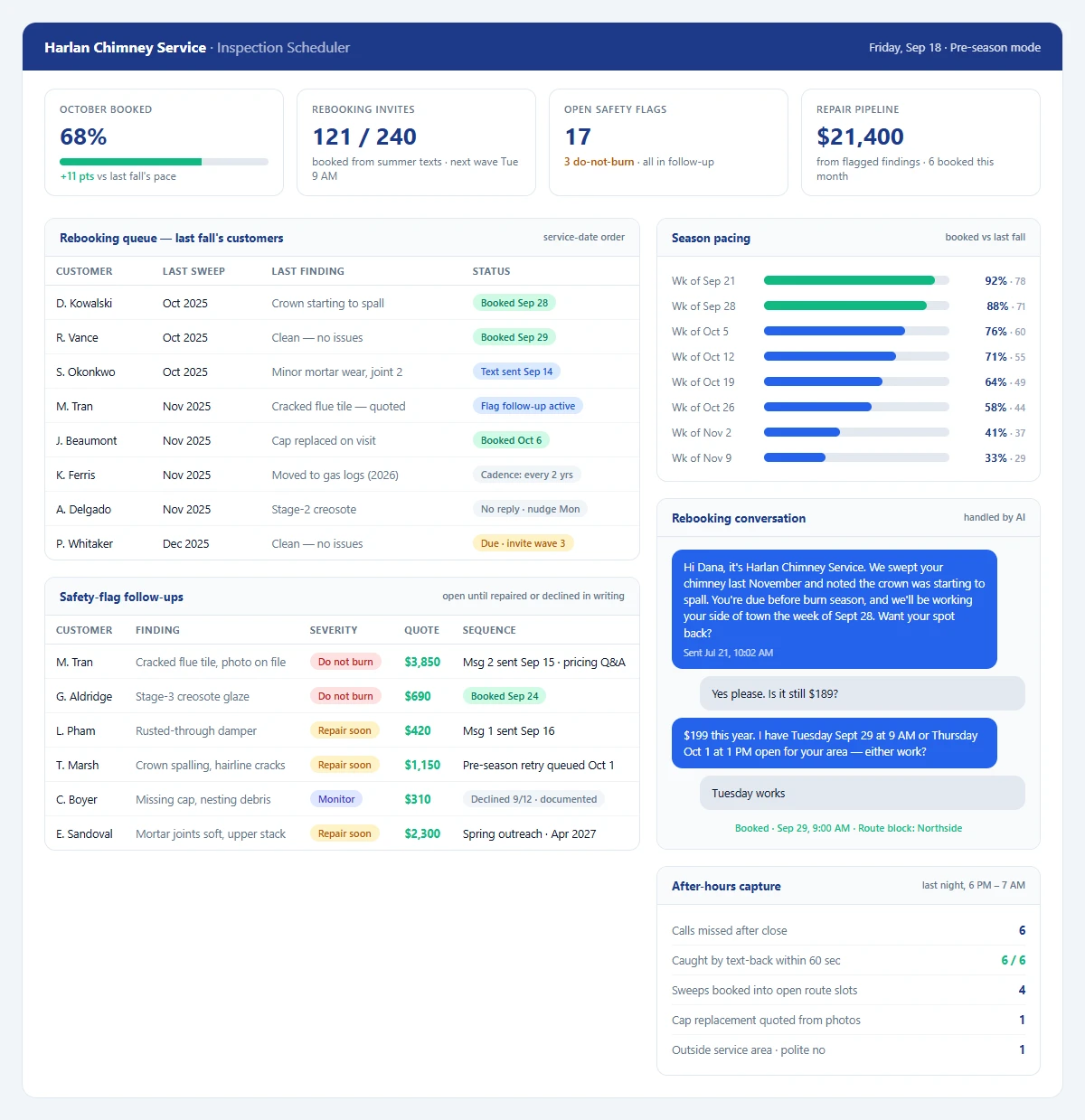
The pre-season board: last year's customers invited back in order, October paced week by week against last fall, and every open safety flag tracked from finding to repair. Download as PDF
View interactive version
Fill October from last year's sweep list
The annual cycle is the gift of this trade. A gutter company guesses when the leaves drop. You don't guess anything: whoever you swept in October 2025 is due in October 2026, and they already trust you enough to have paid you once.
The scheduler's first job runs in the middle of summer, while your phone is quiet. It works through last fall's jobs in service-date order and sends each customer a text that reads like you typed it between jobs:
"Hi Dana, it's Harlan Chimney Service. We swept your chimney last November and noted the crown was starting to spall. You're due for your annual sweep and inspection before burn season, and we'll be working your side of town the week of Sept 28. Want your spot back?"
Two details in that message do the heavy lifting. It references what your tech found last year, which no mass-marketing text can fake. And it offers a specific week, because "call us to schedule" is a chore and "want your spot back?" is a yes-or-no question.
Replies get handled by the same AI layer we wire into lead follow-up for every trade. "How much is it this year?" gets the current price. "We moved to gas logs" updates the record and swaps them to a lighter inspection cadence, because gas appliance flues still need looking at and most homeowners have no idea. A booked reply lands on the calendar in the right neighborhood block without anyone in your office touching it.
Sweeps who do this by hand already know it works; the problem is that by-hand outreach happens once, in whatever week someone finds time, to whatever fraction of the list gets dialed before the season starts anyway. The machine version runs the whole list, in route order, and then keeps nudging the non-responders on a polite schedule into September. We walked through the general mechanics in our customer reactivation post; chimney service is close to the best case for it because the comeback date is written into a national fire standard.
The safety flag is the real product
Every chimney inspection produces findings. A cracked flue tile. Stage-three creosote glaze that a standard brushing won't touch. A rusted-through damper, a crown starting to spall. Your techs already document this, often with photos, because it's how you recommend repairs and cover yourself.
Then, at most companies, the finding goes wherever paper goes. The homeowner hears "you'll want to get that tile looked at before you burn," nods, and forgets by dinner. The tech is on the next roof. Fall is a blur, nobody calls back in the spring, and the finding waits in a filing cabinet for the next inspection to rediscover it.
This is the worst leak in the whole trade, worse than missed calls. A missed call is a stranger you never met. An unfollowed safety flag is a hazard your own company photographed and quoted, then never mentioned again, attached to a customer who already trusts you. It's bad business and it's a genuinely bad outcome waiting to happen.
Our version treats a flagged finding as a live object, not a note. When a tech closes out an inspection and marks a finding, the system opens a flag with the photo, the severity, and the repair quote. That flag stays open until the repair is booked or the customer has clearly said no, and it drives its own follow-up sequence:
"Hi Mike, following up from your inspection on the 14th. The photo attached is the cracked tile we found in your flue. Nothing has to happen today, but we wouldn't light a fire until it's addressed. Your reline quote is good through October and we have two openings next week. Want one?"
No scare tactics, which matters in a trade where homeowners already suspect every sweep of inventing repairs. The message is a photo of their own chimney and a date. If they go quiet, the sequence waits and tries once more at the start of burn season, when "before you light the first fire this year" stops being abstract. If they say "not this year," the flag closes as declined, in writing, with a timestamp. Your liability paper trail builds itself.
The money side is not subtle. A sweep is a $150 to $300 ticket. The repairs behind the flags are caps and dampers in the hundreds and relines in the thousands, sold to people who have already seen the photo. Pull last season's inspection reports at a typical small sweep company and it's common to find dozens of repairs that were documented and quoted and then never chased, which is five figures of work sitting in your own filing cabinet. The flag list on the dashboard is that filing cabinet turned face up, with a follow-up engine attached.
And there's a season-shaping bonus: repairs are how you fill the quiet months. A flag that didn't convert in November becomes a spring outreach, "fix it now and schedule whenever you like, we're not slammed," which turns dead April weeks into masonry revenue.
Pacing the season on one board
The board itself is less dramatic than the flags, and that's fine. It shows the fall the way you want to see it in September: each week from late September through Thanksgiving as a capacity bar, booked against the same week last year, with jobs clustered by neighborhood so trucks spend the crunch sweeping instead of driving.
Pacing against last year is the piece owners tell us they're missing. Booked "pretty solid" means nothing in a trade this seasonal. Booked 68% for October on September 18, eleven points ahead of last year, means something: it tells you the summer texts worked and you can stop worrying, or it tells you there's a soft week coming and the system should widen the next invite wave now, while there's still time to move demand into it.
The board also runs the unglamorous stuff, meaning day-before reminders and an on-the-way text with the tech's name and an arrival window. Standard appointment reminder plumbing, but chimney work gets extra value from it because the customer usually needs to be home and the no-show cost during your six good weeks is brutal. A slot that opens on Tuesday night should be offered to the invite list Wednesday morning without anyone thinking about it.
If this pattern sounds familiar, it's because the fall trades rhyme. We sketched the same September-sells-October logic for a gutter company heading into fall. The difference is that the gutter trade's calendar is set by the trees. Yours is set by a fire code, and your inspections feed a second pipeline that gutters don't have.
A week of this in early October
Monday, the board shows October 71% booked, still ahead of last year's pace. Over the weekend, four customers from the September nudge wave replied and were booked into their neighborhood blocks; one wrote "we don't use the fireplace anymore" and was moved to an every-few-years cadence with a note.
Tuesday, a tech finishes an inspection on Welford Ave and flags stage-three glaze with photos. The homeowner gets the follow-up Wednesday at lunch, asks two pricing questions that the AI answers from the quote, and books the chemical treatment for the following Thursday. That flag lived thirty hours. At most companies it would have lived until next fall's inspection, if the customer even called back for one.
Thursday night, a first-cold-snap flurry: nine calls after 6 PM, which is normal in a trade where a big share of demand shows up after hours. Nobody answers, the text-back layer catches all nine, seven book into open route slots, one is quoted a cap replacement from photos, one turns out to be outside the service area and gets a polite no. Friday morning your office manager reviews a screen instead of a voicemail box.
When a chimney sweep business needs these tools
A one-truck operation sweeping 300 chimneys a year for the same neighborhoods can get most of the rebooking win with last year's invoices and a free July afternoon. We'd tell you that on a call, and we'd mean it. The honest threshold is scale and memory: two or more trucks, a customer list that has outgrown anyone's head, or an inspection-report drawer you already know is full of unfollowed repair quotes.
Timing is the other half of the answer. This is a build for May, June, or July, when your schedule has room to import history and set cadences, so the first invite wave goes out while your competitors are still waiting for the phone to ring. Building it in October is like buying a snowplow during the blizzard. The full picture of what we'd wire together for this trade is on our AI for chimney services page, and the plumbing underneath is the same custom automation stack we use everywhere, pointed at the one trade whose comeback date is printed in a code book.
The calendar was always in your filing cabinet
Chimney demand can't be created and can't be moved. The cold comes when it comes. Most of the homeowners who'll flood your voicemail in October are names you already have, on an annual cycle a fire standard wrote for you. The only real choice is whether this fall gets assembled in July from your own records, with every last-year finding chasing its own repair, or taken one frantic call at a time while the flagged chimneys sit quiet under someone's first fire of the year.
If you'd rather it be July, tell us about your chimney business and we'll sketch the scheduler against your own list before the season turns.

About the author
Zac Spencer is an online marketing specialist and the owner of Crave Media, based in Salt Lake City, Utah. Since 2013 he has managed hundreds of Google Ads accounts across dozens of industries — with budgets from a few hundred dollars to $250K a month — and founded Crave AI to build custom AI tools and automations for local service businesses.