

AI tools for a mold remediation business after fall rains
By Monday morning after a wet week, a mold company's inbox holds three kinds of messages that all read the same at a glance. A woman in Westerville sent a photo at 10:15 Sunday night: gray-green spotting on a bathroom ceiling, maybe the size of a dinner plate. A couple two streets over smells something musty in their finished basement every time the furnace kicks on, and they can't see anything. And a real estate agent forwarded a home inspection report that says "suspected microbial growth, attic sheathing," with a closing date nine days out.
Most shops answer all three the same way: "We can get someone out Thursday for an inspection." That's wrong for two of them. The ceiling spot probably doesn't need you at all. The agent needs a date this week, not Thursday's open slot, and she needs to know you'll keep her posted.
The AI tools we'd build for a mold remediation business start there, with a triage desk that sorts each request by photo and moisture history before anyone drives out. Behind it sit three more pieces: a tracker that follows every job from inspection to clearance, a claim document checklist, and a record of which partners send you work.
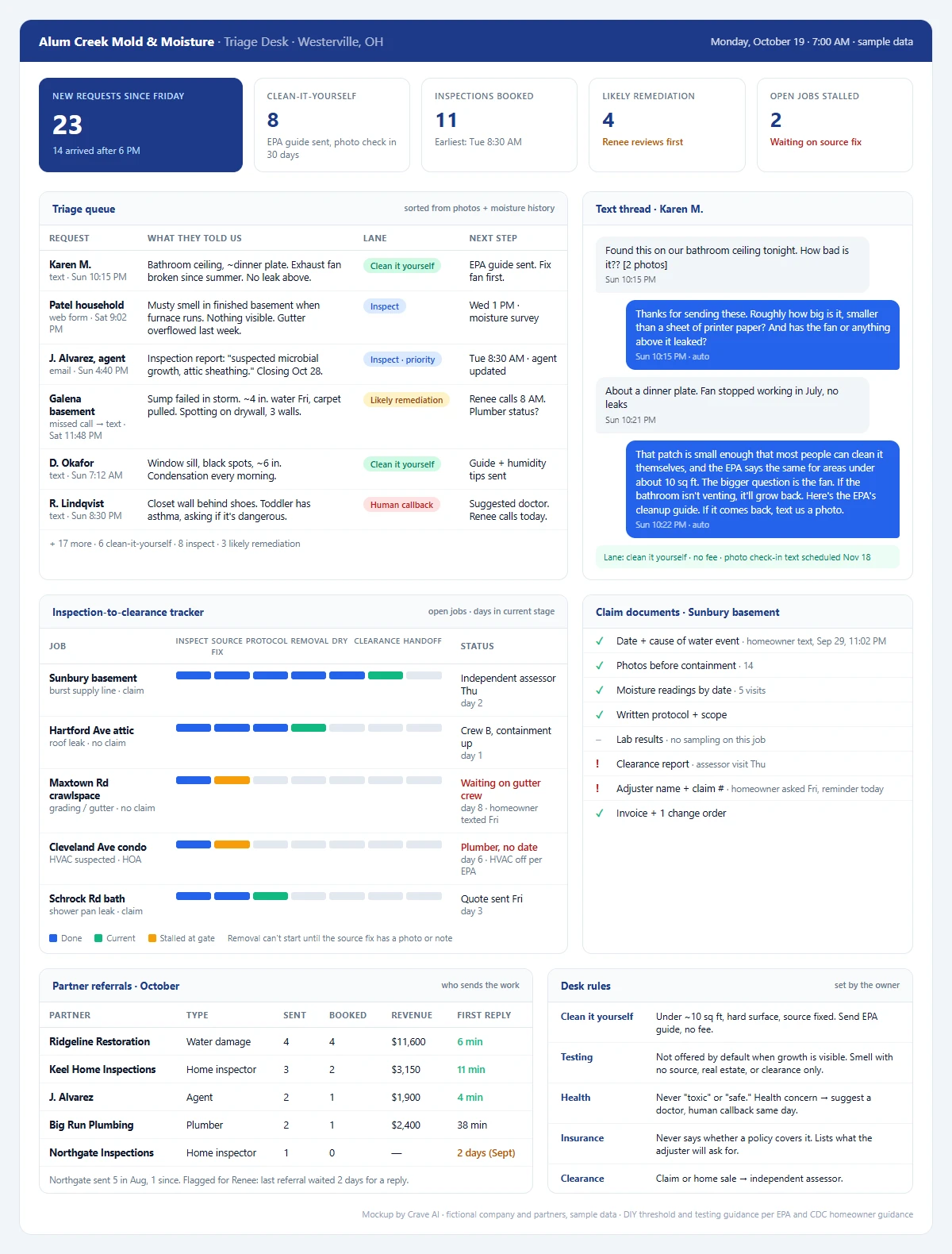
The triage desk for a mold remediation company: new requests sorted into clean-it-yourself, inspect, and likely-remediation lanes, every open job's stage from inspection to clearance, the claim documents each job still needs, and which restoration companies, inspectors, and agents sent work this month. Download as PDF
View interactive version
Why fall rain fills the inbox
Mold work runs year-round, but fall in Ohio stacks the odds. Leaves fill gutters right when the rain picks up, so water spills over at the foundation instead of running out the downspout. Roof leaks that dripped quietly all summer show up as a stain once someone looks up. And the first week the furnace runs, it moves air through a basement that sat closed since spring, which is when people notice the smell.
So the requests come in a clump, and a lot of them come in at night. Our working estimate for mold companies is that around 40% of inquiries land after hours, from people who found something at 10 PM and can't sleep until they know how bad it is. They aren't shopping on price yet. They want somebody calm to tell them what they're looking at.
Triage by photo and moisture history
When a request comes in, by text, web form, or a missed call that turns into a text, the AI asks for the same few things a good office manager would:
- A photo or two, one close and one from across the room
- Roughly how big the area is (we ask people to compare it to a sheet of printer paper or a doormat, because nobody knows square feet off the top of their head)
- What got wet, and when
- Whether the leak or water source is fixed
- Whether anyone in the house has health concerns about it
The fourth question carries the most weight. Mold comes back if the water does, so a job where the roof still leaks is a different job. "When did it get wet" turns up again later, in the insurance file.
From those answers the AI sorts the request into one of three lanes. It's the same photo-first idea we described for quoting junk removal from a picture, except here the photo decides whether a visit is worth anyone's time.
Most requests land in the middle lane, inspect: a smell with nothing visible, staining on drywall with a water history behind it, anything inside a wall, or an area nobody can measure. Those get booked. Large visible growth, a flooded basement, or a suspected problem in the ductwork goes to the likely-remediation lane, which still means an inspection, but the project lead sees it first and it gets the earliest slot. If the HVAC might be involved, the AI passes along the EPA's advice not to run the system until someone looks, since it can spread mold through the house.
The last lane is the one an owner will push back on. Small area, hard surface, water source fixed: clean it yourself. The EPA's own homeowner guide says that if the moldy area is less than about 10 square feet, "in most cases, you can handle the job yourself" (EPA, A Brief Guide to Mold, Moisture, and Your Home).
Send the small ones home
We'd hold this line even though it costs you inspection fees. When the photo shows a dinner-plate spot on a bathroom ceiling and the exhaust fan was broken, the honest answer is "fix the fan, clean it, and text us if it's back in a month." Charging a few hundred dollars to tell her that is how mold companies got the reputation they have.
The text the AI sends reads something like this:
"Thanks for the photos, Karen. From what you've described, that patch is small enough that most people can clean it themselves, and the EPA says the same for areas under about 10 square feet. The bigger question is the fan. If the bathroom isn't venting, it'll grow back. Here's the EPA's cleanup guide. If it comes back or you find more behind the drywall, text us a photo and we'll come look."
Karen doesn't pay you this week. She does have your number saved under "the mold people who were honest," and that's worth more in March, when her basement takes on water, than an inspection fee in October.
What the AI won't say
Two things stay off the table no matter how the conversation goes. The AI never tells anyone their mold is "toxic" or that it's "safe." It doesn't know, and neither does a photo. If someone mentions a sick kid, asthma, or anyone with a weak immune system, it suggests they talk to their doctor and flags the request for a human callback the same day.
It also doesn't push air testing by default. The CDC says plainly that it does not recommend mold testing, partly because there are no set standards for an acceptable amount of mold in a home (CDC), and the EPA says sampling is usually unnecessary when growth is visible. So the AI saves testing for cases with a reason behind it: a smell with no visible source, a real estate deal, or clearance after remediation.
From inspection to clearance
Once a job is real, it moves through stages, and the tracker shows every open job's place in line and how long it's been sitting there:
- Inspection and moisture readings
- Water source fixed (often by someone else: a roofer, a plumber, a gutter crew)
- Protocol and scope written, quote signed
- Containment set up, removal done
- Area dried and confirmed with readings
- Post-remediation check and clearance
- Handoff to whoever rebuilds
Step 2 is where jobs stall. You can't start removal while the basement wall is still taking on water, and the plumber isn't on your schedule. So the tracker treats "source fixed" as a gate. The job doesn't move to containment until someone uploads a photo or note showing the repair, and if it sits more than five days, the AI texts the homeowner to ask where the plumber stands.
A lot of remediation companies work to the IICRC S520, the industry's standard for professional mold remediation. It describes contamination in three conditions, from normal background levels (Condition 1) up to actual growth (Condition 3), and the aim of remediation is to bring the affected areas back to Condition 1. The tracker doesn't enforce a standard. It stores the readings, photos, and notes your crew already takes, in order, on the right job.
Clearance needs its own note. Ohio has no state license for mold assessors or remediators, so nothing stops you from testing your own work. States that do license mold work, like New York and Texas, bar the same company from assessing and remediating the same project. We'd copy that habit on any job with an insurance claim or a home sale attached and send clearance to an independent assessor. The tracker logs who did the check.
The claim document checklist
Insurance is where homeowners get the most confused and where the AI should say the least. Many homeowners policies treat mold from long-term leaks or humidity as a maintenance problem and exclude it, while mold that comes from a covered water event like a burst pipe may be covered, often with a separate and lower limit. Every policy is different. The AI never tells a homeowner whether they're covered. It tells them what their adjuster will probably ask for and keeps the file complete.
For each job with a claim, the checklist tracks:
- Date and cause of the water event (captured on the first night, in the homeowner's own words)
- Photos before containment goes up
- Moisture readings by date
- The written protocol and scope
- Lab results, if any testing was done
- Post-remediation clearance report
- Invoices and change orders
Missing items show in red on the job card, and the AI asks the right person for each one. The homeowner gets asked for their claim number and adjuster's name. Your crew lead gets a text the morning of setup: "Photos of the basement wall before the plastic goes up."
The first-night answer about when things got wet turns out to be useful here. Adjusters care whether damage was sudden or ongoing, and a timestamped text from the homeowner saying "the gutter overflowed during the storm last Tuesday" beats trying to reconstruct it three weeks later. Water damage companies deal with the same paperwork problem, and our AI dashboard for water damage restoration tracks how long each carrier takes to pay.
Referral tracking from partners
A good share of mold work doesn't start with a homeowner. It starts with a water damage company that found growth behind the baseboards, a home inspector who wrote "suspected microbial growth" in a report, a plumber who opened a wall, or an agent with a closing date.
Those partners decide a big chunk of your year, and plenty of mold companies track them in their heads. The desk tracks each one: referrals sent this month, how many booked, revenue, and how fast you got back to them. That last number gets the least attention. An inspector who sends a buyer your way and hears nothing for two days sends the next one somewhere else.
So when a partner refers a job, the AI confirms receipt to them within minutes and updates them when the inspection is booked and when the job clears. Home inspectors in particular live on fast turnaround with agents, and the report delivery system we sketched for a home inspection company is built around that. If your updates make an inspector look good to an agent, he'll keep sending you the attic jobs.
Once a month the desk ranks partners by booked work and flags any whose referrals dropped off, so the owner knows who to take to lunch.
A week in October at Alum Creek
Alum Creek Mold & Moisture is a fictional company in Westerville, Ohio, with one inspector, two remediation crews, and an owner named Renee who still answers the phone too often.
Monday at 7 AM, the desk shows 23 new requests from the weekend. The AI already sent Karen her ceiling-spot text Sunday night. Eight requests are in the clean-it-yourself lane, eleven are booked for inspection this week, and four are flagged for Renee as likely remediation, including a basement in Galena where the sump pump failed during the storm.
The agent with the nine-day closing gets an inspection Tuesday morning instead of Thursday, because the AI reads "closing" and "inspection report" as reasons to bump the slot. She gets a text when it's booked, another when the inspector leaves, and a third when the protocol is ready.
Wednesday, the Galena job stalls at "source fixed." The homeowner hasn't heard back from the plumber. The AI asks her Wednesday afternoon, she calls the plumber, and the sump is replaced Thursday. Containment goes up Friday with before photos on file.
Friday afternoon Renee spends twenty minutes on the board. Two claim files are still missing adjuster names. A finished job in Sunbury went to an independent assessor for clearance and passed. And the restoration company that sent four jobs this month got every status update without anyone in her office picking up a phone, which is probably why it sent a fifth.
How it connects to your current tools
Nothing here replaces your job software or your lab. The pieces we'd connect: the texting number customers already use, your web form, your job software for the calendar and job records, a shared photo folder, and email for lab results and clearance reports. Moisture readings can come in as a photo of the meter or a quick text from the crew, and the AI files them on the right job. The follow-up side, the confirmations and stage updates and partner check-ins, runs on the same lead follow-up system we set up for other trades.
For the first two weeks the AI drafts and Renee approves every reply. That's when she tunes the lane rules for her market, like crawlspaces, or rentals with a landlord in another state.
When a mold business needs this
A one-person shop that gets most of its work from a single restoration company doesn't need a triage desk. That restoration company is the triage. Answer their calls fast and keep a spreadsheet of claim documents.
The fit is a company with an inspector or two, a couple of crews, and requests from a mix of homeowners and partners, enough that the Monday after a rainy week means real sorting. If you've ever driven out to look at a spot the size of a coaster, or found out at payment time that nobody took before photos, that's where this helps. Our AI for mold remediation page covers the year-round side of it.
Let the small ones go
The tracker and the claim checklist are easy to want. The clean-it-yourself lane is the hard sell, because on a busy Monday it looks like turning away eight inspection fees. We'd keep it anyway. In a business that runs on fear, the company that tells a worried homeowner "you've got this one" is the one she trusts when the job is real, and the one she names when her agent or her neighbor asks.
If you want to see your own request mix, job stages, and partners on a board like this, tell us about your mold remediation business and we'll sketch it from a month of your actual requests.

About the author
Zac Spencer is an online marketing specialist and the owner of Crave Media, based in Salt Lake City, Utah. Since 2013 he has managed hundreds of Google Ads accounts across dozens of industries — with budgets from a few hundred dollars to $250K a month — and founded Crave AI to build custom AI tools and automations for local service businesses.