

The solar installation sales pipeline: what AI tracking could look like
Sell a plumbing job and the whole thing is over in a day. Somebody's water heater dies, you show up, you fix it, you get paid. The lead and the close are almost the same event.
Solar doesn't work like that. A homeowner who fills out your form in January might not sign until April, and might not have panels on the roof until June. In between there's a site assessment, a custom design, a financing decision, a utility interconnection, sometimes an HOA, and a spouse who wasn't in the room the first time. That's a long time for a deal to go quiet, and a long time for a good lead to slip out the back while nobody's watching.
That gap is exactly where an AI sales pipeline for solar installation earns its keep. It won't close deals for you. What it does is make sure no lead sits untouched for three weeks because it fell off the bottom of someone's list. This is a Blueprint post, so it's the "what we'd build" version: what the pipeline tracks, how it scores leads, and how it keeps the follow-up going across a cycle that's measured in months, not hours.
Why a solar pipeline is a different animal
Most CRMs are built around a fast sale. Lead in, quote out, job booked, done. They treat a deal like a light switch: it's open or it's closed.
A solar deal is more like a dimmer. It moves through stages, and it can stall at any one of them for reasons that have nothing to do with whether the homeowner still wants panels. They're waiting on a tax refund. They want to see one more winter of electric bills. The financing approval is sitting in an inbox. The deal isn't dead, but it isn't moving either, and a normal pipeline has no idea which of those two things is true.
The cost of getting this wrong is steep because solar leads are expensive. You paid real money for that homeowner's attention, whether through ads, a lead marketplace, or a canvasser knocking doors. Let one go cold at the proposal stage and you didn't just lose a sale, you lit the acquisition cost on fire. Multiply that across a sales team juggling forty or fifty open deals each, and the leaks add up to more revenue than most installers realize they're losing.
The whole point of the pipeline we'd build is to make those stalls visible while there's still time to do something about them.
What the pipeline actually tracks
Picture a board that shows every open deal, sorted by where it sits in the journey and how alive it is. Not a spreadsheet somebody updates when they remember to, but a live view that updates itself as things happen.
Each stage gets its own column: new lead, qualified, site assessment, proposal sent, financing, contract, and scheduled for install. A deal moves right as it progresses. What makes it useful is the second layer on top of the stages: how long each deal has been sitting where it is, and whether it's gone quiet.
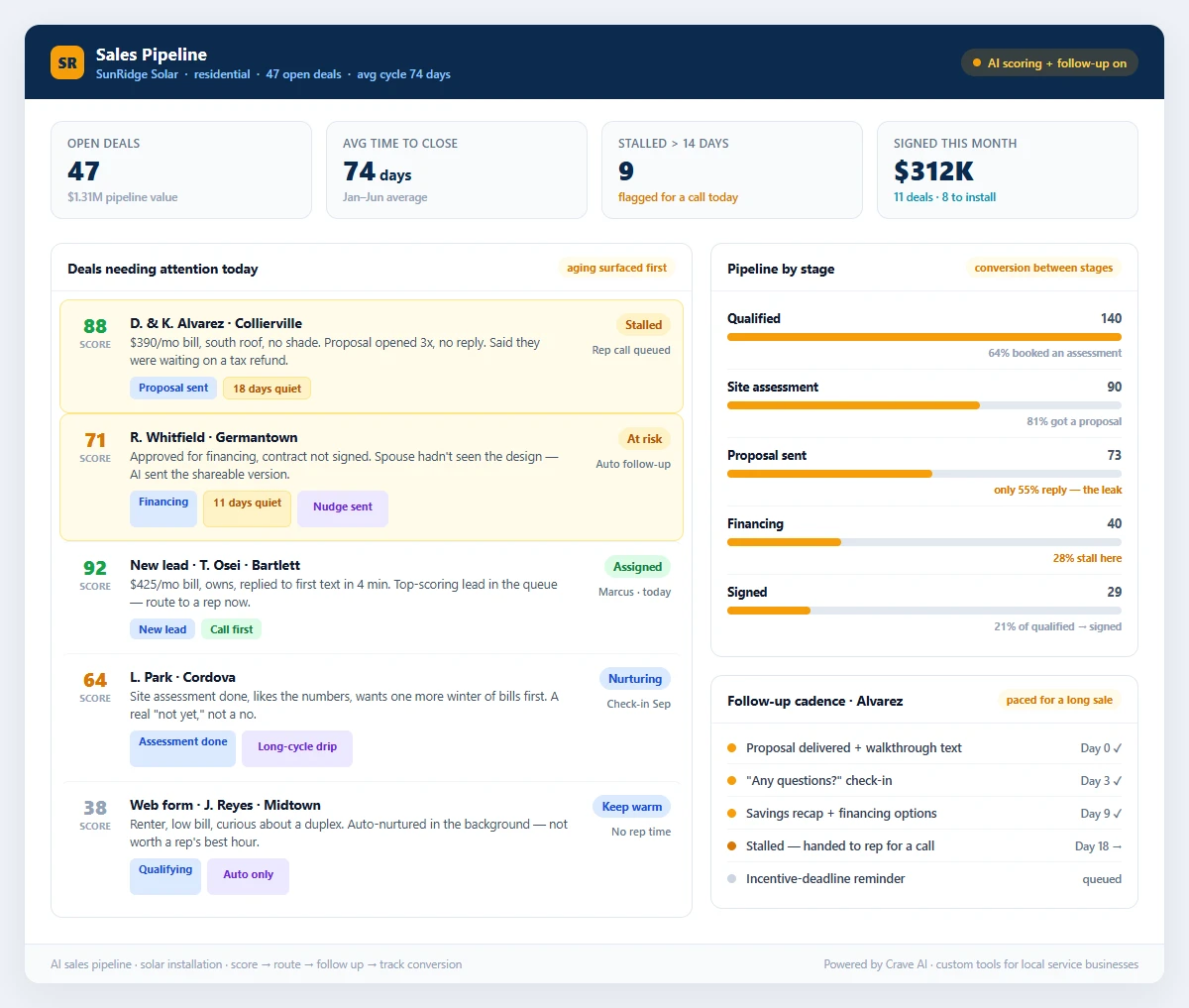
A solar sales pipeline dashboard: every open deal by stage, an AI lead score, follow-up cadence status, and the stalled deals worth a call today. Download as PDF
View interactive version
A deal that's been in "proposal sent" for two days is normal. A deal that's been there for eighteen days with no reply is a flare. The board pushes those flares to the top instead of burying them under the fresh, exciting leads that always steal a rep's attention. That reshuffling is most of the value. Salespeople chase what's new. The pipeline makes sure they also chase what's aging.
Scoring leads so reps spend time on the right ones
Not every solar lead is worth the same amount of effort, and a good rep already knows that in their gut. A homeowner with a $340 monthly bill, a south-facing roof, and no shade is a very different prospect than a renter curious about panels on a duplex. The problem is that gut instinct doesn't scale past a few dozen leads, and it doesn't leave a record anyone else can see.
An AI lead score puts a number on it using the signals you already collect. Roof direction and pitch, average electric bill, homeownership, credit indication if you gather it, how fast they replied, whether they opened the proposal. None of these decide the deal on their own, but together they sort a stack of leads into "call today" and "keep warm."
The score matters most on volume days. When thirty leads come in after a good ad week, a rep can't give all thirty a real first touch. The score tells them which eight to call first, so the best prospects get a human voice while they're still hot instead of a form-letter email two days late. We got into why that timing is so unforgiving in our piece on why lead response time decides who wins the job, and it's doubly true here: the homeowner who filled out three solar forms is talking to three companies, and the first real conversation usually wins the appointment.
Worth saying plainly: the score is a triage tool, not a verdict. A low score doesn't mean ignore the lead, it means don't drop your best hour on it. The pipeline keeps working the low-scoring leads automatically in the background, which is the next piece.
Keeping follow-up alive for three months straight
This is the part no human does well over a ninety-day stretch, and it's the part that quietly loses the most deals.
A homeowner gets a proposal, says they need to think about it, and means it. They're not a no. They're a "not yet." But a rep with fifty other open deals can't personally check in with that person every week for two months without letting someone else fall through the cracks. So the "not yet" leads get one or two follow-ups and then silence, and by the time the homeowner is finally ready in March, they've forgotten your company's name and gone with whoever texted them last.
The follow-up layer we'd build keeps that from happening. It runs a cadence tuned to solar's timeline, not a plumber's. A few touches in the first week while interest is high, then a sensible drip that stretches across the deciding months: a check-in after the site assessment, a nudge when a proposal's been sitting, a note when incentives or rate changes are worth mentioning, a seasonal reminder as the next high-bill stretch approaches. It's the same follow-up engine behind our automated lead follow-up work, paced for a long sale.
Two things keep it from feeling robotic. It stops the second a homeowner replies and hands the conversation to a real rep with the full history attached, so nobody gets a canned drip after they've already picked up the phone. And the messages sound like your company, not a vending machine, because a homeowner about to spend twenty-five grand can smell an autoresponder from a mile off. The goal is to stay in the conversation long enough for "not yet" to turn into "let's do it," without a rep having to remember every one of fifty slow-cooking deals.
Seeing where deals actually stall
Once the pipeline is running, it starts answering a question most installers can only guess at: where do our deals die?
Every solar company loses deals at every stage, but the shape of the leak is different for each one. Maybe you're great at booking assessments but only a third of your proposals ever get a reply, which points at pricing or at how the proposal gets delivered. Maybe proposals close fine but financing is where a quarter of your signed-interest homeowners evaporate, which points at your lender options or how you set expectations. You can't fix a leak you can't see, and a stage-by-stage conversion view makes the leak obvious.
This is the same logic behind the quote pipeline we described for a kitchen remodeling company, another high-ticket sale where most of the money rides on the follow-through after the first pitch. Track the conversion between each stage over a few months and patterns show up that no single rep would ever notice from inside their own deals. That's the difference between "we feel like we lose a lot at financing" and "we lose 28% at financing and here are the twelve deals sitting there right now."
The number that matters most for a long cycle is how many aging deals eventually close versus die. If deals that stall for thirty days almost never recover, that tells you where to concentrate the follow-up. If they recover a decent share of the time, that's proof the patience is paying for itself.
Where Crave AI fits
We don't sell a solar CRM off a shelf, and honestly, if a generic pipeline tool is working for you, keep it. What we build is the custom layer for installers whose deals are too valuable and too slow to leave to memory and good intentions: the scoring that sorts your leads, the follow-up that survives a three-month cycle, and the tracking that shows you exactly where deals leak so you can plug it.
It wires into the tools you already run, from your CRM to your proposal software, so reps aren't copying data between five tabs. You can see the shape of it on our AI for solar installation page, and it's the same idea as our broader service business automations, pointed at the specific problem of selling something expensive that takes months to close.
Stop losing the slow deals
Fast trades lose leads to missed calls. Solar loses them to time. A homeowner who was genuinely interested in February just quietly disappears by April because nobody kept the thread alive, and the acquisition cost goes down the drain with them.
A pipeline that scores your leads, keeps the follow-up running for as long as the decision takes, and shows you where deals stall doesn't make anybody buy panels they didn't want. It just makes sure the ones who did want them are still talking to you when they're finally ready to sign. Over a cycle this long, that's most of the game.

About the author
Zac Spencer is an online marketing specialist and the owner of Crave Media, based in Salt Lake City, Utah. Since 2013 he has managed hundreds of Google Ads accounts across dozens of industries — with budgets from a few hundred dollars to $250K a month — and founded Crave AI to build custom AI tools and automations for local service businesses.