

Building an AI-Powered Quote System for Kitchen Remodeling Companies
A homeowner has been saving for this kitchen for three years. They finally call you, you spend ninety minutes at their house measuring and talking through cabinets and counters, and you leave genuinely excited about the job. Then it takes you eight days to get them a quote, because the only time you can build it is at the kitchen table after the kids are asleep. By the time you send it, two other contractors already have.
Kitchen remodels are big, slow, emotional purchases. A full job runs anywhere from $25,000 to $80,000 and up, and the homeowner is almost never buying from the first person they talk to. They're collecting three to five bids, sitting with them for a few weeks, and trying to figure out who they trust with the most expensive room in the house. The quote is where you either earn that trust or quietly fall out of the running.
For most remodeling shops, the quote is also the slowest, most painful part of the whole operation. That's the gap worth closing.
Why the quote is where remodelers lose jobs
The bid itself isn't the problem. You know your numbers. The problem is everything around the bid: how long it takes to produce, how clear it is when it lands, and whether anyone follows up after you send it.
Speed matters more on a remodel than people expect, because the homeowner is comparing you to whoever responds first and sounds most organized. Take a week and a half to send a quote and you've told them, without meaning to, what your communication will be like during a two-month renovation that lives in their house. A clean, itemized proposal in two days does the opposite. It says you run a tight operation, and on a job this size that's half the sale.
Then there's the part almost nobody does: following up. A kitchen buyer goes quiet for two or three weeks while they compare bids, talk to their spouse, and work up the nerve to spend the money. Most contractors send the quote and wait. The job doesn't go to the lowest bid. It goes to the one who stayed in front of them without being annoying about it.
Why this is genuinely hard for a small remodeling shop
You're not slow because you're disorganized. You're slow because building a real kitchen quote is actual work, and you're the one doing it between job sites.
Every kitchen is different. Cabinet lines and box construction, countertop material from laminate to quartz to slab stone, whether you're moving plumbing or a gas line, the electrical the inspector will want, demo and disposal, the appliance package the homeowner picked off a Pinterest board. Pricing all that means pulling current numbers from suppliers, applying your labor and margin, and assembling it into something a homeowner can read. Do that carefully and it's a couple of hours per quote. Do it for every lead and you're spending your evenings on bids, half of which won't close.
So shops cut corners to survive it. Quotes go out slow. They go out as a single lump-sum number with no breakdown, which makes the homeowner suspicious and gives them nothing to compare. Or the lead just sits for a week because there's no good time to sit down and build the thing. Meanwhile the design-build firm across town has someone whose entire job is turning consults into polished proposals by the next morning. That's the matchup, and it's winnable, but not by working more nights.
It's the same follow-up math we walked through for an electrician chasing quote approvals, just with bigger tickets and longer decision windows.
What the AI quote system would actually do
We don't build "an AI." We build a specific tool that does one job well, and for a kitchen remodeler that job is turning a consult into a clear, priced proposal fast, then keeping it alive until the homeowner decides. This is what we'd put on one screen.
Scope capture that starts at the consult, not after it. You walk the kitchen and feed in what you find, by voice on the drive home or by typing a few lines and dropping in photos: cabinet count and line, counter material and rough square footage, whether plumbing or gas is moving, the appliance package, demo scope. The system turns that into a structured project scope instead of a notepad you have to decode three days later.
A pricing engine that holds your real numbers. Your cabinet pricing, your counter cost per square foot by material, your labor rates, your standard margin, your demo and disposal costs. The AI assembles the line items and does the math, producing an itemized estimate with a sensible range rather than a single guess. You're reviewing and adjusting a draft, not building it from zero.
A clean proposal a homeowner can read. The same numbers, laid out by category with a clear total and good-better-best options where they make sense, sent the next day under your brand. Not a lump sum. Something that makes the homeowner feel like they understand what they're paying for.
And a pipeline view so nothing falls through. Every active quote, what stage it's in, how long since you sent it, and which ones are due for a nudge. The dashboard surfaces your quote turnaround time and your win rate by lead source, so you can see which of your marketing dollars actually become signed jobs.
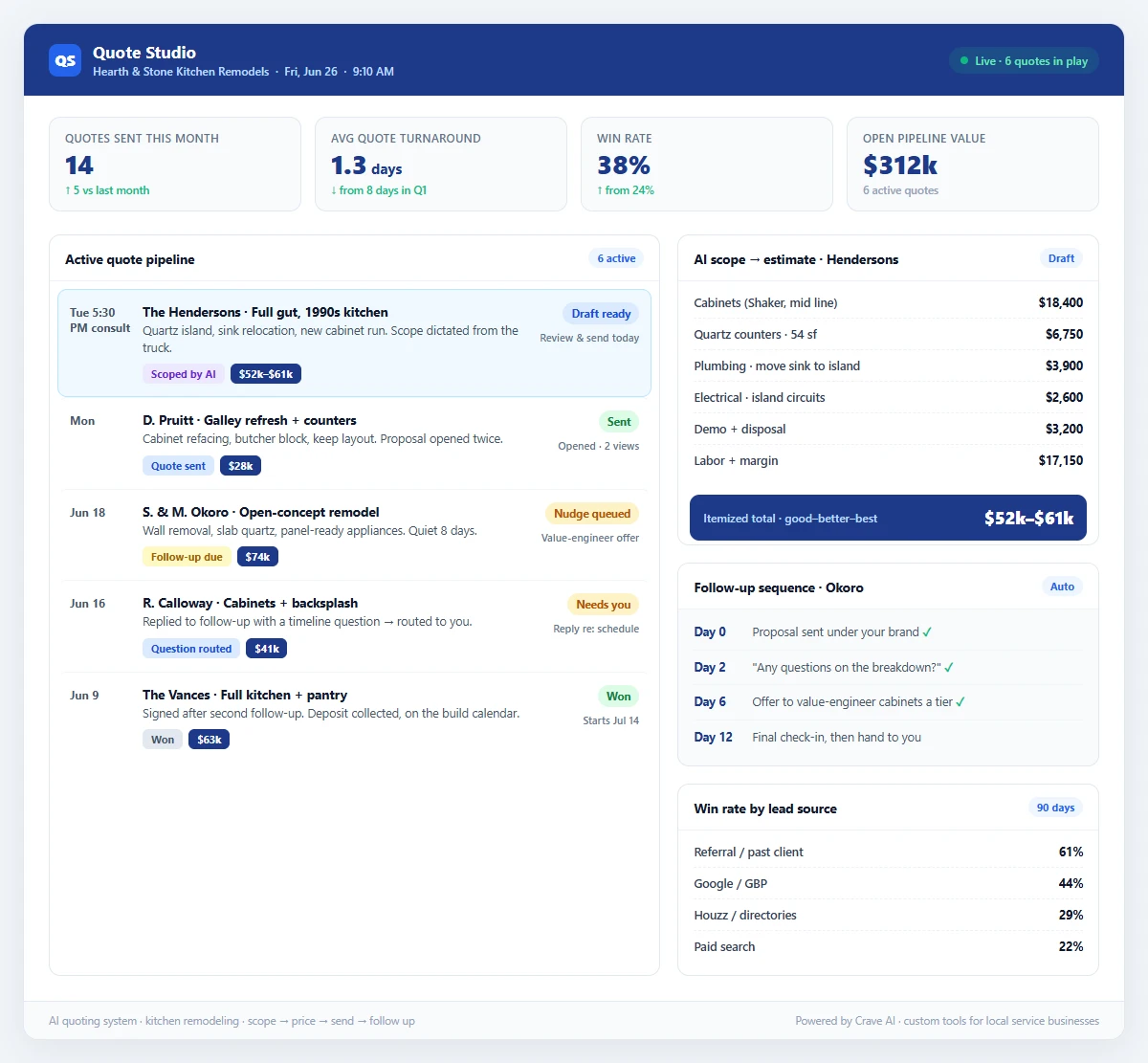
An AI quoting system for a kitchen remodeling company, showing the active quote pipeline by stage, the AI scope-to-estimate breakdown with a price range, the follow-up sequence on a sent proposal, and turnaround and win-rate metrics. Download as PDF
View interactive version
The sequence that runs from consult to signed contract
The point of all this is that the slow, after-hours parts happen on their own.
You finish a consult and, before you pull out of the driveway, you dictate the scope into your phone. By the time you're back at the shop the system has a draft estimate built from your pricing, itemized and ready for you to sanity-check. You tweak a line or two, approve it, and the proposal goes out the same afternoon while the homeowner still remembers liking you.
Then the follow-up runs without you remembering to. Two days after the quote lands, if they haven't responded, they get a short, real-sounding message asking if they had questions on anything. A few days later, another that offers to walk through the options or adjust the scope to fit a number they're comfortable with. If they ask a question, it routes to you. If they go quiet for two weeks, they get one more touch instead of being forgotten. None of it sounds like a robot, and none of it requires you to keep a mental list of who you're waiting on.
By the time the homeowner is ready to choose, you're the contractor who answered fast, sent something clear, and stayed in touch. On a $50,000 decision, that's usually the one who wins.
A real Tuesday, the flow in motion
Picture a consult at 5:30 on a Tuesday evening, a full gut of a 1990s kitchen. You measure, talk through quartz versus butcher block, note that they want to move the sink to the island and add a run of cabinets. Old way, that quote gets built Thursday night and sent Friday, lump sum, $58,000, take it or leave it.
New way, you record the scope in the truck. The system drafts the estimate: cabinets by line, quartz at your per-foot number across the measured footage, plumbing relocation, the electrical for the island, demo and disposal, your labor and margin. It comes back as an itemized proposal with a good-better-best on the counters, $52,000 to $61,000 depending on finishes. You review it Wednesday morning over coffee, adjust the cabinet allowance, and send it. The homeowner opens a clear breakdown two days after you stood in their kitchen.
They go quiet, the way kitchen buyers do. The system nudges them Friday, then again the next week with an offer to value-engineer the cabinets down a tier. They reply to that one with a question about timeline, which lands on your phone. You answer, they book. You never spent an evening building the bid, and you never had to remember to chase them.
How it fits what you already run
A fair worry is that this means throwing out your tools and learning some new platform mid-season. It doesn't.
The system pulls from the supplier pricing you already use and hands signed jobs into whatever you run your business on, whether that's a full construction CRM, a project tool, or a folder of spreadsheets and a calendar. We shape it around how you already estimate, not the other way around. And to be honest, if you already have a dedicated estimator who turns consults into beautiful proposals by the next morning and a process for following up, you may not need this. The value shows up when you're the owner, the salesperson, and the lead carpenter all at once, and the quotes are the thing that keeps slipping. There's a longer version of that "do you even need custom" question in our take on custom AI versus better software. The same dashboard thinking shows up on the project-tracking side in what we'd build for a general contractor's reporting.
What changes when quoting stops being the bottleneck
The shift is simple to picture. Right now your quote turnaround is measured in days and your follow-up is whatever you remember to do, which means the slow, well-funded competitor wins jobs you were better suited for. Tighten turnaround to a day or two and make the follow-up automatic, and you start winning on responsiveness instead of losing on it.
You also stop leaving evenings on the table. The hours you were spending building bids and trying to recall who you owe a call go back to running jobs and being home. And because the dashboard shows win rate by source, you finally learn which lead channels are worth paying for and which just generate quotes that never close.
Where we'd start
We wouldn't try to automate your whole estimating department on day one. We'd build the one piece that's quietly costing you the most, which is the lag between the consult and the sent proposal.
The first build would be scope capture plus the pricing engine, tuned to your real supplier and labor numbers, so you can turn a consult into a reviewed quote the next morning. That alone tends to pull turnaround from a week down to a day or two, and it gives us real data to set up the follow-up sequences and the pipeline view. From there we add the automated nudges, the source-level win tracking, and deeper hooks into your scheduling.
If you run a kitchen remodeling company and you know quotes are where you're losing jobs but can't say how many, that's the number worth measuring first. You can see the kind of tooling we'd build on the kitchen remodeling AI page, or look at the broader set of custom AI tools we put together for local service businesses. Tell us how your quotes go out now, and we'll show you what turning them around by tomorrow morning would look like.

About the author
Zac Spencer is an online marketing specialist and the owner of Crave Media, based in Salt Lake City, Utah. Since 2013 he has managed hundreds of Google Ads accounts across dozens of industries — with budgets from a few hundred dollars to $250K a month — and founded Crave AI to build custom AI tools and automations for local service businesses.