

Why your business isn't showing up in ChatGPT
Someone in your city typed "best plumber near me" into ChatGPT last week. ChatGPT gave them three names. Yours wasn't one of them.
This is already happening at scale. Tens of millions of people use ChatGPT regularly, and a growing chunk of them are using it to find local services. They're asking it who to call for a roof leak, which HVAC company is reliable, or where to get their carpets cleaned. ChatGPT answers with specific business names. If yours isn't in the mix, you're losing jobs to competitors you've never even heard of.
The frustrating part is that most local service businesses have no idea this is happening. You're tracking your Google ranking, maybe running some ads, checking your reviews. But nobody told you there's a new search channel sending leads to your competition, and it works completely differently from Google.
Here's how ChatGPT finds businesses, why yours might be missing, and what you can do about it right now.
How ChatGPT picks which businesses to mention
Google works on keywords and links. You optimize your website, build citations, get reviews, and your ranking moves up. The process is well-documented and your SEO person probably has a spreadsheet for it.
ChatGPT doesn't work like that. It pulls from two sources when answering questions about local businesses.
The first source is its training data. ChatGPT was trained on a massive amount of web text. If your business appeared frequently across the web before the training cutoff, the model might "know" about you. But training data is static. It's a snapshot of the internet from months or years ago. If you opened your business last year or changed your name or moved locations, the training data might not reflect that.
The second source is live web browsing. Newer versions of ChatGPT can search the web in real time when answering questions. That matters for local businesses, because it means ChatGPT is pulling from many of the same places Google pulls from: your website, your Google Business Profile, directory listings, review sites, and structured data in your HTML.
The difference is how it reads those sources. Google crawls your site and indexes individual pages. ChatGPT reads your site and tries to understand what your business does, where you operate, how customers feel about you, and whether you're a credible answer to someone's question.
That distinction matters. A website that ranks well on Google can still be invisible to ChatGPT if the information is buried in images, scattered across dozens of pages with no clear structure, or missing from the directories and data sources that AI models check first.
Why most local service businesses are invisible to AI search
We've looked at a lot of local service company websites, and the same problems show up repeatedly. These aren't design problems or SEO problems in the traditional sense. They're AI search visibility problems.
Missing structured data
Your website might say "Licensed plumber serving Memphis since 2008" in a headline, but that's just text on a page. ChatGPT can read it, but it has to guess what's a business name, what's a service area, and what's a credential. Schema markup turns that guessing into certainty. It's code in your HTML that explicitly labels your business name, address, phone number, service area, hours, and services. About 80% of the local service websites we see have no schema markup at all. The ones that do often have incomplete or outdated markup that lists the wrong address or is missing service descriptions.
Inconsistent directory listings
ChatGPT cross-references multiple sources when deciding whether to recommend a business. If your Google Business Profile says you're at 1420 Oak Street, your Yelp listing says 1420 Oak St., your BBB page says 1420 Oak Street Suite B, and your website says 1420 Oak, that's four different versions of your address. To a human, those are obviously the same place. To an AI model comparing data across sources, inconsistency reduces confidence. The model is less likely to recommend a business when the data doesn't line up cleanly.
Thin or absent web presence
Some service companies have a five-page website that hasn't been updated since 2019. No blog, no service area pages, no recent content. From ChatGPT's perspective, there's very little information to work with. If a competitor has detailed service pages, recent blog posts, and active directory listings, the AI has more data to draw from and is more likely to surface them.
No reviews, or reviews on only one platform
Review content is a strong signal for AI models. They don't just count stars. They read what people wrote. A business with 200 Google reviews that mention specific services, technician names, and neighborhoods gives ChatGPT a rich understanding of what that business does and how well they do it. A business with 12 reviews and no detail gives it almost nothing.
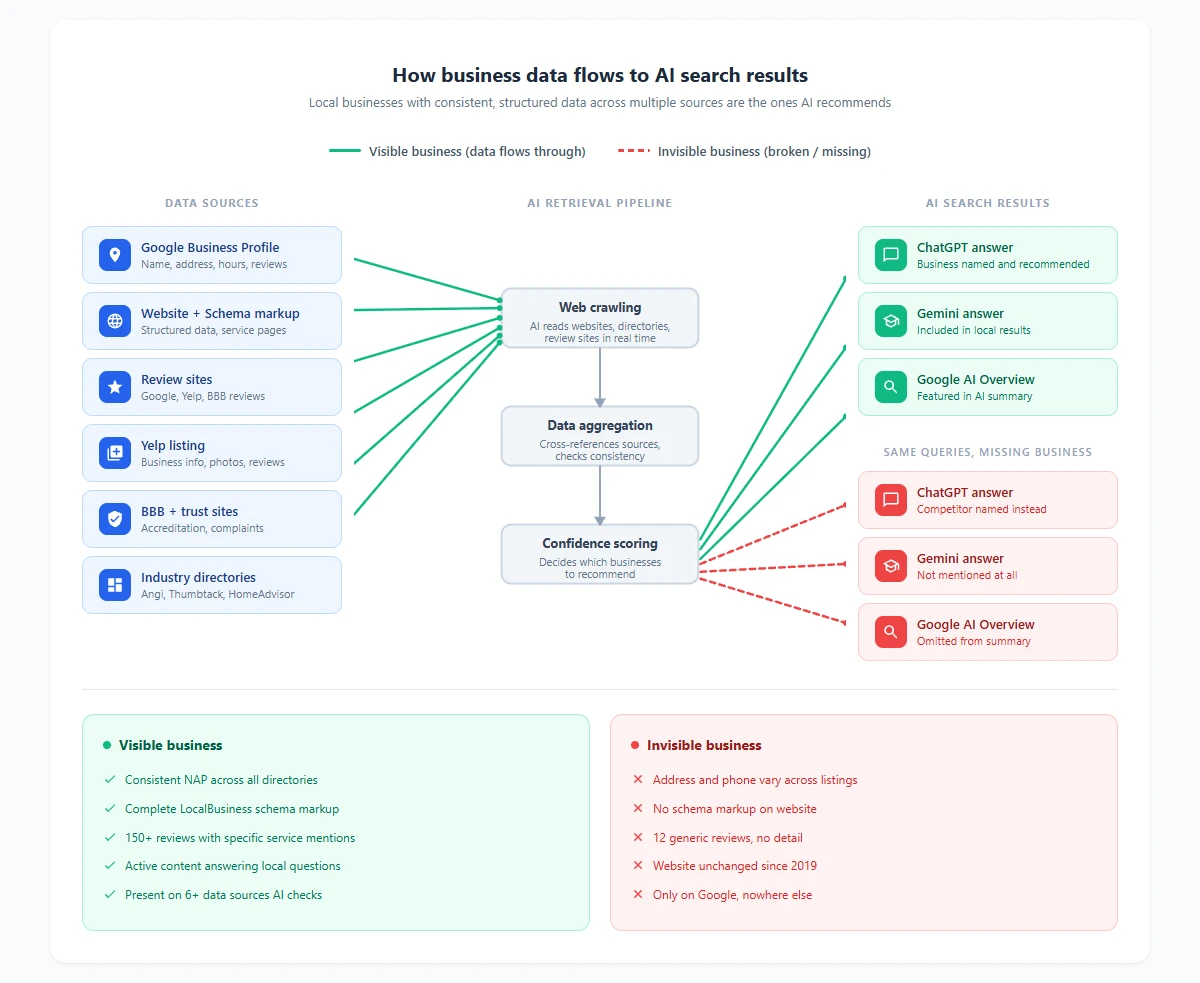
How business data flows from directory listings and structured data to AI search results. Businesses with consistent, complete data across multiple sources are more likely to appear. Download as PDF
View interactive version
Five things you can check this week
You don't need to hire anyone to start fixing this. These are things you can check yourself or hand to whoever manages your web presence.
1. Audit your Google Business Profile
Log into your Google Business Profile and check every field. Business name, address, phone, website URL, hours, service area, business category, and business description. Make sure nothing is outdated. If you added a new service last year, it should be listed. If you expanded your service area, update it. Google Business Profile is one of the first places AI models look, partly because Google's own AI Overview pulls directly from it.
2. Check your directory consistency
Pull up your listings on Yelp, BBB, Angi, Thumbtack, and any industry-specific directories you're on. Compare the name, address, and phone number on each one. They should match exactly. Not mostly. Exactly. Same format, same suite number, same phone number. If you find inconsistencies, fix them. This takes an hour, maybe two, and it directly affects whether AI models trust your business data.
3. Look at your website's structured data
Go to Google's Rich Results Test (search for it, it's free) and paste in your homepage URL. It will tell you what structured data Google can read on your site. If the result comes back empty or only shows basic organization data, you're missing the schema markup that helps AI models understand your business. A complete LocalBusiness schema should include your business type, address, phone, hours, service area, and the services you offer. If you're using WordPress, a plugin like Rank Math or Yoast can help you add this without touching code.
4. Read your reviews like an AI would
Open your Google reviews and read the first 20. Are customers mentioning specific services? Specific neighborhoods? Specific people on your team? That specificity is what AI models pick up on. If your reviews are all "Great service, would recommend," they don't give ChatGPT much to work with. You can't control what customers write, but you can encourage detail. When you send a review request, try asking something like: "If you have a minute, a Google review would mean a lot. Mentioning the service we did and your area helps other homeowners find us."
5. Publish content that answers questions
ChatGPT answers questions. If your website answers those same questions in clear, detailed text, you become a source. What does emergency water damage restoration cost in Nashville? How often should you get your HVAC serviced in the South? What's the difference between a repair and a replacement for a garbage disposal?
These don't need to be long. 400 to 600 words of honest, specific information about a question your customers ask you every week. That content gets crawled, indexed, and read by AI models looking for trustworthy answers.
This isn't replacing Google. It's adding a lane.
A common reaction to all of this is "I've got enough to worry about with Google, now there's another thing?" Fair. But this isn't a separate project with a separate budget. Almost everything that makes you visible to ChatGPT also makes you more visible to Google's AI Overview, Gemini, Perplexity, and every other AI-powered search tool.
Consistent directory listings help your Google ranking too. Schema markup improves your rich snippet appearance. Review volume and quality affect everything across the board. And content that answers real questions has always ranked better, regardless of which search engine is reading it.
The businesses that will show up in AI search results in 2026 and 2027 are the ones that have clean, well-structured information across the web right now. Not the ones with the biggest ad budget. The ones with data that AI models can read, verify across sources, and confidently recommend.
Where we fit in
We build AI visibility systems for local service businesses. That means auditing your current presence across the data sources AI models check, fixing the gaps, adding structured data to your site, and monitoring how you show up in AI search results over time.
It's not magic and it's not overnight. It's the kind of detailed, unglamorous data work that most web agencies skip because it doesn't look impressive in a portfolio. But when someone in your city asks ChatGPT who to call, it's the difference between your name showing up and silence.
If you want to see where your business currently stands with AI search visibility, we'll run a free audit and show you exactly what's missing. No pitch deck, just the data. Start here.

About the author
Zac Spencer is an online marketing specialist and the owner of Crave Media, based in Salt Lake City, Utah. Since 2013 he has managed hundreds of Google Ads accounts across dozens of industries — with budgets from a few hundred dollars to $250K a month — and founded Crave AI to build custom AI tools and automations for local service businesses.