

AI search vs Google search: what changes for local businesses
For twenty years, getting found online meant the same thing for a local business: rank on Google, ideally in the map pack, and collect the clicks. That system had rules you could learn and a scoreboard you could watch.
AI search runs on different rules. When someone asks ChatGPT or Google's AI Overview for a plumber instead of typing "plumber near me" into a search box, the output isn't a page of links with your listing somewhere on it. It's an answer. Understanding the difference between AI search and Google search is worth a business owner's time right now, because the two reward different things, and the gap between them is where customers are quietly moving.
This post covers what changes: who does the sorting, what happens to your website traffic, what the visitors you still get look like, and why the penalty for being invisible is getting steeper.
Google gives you a list, AI gives you a verdict
Classic Google search is a ranking machine. You type a query, it hands back ten organic results, a map pack, and some ads, and then its job is done. You scan, you compare, you click around, you decide. Google sorts pages. The human sorts businesses.
An AI assistant takes over that second job. Ask Gemini or ChatGPT who should replace your water heater and the model reads the available evidence, weighs it, and hands back two or three names with a sentence of reasoning attached. The comparison shopping you used to do across six tabs happened inside the model, in about four seconds, using whatever public information it could retrieve.
That's the core difference, and almost everything else follows from it. On Google, being option eight still gets you something. In an AI answer, there is no option eight.
Zero-click answers change what your content does
A big share of local-intent searches were never "hire someone" queries to begin with. They were questions. What does a furnace tune-up cost. Why is the AC leaking. Can you patch a 15-year-old roof or does it need replacing.
Businesses have spent years writing blog posts and FAQ pages to catch those questions, rank for them, and pull the reader into the site where a phone number waits. AI search answers most of them on the spot. The searcher asks, reads the synthesized answer, and leaves satisfied without visiting anyone. No click happens, so no visit shows up in your analytics.
That doesn't make the content worthless. It changes its job. A page that plainly answers "what does drain cleaning cost in Memphis" used to earn a visit; now it earns something different, which is being the source the model quotes when it builds the answer. The answer often carries the name of the business it drew from, and the reader meets you inside it. Your content stops being a traffic magnet and starts being a citation target. If the page is written for a person and puts real numbers on real questions, it can still do its work without the visit ever happening.
The uncomfortable part is measurement. A citation in an AI answer doesn't appear in Search Console. For now, the closest thing to tracking it is asking new customers how they found you and taking "I asked ChatGPT" seriously as an answer.
The visitors you keep are worth more
Site traffic falling while business holds steady sounds like a contradiction. It's what we expect this shift to look like for a healthy local company.
Think about who still lands on your website in an AI-search world. The person three weeks from a decision who just wanted a ballpark price got it in the chat window and never arrived. The one who clicks through is the one who already saw you named, already read a one-sentence case for you, and is now checking whether your site backs it up before calling. The research phase ended before you ever saw them.
Owners who watch pageviews as their health metric will read this as decline. The number that deserves the attention is conversion: calls, form fills, and booked jobs per visitor. Fewer visitors arriving warmer means that rate should climb even while raw traffic sags. If sessions are down 30% but the phone rings the same amount, you haven't lost anything except a vanity number.
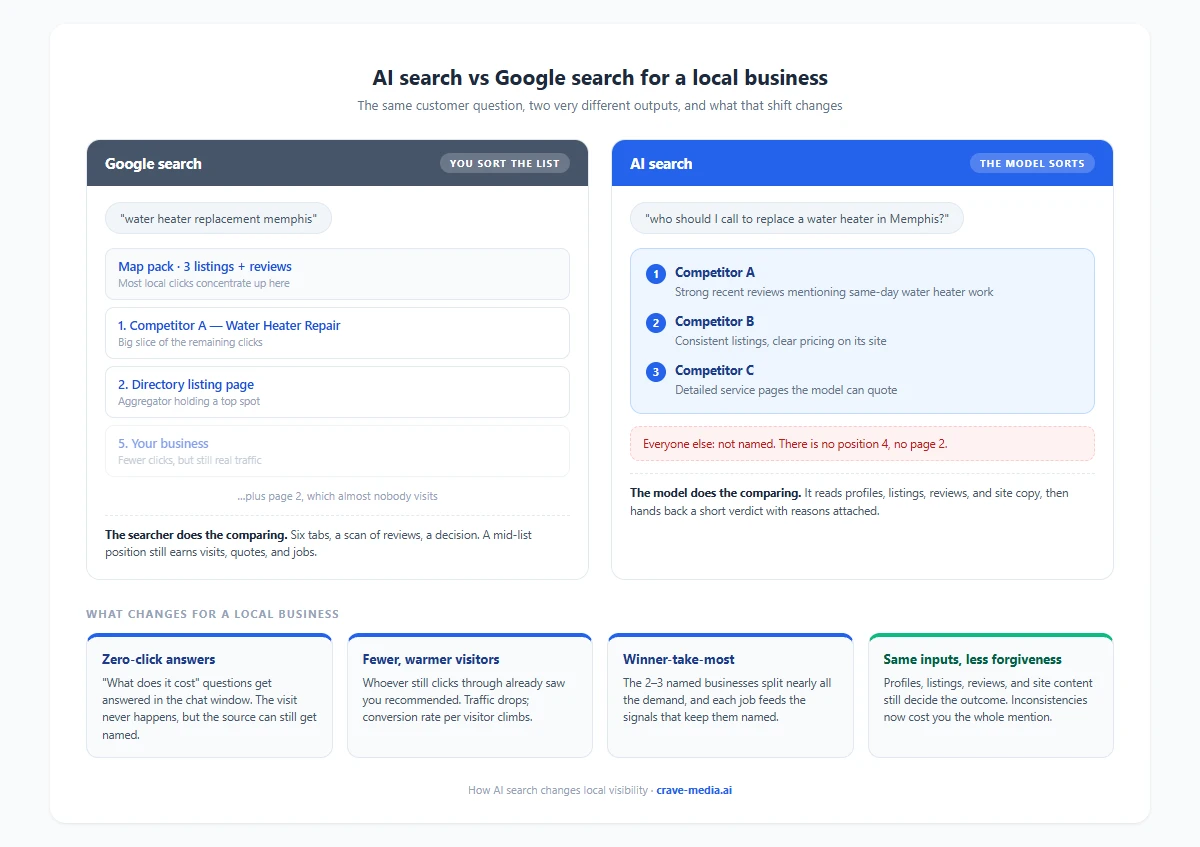
What changes between Google search and AI search for a local business. The searcher stops sorting a list, the model hands back a short answer, informational queries resolve without a click, and the businesses that get named collect most of the demand. Download as PDF
View interactive version
Winner-take-most gets stronger
Google search already concentrated attention at the top. The first organic result takes a big slice of clicks, the map pack's three names take most of the local action, and page two might as well be a filing cabinet. But the long tail existed. Position six got scraps, and scraps kept a lot of businesses fed.
AI search compresses that curve hard. When the model answers "who's a good electrician in town" with three names, those three companies split roughly all of the demand that flowed through that question. Fourth place isn't getting scraps. Fourth place wasn't mentioned.
It compounds, too. The businesses that get named get the calls, which produce jobs, which produce fresh reviews and activity signals, which make the model more confident naming them next time. The flywheel spins in one direction. Early position in AI answers is going to be worth far more than the same position was worth in blue links, and it will be harder to dislodge whoever holds it.
That sounds bleak if you're not currently on the list. The other side of it: most of your competitors have no idea this list exists. The window where showing up is cheap is still open.
AI search and Google search read the same inputs
For all the difference in what the searcher sees, the model builds its answer from things you already know about. Your Google Business Profile. Your presence and consistency across the major listings. Your reviews, read as sentences now and not just counted. Your website's plain-language answers to real questions.
Those are the same assets good local SEO has always been built on. The work transfers. What changes is the tolerance for gaps: Google might rank you despite a half-finished profile because your site was strong, but a model cross-referencing sources gets less confident with every inconsistency it finds, and a model that isn't confident leaves you out of the answer entirely. We walked through which listings feed AI answers in the piece on the directories that feed AI search results, and the full workthrough lives in our 2026 AI search optimization checklist.
Google search isn't disappearing while this happens. The map pack still drives real calls and will for years. This isn't a platform migration where you drop one thing and pick up another. The same foundation now serves two systems, and one of them is much less forgiving.
Run the five-minute test
Open ChatGPT, ask it for the service you sell in the city you sell it, phrased like a customer would ask a friend. Then try Gemini, and run a Google search and look at the AI Overview if one appears. Three checks, five minutes.
If your business shows up, look at what the model says about you and where that language came from. You'll usually recognize it, from your profile, your reviews, or a page on your site. If you don't show up, the names that do are your actual competition in this channel, and their public data is sitting there to compare against yours.
That gap between what AI says about them and what it says about you is fixable, and right now it's fixable cheaply because so few local businesses are working on it. Closing it is most of what our AI visibility service does: cleaning up the data sources models read, making your site quotable, and monitoring what the answers say month over month. If you'd rather have us run the check and show you where you stand, reach out and we'll pull it together.
The searcher's habit is the thing to watch. Every month, a few more of your customers stop reading lists and start taking recommendations. Be in the recommendation.

About the author
Zac Spencer is an online marketing specialist and the owner of Crave Media, based in Salt Lake City, Utah. Since 2013 he has managed hundreds of Google Ads accounts across dozens of industries — with budgets from a few hundred dollars to $250K a month — and founded Crave AI to build custom AI tools and automations for local service businesses.