

AI Search Optimization: The 2026 Checklist for Local Businesses
If you've been meaning to sort out whether ChatGPT, Gemini, and Google's AI Overview actually mention your business, this is the AI search optimization checklist for 2026 you can work straight through. No theory, no new budget line. Just the things AI models check before they name a local company, in the order I'd tackle them.
Most of what follows you can do yourself or hand to whoever runs your website. None of it is exotic. The businesses getting cited in AI answers right now aren't doing anything clever. They have clean, specific, consistent information spread across the places AI tools read, and their competitors don't.
How to work through this AI search optimization checklist
I'll go category by category. Each section is a short list of concrete checks. Run the ones you're missing and skip the ones you've already nailed.
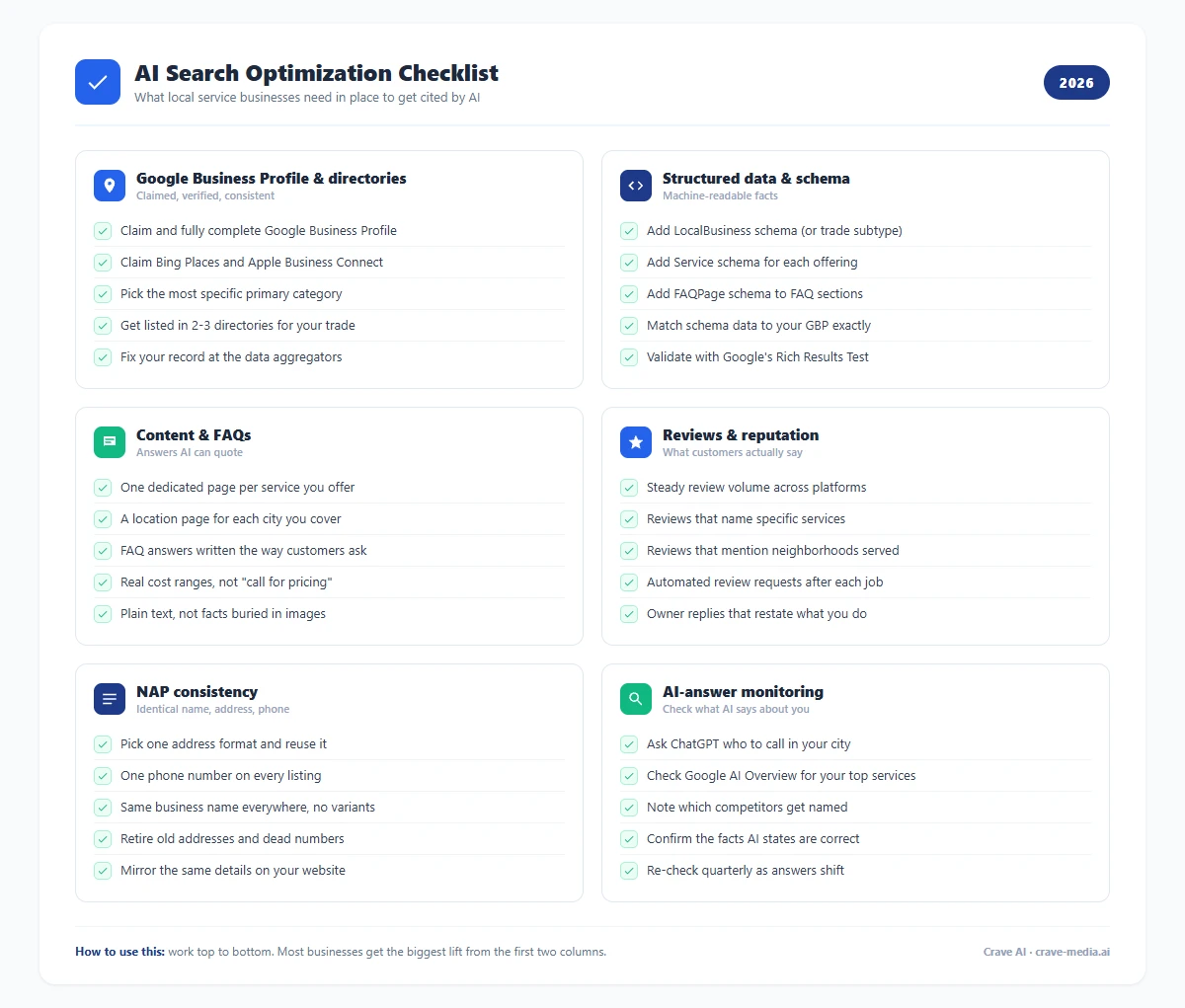
The full 2026 AI search optimization checklist, grouped into the six areas that decide whether AI tools can confidently recommend your business. Work the columns left to right. Download as PDF
View interactive version
Google Business Profile and directories
This is the foundation, so it goes first. When someone asks an AI tool for a plumber or a roofer in your city, the model leans on the same authoritative business listings Google and Bing already index. If you're missing from those, the rest barely matters.
Claim and completely fill out your Google Business Profile. Every field. Name, address, phone, website, hours, service area, primary category, secondary categories, services, and a real description that names what you do and where you do it. A half-filled profile is the single most common reason a legitimate business gets skipped.
Then claim Bing Places and Apple Business Connect, because almost nobody in the trades does. ChatGPT's web browsing and Microsoft Copilot both run on Bing's index, so Bing Places quietly sits under a big slice of AI search. Apple Business Connect feeds Apple Maps and Siri, and Siri now hands a lot of questions to ChatGPT. Both take fifteen minutes and let you import from Google.
Pick the most specific primary category you can. "Plumber" beats "Home Services." After that, get listed on the two or three directories that fit your trade and your area instead of carpet-bombing every directory online. A storm-restoration roofer wants roofing directories. A salon wants something else entirely. If you want the full breakdown of which listings carry the most weight, I went deep on the directories that feed AI search results in a separate post.
Structured data and schema
Your website might say "Licensed plumber serving Memphis since 2008" right in the headline. A person reads that and understands it instantly. An AI model has to guess which part is the business name, which is the service area, and which is a credential. Schema markup removes the guessing.
Schema is code in your site's HTML that explicitly labels your business name, address, phone, hours, service area, and services. Add LocalBusiness schema, or the subtype that matches your trade, like Plumber, HVACBusiness, or Electrician. Add Service schema for each thing you offer. Add FAQPage schema to any FAQ section. About 80% of the local service sites we look at have no schema at all, and many of the rest have outdated markup listing an old address.
The part people miss is consistency. The data in your schema has to match what's in your Google Business Profile. When the two line up, Google's confidence in your business goes up. When they conflict, Google tends to ignore both. We broke down how to set this up correctly in our guide to schema markup for local service businesses, and the same markup that helps traditional search helps AI tools read you without guessing.
When you're done, paste your homepage into Google's Rich Results Test. It's free, and it shows you exactly what structured data Google can read. If it comes back empty, that's your gap.
Content and FAQs
AI tools answer questions. If your website answers those same questions in clear text, you become a source the model can quote. If your information is thin, buried in images, or crammed onto one combined "Our Services" page, there's very little for the AI to pull from.
Give every service its own page. A company with separate pages for drain cleaning, water heater repair, sewer line inspection, and emergency service hands the AI four sources. A company with one services page hands it one. Add a location page for each city in your service area. Each page should cover what the service is, who it's for, what's included, and roughly what it costs.
Cost is where a lot of sites go quiet, and that's a mistake. "How much does drain cleaning cost in Nashville?" is exactly the kind of question an AI Overview wants to answer, and it can only do that if someone put a real number on a page somewhere. You don't need an essay. Four hundred to six hundred words of honest, specific information about a question your customers ask you every week is plenty.
Write your FAQ answers the way customers actually phrase the question, not the way a brochure would. The closer your wording is to how people ask, the easier you are to match.
Reviews and reputation
AI models read the actual text of your reviews, beyond the star rating. Ten reviews that say "they replaced our tankless water heater the same day we called" teach the model far more than a flawless 5.0 stacked with "great job, five stars." The first kind tells the AI what you do, how fast, and where. The second tells it almost nothing.
So volume matters, but specificity matters alongside it. Encourage customers to mention the actual service and their neighborhood. You can't script a review, but you can nudge it. When you send a review request, try something like: "If you have a minute, mentioning the work we did and your area really helps other folks nearby find us."
If you're not already sending review requests automatically after each job, that's one of the simplest automations worth setting up. It runs in the background and keeps a steady trickle of fresh, detailed reviews coming in across Google, Yelp, and wherever else you're listed. When you reply to reviews, restate what happened in plain language, since those replies are readable signal too.
NAP consistency
NAP is name, address, and phone number, and getting it identical everywhere is the most boring item on this list. It's also one of the most important, because inconsistency quietly tanks the confidence AI models have in your data.
Picture the trap. Your Google profile says 1420 Oak Street. Your Yelp listing says 1420 Oak St. Your BBB page says 1420 Oak Street Suite B. Your website footer says 1420 Oak. To you, those are obviously the same address. To a model cross-referencing records across sources, they read as four different places, and that mismatch costs you.
Pick one format for your address, down to whether you abbreviate "Suite" or "Ste," and use it on every listing including your own site. Use one phone number everywhere. Use the exact same business name with no stray variations. If you moved three years ago and an old listing still shows the previous address, fix it now. Then mirror those same details on your website, backed by the schema from earlier so AI can read them cleanly.
AI-answer monitoring
You can't improve what you never look at. The last category is checking what AI tools currently say about your business, which most owners have never done.
Open ChatGPT and ask it who to call for your service in your city. Then do the same Google search you'd expect a customer to run and read the AI Overview at the top. Note whether you show up, and note which competitors get named when you don't. Half the value here is just discovering that there's a whole search channel sending leads to companies you've never heard of.
Check that the facts the AI states about you are right. Models sometimes recommend a business but botch the hours, the service area, or the phone number, usually because of one of the inconsistencies in the section above. And re-check on a schedule. AI answers shift as the underlying data updates, so a quarterly pass tells you whether your fixes landed and whether anything drifted back out of sync. This kind of monitoring is part of the broader work of getting your business to show up in ChatGPT and the other assistants over time.
Why this is one project, not two
A fair reaction to a six-part checklist is that it sounds like a second full-time job stacked on top of your regular SEO. It isn't. Almost everything here also makes you more visible in traditional Google search. Consistent listings help your local ranking. Schema improves your rich snippets. Detailed service pages and real reviews have always ranked better. You're not building a separate machine, you're tightening the one you already have so AI tools can read it.
The businesses that get named when someone asks an AI who to call in 2026 aren't the ones with the biggest ad budget. They're the ones whose information is clean, specific, and consistent across every place a model checks. That's a position you earn with unglamorous data work, which is exactly why most competitors won't bother.
Where to start this week
If the whole list feels like a lot, don't run it all at once. Spend ninety minutes on the items that move the needle most. Claim or complete your Google Business Profile and fill every field. Claim Bing Places and import from Google. Claim Apple Business Connect. Then open Yelp and make your name, address, and phone match the other three exactly. That covers the sources feeding Google AI Overview, ChatGPT, Copilot, and Siri.
Next, run the Rich Results Test on your homepage to see whether you have any schema, and ask ChatGPT who it recommends in your city so you know where you stand. Those two checks take ten minutes and tell you which sections of this checklist deserve your attention next.
If you'd rather have someone audit all six layers and fix the gaps for you, that's exactly what our AI visibility service does. We map where your business shows up across the data sources AI models read, clean up the records that conflict, add the structured data your site is missing, and track how you appear in AI answers over time. If you want to see where you stand today, we'll run a free audit and show you what's missing, no pitch deck attached.

About the author
Zac Spencer is an online marketing specialist and the owner of Crave Media, based in Salt Lake City, Utah. Since 2013 he has managed hundreds of Google Ads accounts across dozens of industries — with budgets from a few hundred dollars to $250K a month — and founded Crave AI to build custom AI tools and automations for local service businesses.