

AI tools for a locksmith business during the holidays
At 10:52 on the night before Thanksgiving, a woman stands in a grocery lot in Kettering with her keys on the driver's seat of a locked CR-V and two bags of groceries on the hood. She searches "locksmith near me." The first listing promises a $19 service call. The second is a number with no address. The third is a real shop two miles away, and it doesn't pick up because both of its techs are already out on lockouts.
She's going to hire somebody in the next five minutes. She's also tired, cold, and expecting to get ripped off, because that's the reputation this trade carries into every midnight phone call.
If that third shop texts her back within a minute with a price range, the ID it'll ask for, and the name of the tech who's coming, it has a good shot at the job, even though a van won't arrive for 20 minutes. That text is the first of the AI tools we'd build for a locksmith business. Behind it sits a dispatch board that knows where every van is, a queue that parks commercial work until Monday, and a rekey list for the daytime hours between lockouts.
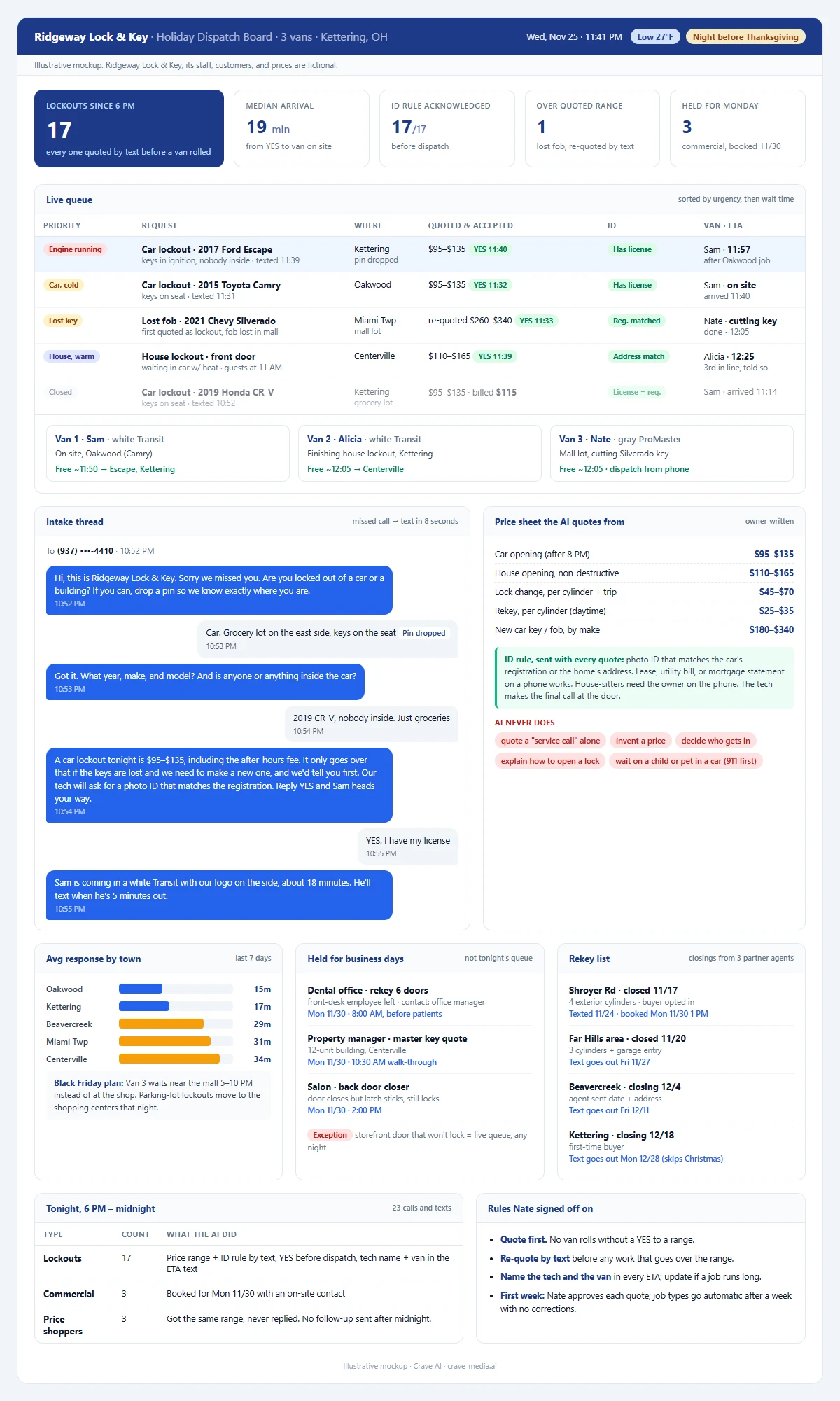
The holiday dispatch board for a three-van locksmith shop: tonight's lockout queue with the price range each customer agreed to by text, the ID rule they acknowledged, van positions and ETAs, response times by town, commercial jobs held for Monday, and new homeowners due a rekey. Download as PDF
View interactive version
Holiday lockouts are a trust problem
Our industry notes put about 70% of locksmith calls outside business hours, more than any other trade we've written about. A lockout ticket usually lands somewhere between $75 and $300. Small money per job, and a lot of jobs, most of them at night.
The holidays add volume and a worse mood. People travel, shop late, run errands with the car idling in a cold lot, and hand house keys to sitters who lose them. The Wednesday before Thanksgiving and the weekend after it are when a three-van shop finds out its phone can't keep up.
Getting there fast still counts. We covered that side for a garage door company's emergency dispatch, where the problem was catching the 6 a.m. call before a competitor did. A locksmith has a different problem: the customer can't tell you apart from the scammer.
The scam is old and well documented. In July, Connecticut's consumer protection department warned about the locksmith bait-and-switch: a low price on the phone, then a "more complicated than anticipated" price once the tech is standing at the door. Its advice was to get the full price upfront, including service and travel, and a written quote before work begins. Connecticut lets people look up a registered locksmith. Ohio doesn't license locksmiths at the state level, so an Ohio customer at 11 PM has your listing, your reviews, and whatever your first message says.
The lockout intake by text
Every missed call gets a text back within seconds (the same missed-call text-back we've described for other trades). For a locksmith, the AI asks four things, one at a time, in plain words:
- Where are you? It asks for a dropped pin, because "the Kroger by the highway" doesn't help a tech driving in the dark.
- Car or building? For a car, the year, make, and model, and whether the keys are inside or lost. For a house, which door and a photo of the lock if they can get one.
- Is anyone or anything stuck inside? A child or a pet in a locked car gets a reply to call 911 right now, and the AI pages the nearest tech at the same time. A running engine bumps the job up the queue.
- Do you have ID with you?
The keys-inside versus keys-lost question saves the most trouble. A car opening is a 10-minute job. A lost fob on a newer car means cutting and programming a key, which costs more, takes longer, and sometimes needs a part your van doesn't carry at 11 PM. The customer should know that before they wait 25 minutes for the wrong van.
The ID rule, said before you arrive
Most legitimate shops already check ID. The tech compares the driver's license to the registration in the glove box before handing the car back, or asks to see something with the home's address on it. What goes wrong is the surprise. A customer who learns about the rule in the driveway feels accused, and a tech who skips it to avoid the argument is taking a real risk.
So the rule goes in the intake text, written by the owner once:
"For your security and ours, our tech will ask for a photo ID that matches the car's registration (or, for a home, the address). A lease, utility bill, or mortgage statement on your phone works too. If you're house-sitting, we'll need the owner on the phone."
Who gets in is still the tech's call. An AI can't see an ID through a text and shouldn't pretend to. It states the rule, records that the customer said "yes, I have it," and passes any oddity to the tech: an ID with last year's address, a caller who says it's "my ex's place."
The price, before the van rolls
If an owner asked us to skip one piece of this, it wouldn't be this one. The AI quotes a real range in the first exchange, with the after-hours fee inside it, and says what would push it higher.
"A car lockout tonight is $95-$135, including the after-hours fee. It only goes over that if the keys are lost and we need to make a new one, and we'll tell you the price before we start. Reply YES and Sam heads your way."
The customer's YES, with a timestamp, is the written quote Connecticut told people to ask for. The ranges come from the owner's price sheet: car opening, house opening, lock change per cylinder, key origination by make. The AI never makes up a number, and it never quotes a low "service call" to win the click.
You'll lose a few calls to the $19 listing. We think that's fine. Those are the customers who'd have argued about the bill on the curb anyway.
The dispatch board
Behind the intake is one screen for whoever is running dispatch tonight, which in a small shop is usually the owner on a phone at the kitchen table.
It shows each van, the job it's on, and when that job should wrap. New requests drop into a queue sorted by urgency: a child or pet in a car first, then running engines, then car lockouts in the cold, then house lockouts where the person is somewhere warm, then anything that can wait for daylight. The ETA in each customer text comes from where the vans are, plus how long the job ahead of them usually runs. When a job runs long, the AI sends the waiting customer an update before they have to ask.
The ETA text names the tech and describes the van. "Sam is coming in a white Transit with our logo on the side, about 18 minutes. He'll text when he's 5 minutes out." A customer standing alone in a dark lot wants that more than the price.
Over a week, the board tracks response time by town. If Centerville lockouts average 34 minutes and Kettering averages 17, you can move where a van waits between calls. Holidays shift the pattern. Black Friday puts lockouts in shopping-center lots that are empty on a normal Tuesday night, so a van parked near the mall at 6 PM is better placed than one parked at the shop. We've gone through the numbers on lead response time for service businesses separately; for a lockout, the window is about as short as it gets.
Commercial work waits for Monday
Not every request at 11 PM on a holiday week is a lockout. A dental office wants its locks rekeyed because a front-desk employee quit. A property manager wants a master key system priced for a 12-unit building. These are good jobs, often better than a lockout, and none of them can happen Thursday because nobody with authority will be in the building.
The AI recognizes them, says so plainly, and books them for the first business day: "We'll get this on the schedule for Monday, November 30. Who should our tech meet on site, and what time does the office open?" The board keeps them in a separate list so they don't clog tonight's queue.
The exception is a storefront door that won't lock on Black Friday night. That's an emergency for the store, and it goes in the live queue.
A rekey list built from closing dates
Lockouts pay at night. Daytime is where a lot of locksmiths have holes in the schedule, and new homeowners fill them.
Someone who just closed on a house has no idea who else has a key. The previous owner, a dog walker, a contractor from three years ago, the listing agent's lockbox. Rekeying every exterior lock costs a fraction of replacing them, and it's easy to put off while the boxes are still taped shut.
So we'd build a referral list with a few local real estate agents. With the buyer's permission, the agent passes along the closing date and address. A week after closing, the AI texts: "Congrats on the new place on Shroyer. Most buyers never find out who still has keys. We can rekey your exterior doors so only your keys work, usually under an hour." It books into the daytime gaps the board shows.
It's also the only text in this whole setup that reaches someone when nothing has gone wrong.
Wednesday night at Ridgeway Lock & Key
Ridgeway Lock & Key is a fictional three-van shop in Kettering, Ohio, used here to show how this would run. Nate owns it and runs dispatch from his phone. Sam and Alicia drive, and Nate takes the third van when it gets busy.
Between 6 PM and midnight on Wednesday, November 25, the shop gets 23 calls and texts. Seventeen are lockouts. Three are commercial, and the AI books them for Monday. Three are price shoppers who never reply.
At 10:52 PM, the woman in the grocery lot calls, gets no answer, and has a text 8 seconds later. She drops a pin, says it's a 2019 CR-V with the keys on the seat, nobody inside, and that she has her license. The AI quotes $95-$135 and the ID rule. She replies YES at 10:55. Sam is finishing a house lockout 4 miles away, so the text says 18 minutes and describes the van. He arrives at 11:14, checks her license against the registration, and opens the car. The bill is $115.
At 11:38 PM, a man in Centerville texts that he's locked out of his house and his in-laws land at 11 the next morning. He's sitting in his car with the heat on, so the job ranks below two car lockouts. The AI tells him that: "You're third in line. Alicia should reach you around 12:25. Stay in your car, we'll text when she's close." His ID shows the address. Alicia gets there at 12:22.
By midnight, all 17 lockouts are done or on the way, and three commercial jobs sit on Monday's calendar. One job ran over its range: a 2021 Silverado whose owner had lost the fob somewhere inside the mall. He got the price for a new key by text and replied YES before Nate started cutting it.
How it fits what you already run
You keep your phone number, your job software (or your notebook), and whatever GPS you use on the vans. We'd connect your number to a texting line, read van locations from your fleet tracker or the techs' phones, and load your price sheet and ID rule. Those two documents are the most important part of the build, and you write them, not us.
Nate would approve each quote from his phone for the first week, mostly to catch prices the sheet got wrong (the first version usually has a couple). Once a job type has gone a week without a correction, it sends on its own. A request that doesn't match anything on the sheet still goes to a person. If the shop's office closes on the holiday itself and only the emergency side runs, our post on holiday after-hours coverage covers how to set the calendar, the greeting, and Google's special hours.
The intake and the ETA texts are the lead follow-up side of the system. The response-time tracking and van positioning are the board. You can start with just the first.
Who should skip it
A one-person locksmith who answers every call, quotes over the phone, and rarely misses one can skip the dispatch board. He might want the missed-call text for the nights he's under a dashboard, and that's about it.
A shop that's mostly access control, safes, and scheduled commercial work doesn't need a lockout queue either. The rekey list might still be worth it. Our page on AI for locksmiths covers the response-time tracker on its own.
Say the price before the van rolls
The woman in the grocery lot paid $115 on a $95-$135 quote, to a tech whose name and van she knew before he pulled in. Nothing about that is fancy. It's the thing the $19 listing can't do, because its business depends on the number changing once the van shows up.
You can start on this before Thanksgiving without us: write your price sheet with the after-hours fee folded in, and the two sentences of your ID rule, and read both to whoever answers your phone Wednesday night. If you want the text, the board, and the van ETAs built around them, send us a month of call logs and tell us about your shop.

About the author
Zac Spencer is an online marketing specialist and the owner of Crave Media, based in Salt Lake City, Utah. Since 2013 he has managed hundreds of Google Ads accounts across dozens of industries — with budgets from a few hundred dollars to $250K a month — and founded Crave AI to build custom AI tools and automations for local service businesses.