

AI tools for an auto repair shop waiting on approvals
At 9:05 on a cold Tuesday, a 2014 Honda Pilot goes up on the lift for an oil change and a heater that's been blowing lukewarm. The tech pulls the splash shield and finds dried coolant crusted under the water pump. On that engine the pump runs off the timing belt, so the honest recommendation is both, around $1,180. The service writer calls the owner. Voicemail. He tries again at 10:30. Voicemail. She calls back at 12:15 from her lunch break, asks three questions he can't answer without walking back to the bay, and says yes at 12:40.
The Pilot sat on that lift for three and a half hours, and the job itself took four. In November, when half the cars coming through the door need a battery, tires, or a heater looked at, those dead hours are the shop's margin.
So the AI tools we'd build for an auto repair shop aim at one gap: the time between "we found something" and "go ahead." That means a text-to-approve inspection, an assistant that answers "is it safe to drive?" from the tech's notes and nothing else, a board that counts the bay-hours lost waiting, and declined-work follow-up that waits for a reason.
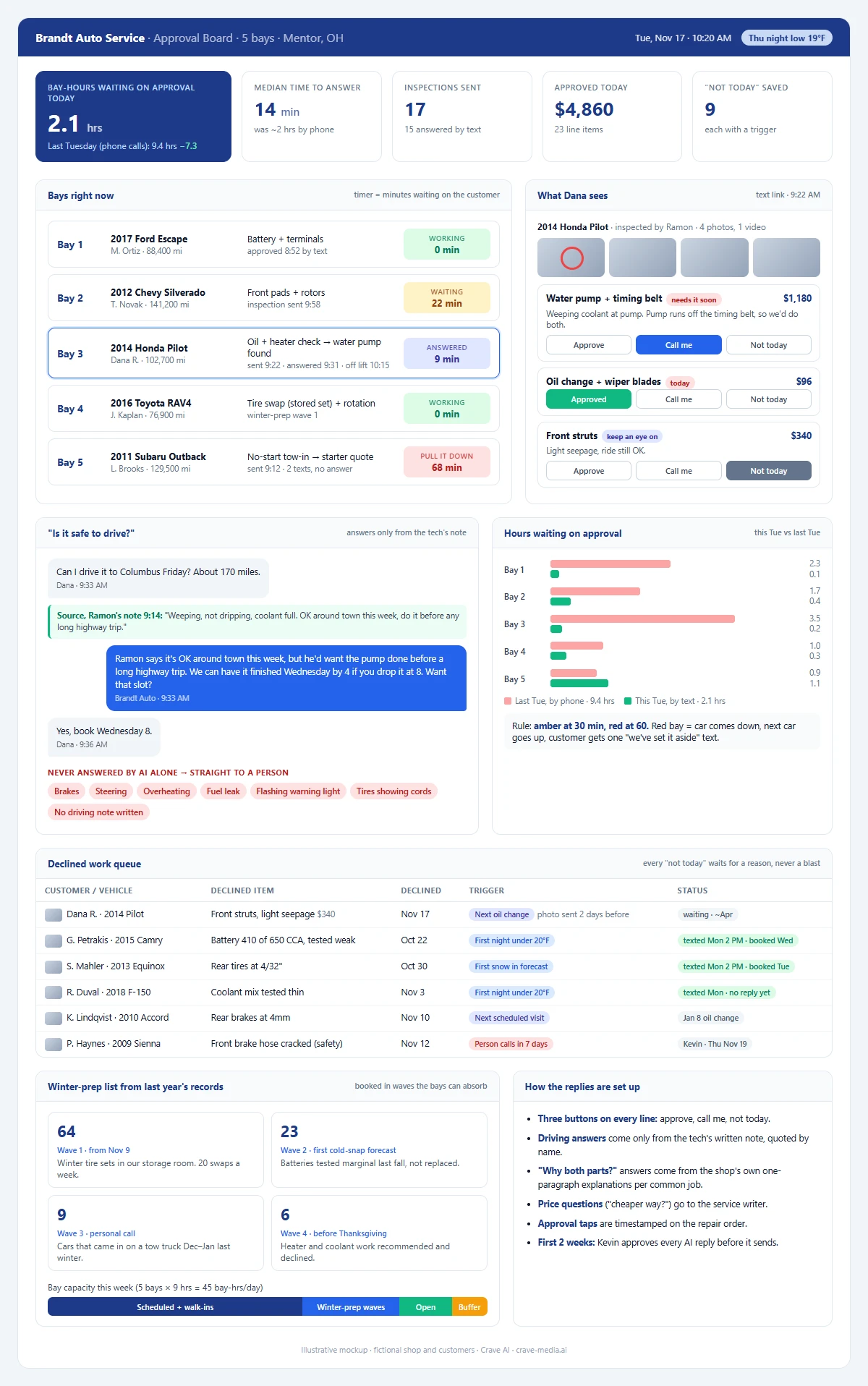
The approval board for a five-bay independent shop: which bays are tied up waiting on a customer, the inspection text the customer sees with three buttons, what the AI is allowed to say about driving the car home, declined work waiting for its trigger, and the winter-prep list pulled from last year's battery tests and tire records. Download as PDF
View interactive version
Why approvals stall in winter
Repair tickets run from about $100 for an oil service to $1,500 or more for real engine work. The big ones almost never get approved at the counter. They come up mid-job, with the car apart and the customer at work.
Winter stacks the deck. Cold mornings finish off weak batteries, the first snow sends people in about tires, and heaters that limped through October quit. A lot of those visits turn up a second problem, and every second problem means a phone call to someone who's in a meeting or driving a loaner.
Then there's trust. Customers walk in half expecting to be oversold, and a voice on the phone saying "your water pump's leaking" sounds exactly like the upsell they were bracing for. A dealership can lean on the brand. An independent shop has to earn it on every ticket, and a phone call where the customer can't see the part is a bad place to start.
The text-to-approve inspection
The first tool swaps the phone tag for a text. While the car's on the lift, the tech takes photos and a short video and writes plain notes. The service writer builds the estimate, and the customer gets a link showing:
- Photos, with the problem circled
- Each line item and its price, sorted into "needs it now," "soon," and "keep an eye on"
- The tech's note in plain English
- Three buttons on every item: approve, call me, not today
Most shop management systems already do the first half of this. Tekmetric, Shopmonkey, and others send digital inspections that customers approve line by line from their phone. If yours does, keep it. What we'd build sits around that inspection, and it decides whether the customer taps a button in four minutes or ignores the link until lunch.
The "not today" button is there on purpose. Give people an easy way to turn down the $340 struts and they're more likely to say yes to the $1,180 water pump, because they can see nobody's bundling. And every "not today" goes on a list you'll use later.
Texting also gives you a better paper trail. Ohio's auto repair rule gives customers the right to an estimate on jobs expected to cost more than $50, and the bill can't come in more than 10% over that estimate unless the customer approves the extra before the work is finished (Ohio Admin. Code 109:4-3-13). A timestamped tap on the repair order beats "talked to her 12:40, OK'd" in pen on the ticket. Other states have their own versions, so check yours.
"Is it safe to drive?"
That question shows up within a minute of almost every inspection text. It's also the one where an AI can do the most damage.
Our rule: the assistant answers only from what the tech wrote down. Say the note reads "weeping, not dripping, coolant full, OK to drive this week, recheck if temp gauge climbs." The AI can repeat that, credit the tech by name, and offer the earliest slot to bring it back. If the note says nothing about driving, the reply is "Ramon is checking and will text you in a few minutes," and Ramon gets a ping on the shop floor.
Some topics it never answers alone, even when the note looks clear. Brakes. Steering. Anything overheating or leaking fuel. A flashing warning light. Tires showing cords. Those go straight to a person, every time. One wrong "you're fine" on a brake job costs more than a year of saved phone calls.
The easier questions it can handle. "Why does the timing belt have to be done too?" comes from a short explanation your shop writes once for each common job. "Can it be ready by 5?" gets checked against the bay schedule. "Is there a cheaper way?" goes to the service writer, who knows whether there is.
The bay board
The second tool is a screen by the service desk. Every bay, what's on the lift, and how long that car has been waiting on a customer. The timer turns amber at 30 minutes and red at an hour.
In the moment, red means pull the car down and put the next one up. A lift holding an unapproved car isn't billing anyone. When that happens, the AI texts the customer once more: "We've set your Pilot aside so another car can go up. Reply YES anytime today and we'll have it done by 5."
Over a month, the board totals the waiting by bay and by service writer, which is the number most shops have never seen.
Declined work, timed to a reason
The shop software already saves declined items on the vehicle record. Nothing brings them back up at the right time, so in March the customer gets the struts done across town.
We'd give every declined item a trigger. Wear items that aren't urgent, like struts or rear brakes at 4mm, ride along to the next scheduled visit: two days before the appointment, the customer gets the original photo and a question about adding it, and the same appointment reminder automation handles the visit itself. Cold-weather items wait for the forecast. A battery that tested weak, wipers, coolant that tested thin, tires near the end. When the 10-day forecast shows the first night in the teens, those customers get a text that afternoon with their own photo and test result.
Safety items someone declined anyway get a phone call from a person a week later.
Nobody gets "Winter's coming, stop in for a check!" It's closer to the quote follow-up we'd build for an electrician, except that in a repair shop the follow-up date comes from the calendar or the weather, not a count of days since the quote.
Winter prep from last year's records
Once a year, around late October, the AI reads last winter's repair orders and pulls a list. Batteries that tested marginal and weren't replaced. Customers whose winter tires you sold or store. Cars that arrived on a tow truck in December or January. Heater and coolant work that got declined.
It's a short list, so you can book it in waves your bays can absorb. Twenty tire swaps a week, starting with the sets in your storage room, beats two hundred texts on the first snowy Monday.
A week at Brandt Auto Service
Brandt Auto Service is a fictional five-bay independent shop in Mentor, Ohio, a few miles off Lake Erie, where the first lake-effect snow often beats Thanksgiving. Carla owns it. Kevin writes service, and three techs share the bays.
On Monday, November 16, the forecast shows 19 degrees for Thursday night. By 2 PM the AI has texted 34 customers with declined cold-weather items. Eleven book for Tuesday or Wednesday, most of them batteries.
At 9:05 Tuesday, Ramon has a Pilot up in bay 3 with the water pump leak. He takes four photos, writes "weeping, not dripping, coolant full, OK around town this week, do it before any long highway trip," and Kevin has the estimate out by 9:22. The owner, Dana, opens it at 9:31 at her desk. She taps "call me" on the water pump and asks whether she can drive to Columbus on Friday. The AI quotes Ramon's note back to her, word for word, and offers Wednesday at 8 so the Pilot is done before the 170-mile drive. Dana approves the oil change and wiper blades, taps "not today" on the struts, and books the pump and timing belt for Wednesday.
The Pilot is off the lift by 10:15, and bay 3 does a battery and a brake job before lunch. The struts go on her record, photo attached, pinned to her spring oil change. At close on Tuesday, the board shows 2.1 hours of bay time spent waiting across all five bays. The Tuesday before, on the phone, it was 9.4.
Where AI tools fit in your repair shop
Repair orders, inspections, parts, and invoicing stay in your shop management system. We'd connect that system to your texting number, a weather forecast feed, and a short document of tech-written explanations for common jobs, then build the safe-to-drive replies, the triggers, and the winter list as automations on top. Shops tempted to switch platforms just for AI features should read our take on adding AI to the software you already have first.
Kevin approves every AI reply for the first two weeks. Mostly what he learns is which techs write notes the AI can use and which write "leaking, see me." The fix is a habit: one line on driveability per inspection.
The same assistant can pick up after-hours texts, too. Our industry notes put roughly a third of repair inquiries after closing, usually someone whose car just made a new noise. It checks the vehicle history and offers a morning drop-off, which is the lead follow-up half of the system.
Who should skip it
A two-bay shop where customers wait in the lobby doesn't need a bay board. The customer is twenty feet away. If your writer already gets approvals in minutes, the inspection your software sends is enough.
Four or more bays, customers who drop off and go to work, one writer covering both the phone and the counter: that's where the hours leak. Our page on AI for auto repair shops covers the service-history and maintenance-reminder side.
Make "not today" easy
Owners usually balk at the third button. Letting customers decline with one tap feels like handing them the exit. We think it does the reverse. Dana said no to the struts without an awkward phone call, so she believed Ramon about the water pump, and the struts are sitting on her record with a photo for April.
Send us a week of repair orders and we'll show you how many bay-hours your shop spent waiting on a phone to ring. Tell us about your shop.

About the author
Zac Spencer is an online marketing specialist and the owner of Crave Media, based in Salt Lake City, Utah. Since 2013 he has managed hundreds of Google Ads accounts across dozens of industries — with budgets from a few hundred dollars to $250K a month — and founded Crave AI to build custom AI tools and automations for local service businesses.