

The AI tool a roofing company needs after every storm
A hailstorm hits your service area on a Tuesday night. By Wednesday morning, your phone starts ringing at 6 AM and doesn't stop. You get 85 calls before lunch. Your office manager is writing names on sticky notes, your sales guys are texting from the field, and everyone's promising callbacks that may or may not happen.
By Friday, half those leads have already called someone else. You don't know which ones got estimates, which ones are waiting on insurance, and which ones fell through the cracks entirely. Sound familiar?
This is the single biggest revenue leak in roofing. Most roofing companies lose around 60% of storm leads because they can't follow up fast enough. Not because they don't care. Because 85 leads in a day is physically impossible to manage with a clipboard and a cell phone.
AI tools for roofing companies can fix this problem. Not with some vague "optimization platform," but with a specific tool: a storm damage lead pipeline that tracks every lead from first contact through completed install.
Here's what that looks like.
What a storm lead pipeline does
Think of it as a board where every storm lead sits in a column based on where they are in the process. New leads on the left. Completed jobs on the right. Everything in between is visible, sortable, and tracked.
The columns look like this:
- New Leads -- someone called, filled out a form, or got referred. No one's talked to them yet.
- Inspection Scheduled -- you've got an appointment on the books.
- Estimate Sent -- your sales rep did the inspection and sent the homeowner a number.
- Insurance Review -- the homeowner filed a claim and you're waiting on the adjuster.
- Approved / Ready to Book -- insurance approved it, the homeowner said yes, and you need to schedule the work.
- Completed -- roof's done, final invoice sent.
Every lead has a card. The card shows the homeowner's name, address, contact info, when they first called, what the estimated job value is, and a timeline of every interaction. Every call, text, email, and note from your team lives on that card.
This isn't a CRM with 400 features you'll never use. It's one screen that answers the question every roofing company owner asks after a storm: where do we stand?
The storm hits at 85 leads
Let's walk through what this looks like in practice.
Tuesday night, a hailstorm rolls through your county. Wednesday morning, leads start pouring in. Some come through your website form. Some call your office line. Some text a number they found on your yard signs. A few come from Angi or HomeAdvisor.
Without the pipeline, your office manager is juggling a spreadsheet, a phone, and prayer. With it, every lead lands in the "New Leads" column automatically, no matter where it came from. Web form, phone call, text message, third-party lead -- they all end up in the same place.
By Wednesday afternoon, you've got 85 leads on the board. This is where the AI part starts working.
The system sends every new lead an immediate text: "Hi [name], this is [Your Roofing Co]. We got your message about storm damage. We're scheduling inspections this week. Can you confirm your address so we can get you on the calendar?"
That text goes out within 60 seconds. While your team is on the phone with one person, the other 84 are getting a response. Nobody's sitting in silence wondering if you got their call.
About 40% of those leads come in after business hours. A homeowner notices damage when they get home from work at 7 PM, fills out a form, and expects... nothing until morning. Instead, they get a text in under a minute confirming their request and asking a couple of qualifying questions. That's the difference between getting the job and losing it to the company that responded first.
Moving leads through the pipeline
As your team works through the leads, cards move across the board. Your sales rep goes to a house for an inspection and updates the card to "Inspection Scheduled" from his phone. After the inspection, he sends an estimate and moves the card to "Estimate Sent." Each move is timestamped. Nothing slips.
This is where the pipeline gets more useful than any spreadsheet you've tried. At any point, you can look at the board and see:
- 23 new leads that haven't been contacted yet (your morning priority)
- 12 inspections scheduled for this week
- 34 estimates sitting with homeowners
- 18 jobs waiting on insurance adjusters
- 8 jobs approved and ready to book
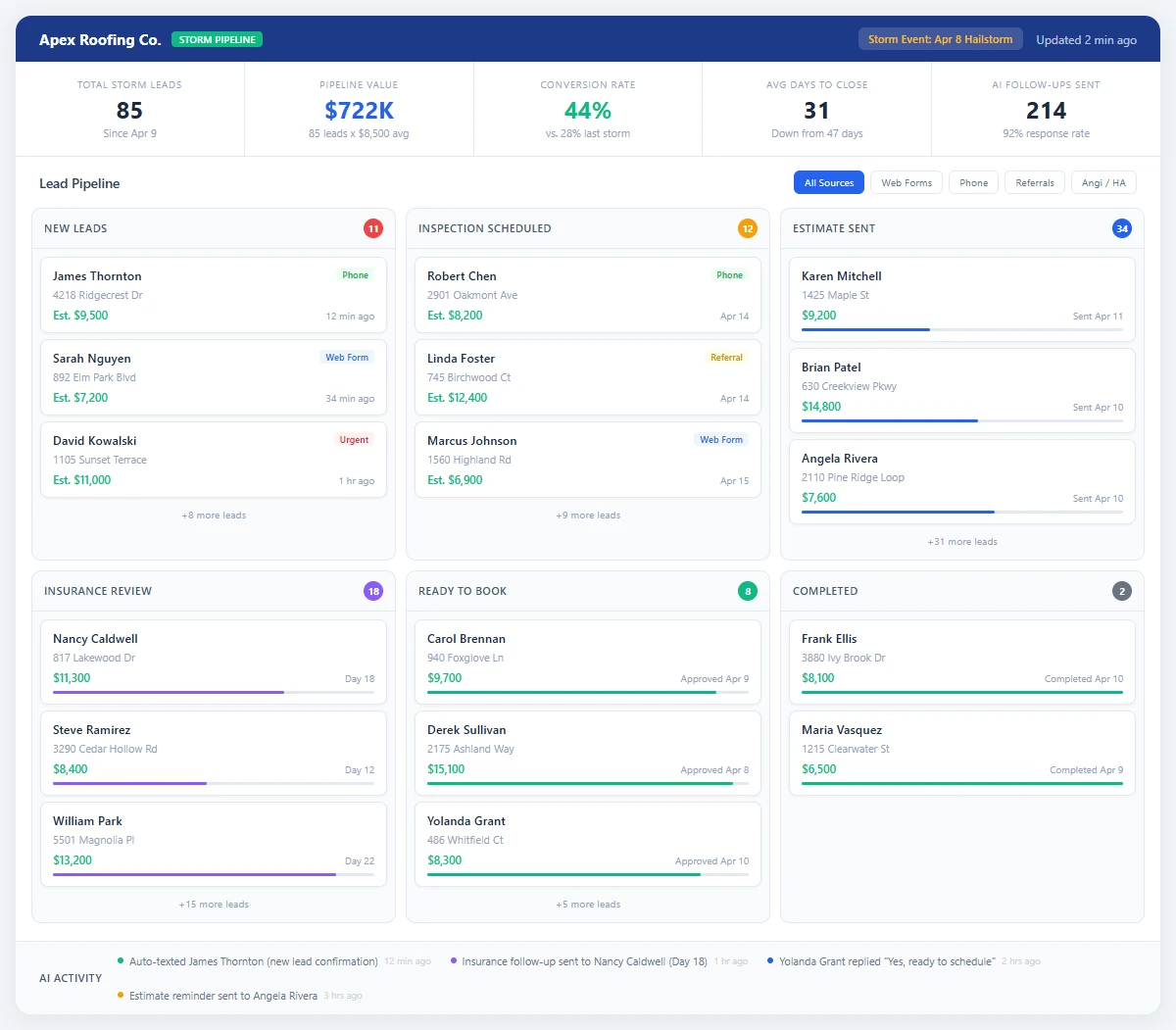
The Storm Damage Lead Pipeline dashboard we'd build for a roofing company: every lead captured, qualified, and tracked from first contact through signed contract with real-time response time monitoring. The data is fictional, but the layout and stages are based on how roofing companies actually move leads through the process. Download as PDF
View interactive version
Those numbers tell you exactly where to focus. If estimates are piling up and nobody's following up, you can see that. If insurance reviews are taking three weeks and you've got 18 of them, you know your install schedule is about to get busy.
The dashboard shows totals at the top: total active leads, pipeline value (add up all the estimated job amounts), average days from first contact to completed job, and conversion rate. For a typical storm surge, you might see something like $1.2 million in pipeline value across 85 leads, with an average ticket of $8,500 per roof.
The insurance follow-up problem
Insurance is where roofing leads go to die. The typical sequence goes like this: homeowner files a claim, adjuster takes two to four weeks to show up, adjuster approves or denies, homeowner needs to make a decision, and then they need to schedule the work.
That's a lot of waiting. And during the waiting, your lead goes cold. They forget about you. Another roofer knocks on their door. They get busy with life and the roof becomes a "next month" problem that turns into a "next year" problem.
The AI follow-up system handles this without your team lifting a finger. For a lead sitting in the "Insurance Review" column, it runs a sequence like this:
- Day 3: "Hi Karen, just checking in on your insurance claim for the roof at 1425 Maple. Any word from your adjuster yet? Let us know if you have questions about the process."
- Day 10: "Hi Karen, insurance adjusters typically schedule inspections within 2-3 weeks of a claim. If you haven't heard from yours, it might be worth calling [claim number] to check on the status."
- Day 18: "Hi Karen, we wanted to see if there's an update on your claim. Once the adjuster approves, we can usually get you on the install schedule within 2 weeks."
- Day 25: "Hi Karen, have you heard back from your adjuster? We've got some openings on our install calendar coming up and want to make sure we hold a spot for you."
Each message is specific to where they are in the process. It answers questions they probably have. It doesn't feel like a robocall because it references their actual address and their actual claim.
When Karen texts back "adjuster approved us yesterday," the system flags her card for your team and moves it to "Approved / Ready to Book." Your office manager gets a notification: "Karen Mitchell at 1425 Maple is ready to schedule. Insurance approved. Estimated job value: $9,200."
That's a $9,200 job that would have disappeared into your spreadsheet without this follow-up. Multiply that by the 18 leads in insurance review and you're talking about real money.
What happens to the leads you'd normally lose
Let's run the numbers on a real storm surge. You get 85 leads. Without a pipeline and automated follow-up, industry averages say you'll close about 25-30% of them. That's roughly 22 jobs.
With the pipeline tracking every lead and the AI following up at every stage, you're looking at closing 40-50% instead. That's 38 jobs. Sixteen more roofs than you would have done otherwise.
At an average of $8,500 per roof, those 16 extra jobs are $136,000 in revenue from a single storm event. That's not a hypothetical multiplier. It's what happens when you stop losing leads to slow follow-up and forgotten callbacks.
The leads you lose aren't going to nobody. They're going to whichever roofer responds faster. If you text back in 60 seconds and your competitor calls back tomorrow, you win. If you follow up during the insurance process and your competitor sends one estimate and never reaches out again, you win.
Connecting to how you already work
This isn't meant to replace everything you're doing. It's meant to organize it.
Your sales reps still do inspections and send estimates. Your office manager still schedules installs. Your crews still do the work. The pipeline just makes sure nothing falls through the gap between those steps.
The tool integrates with what you already use:
- Your phone system: Calls and texts automatically create or update lead cards.
- Your estimating software: When you send an estimate, the card updates.
- Your calendar: Scheduled inspections and installs show up on the card timeline.
- Google Business Profile: Review requests go out automatically after completed jobs.
Your morning routine changes from "check the spreadsheet and figure out what happened yesterday" to "open the dashboard and see exactly where everything stands." Your weekly sales meeting goes from "who remembers which leads we're waiting on" to looking at the board and knowing.
Seasonal timing matters
Storm season doesn't wait for you to get organized. If you're reading this in early spring, you've got time to set this up before the first big storm hits. If you're reading this after a storm just rolled through, you already know the pain.
The companies that win storm season aren't the ones with the biggest crews or the lowest prices. They're the ones that respond to every lead, follow up through the insurance process, and don't let a single qualified homeowner slip away.
A custom dashboard like this takes a few weeks to build and connect to your existing systems. Once it's running, it handles the next storm automatically. Your team focuses on inspections, estimates, and installs. The pipeline handles everything in between.
The competitive gap is right now
Most roofing companies are still running on spreadsheets, notepads, and memory. Some use a generic CRM that wasn't built for roofing and doesn't understand the insurance workflow. Very few have anything purpose-built for the way a storm surge actually works.
That gap is your opportunity. The roofing company in your market that builds this first gets every advantage: faster response times, better follow-up, higher close rates, and a clear view of their business that nobody else has.
Eighty-five leads after a storm is a great problem to have. Losing half of them to slow follow-up is a problem you can fix.
If you're running a roofing company and want to see what a storm lead pipeline would look like for your business, that's what we build.

About the author
Zac Spencer is an online marketing specialist and the owner of Crave Media, based in Salt Lake City, Utah. Since 2013 he has managed hundreds of Google Ads accounts across dozens of industries — with budgets from a few hundred dollars to $250K a month — and founded Crave AI to build custom AI tools and automations for local service businesses.