

How to use AI to stay busy during your slow season
Every service business has a stretch where the phone stops ringing. For an HVAC company it's the mild weeks of spring and fall. For a landscaper it's January. Pool guys dread October, roofers dread the quiet between storms, and pest control slows down the second it gets cold. The work doesn't disappear forever. It just goes quiet long enough to make payroll feel heavy.
The frustrating part is that the fix is usually sitting in your own files. You don't need more ads or a bigger territory to get through a slow season. You need to reach back out to the people who already hired you once, the quotes that never closed, and the customers who'd happily sign up for a maintenance plan if anyone asked. That's repetitive, perfectly-timed outreach, and it's exactly the kind of thing AI automation handles for service businesses without you hiring a person to do it.
We build custom automations for service businesses, and the slow-season version comes down to four plays that all run off your existing customer list.
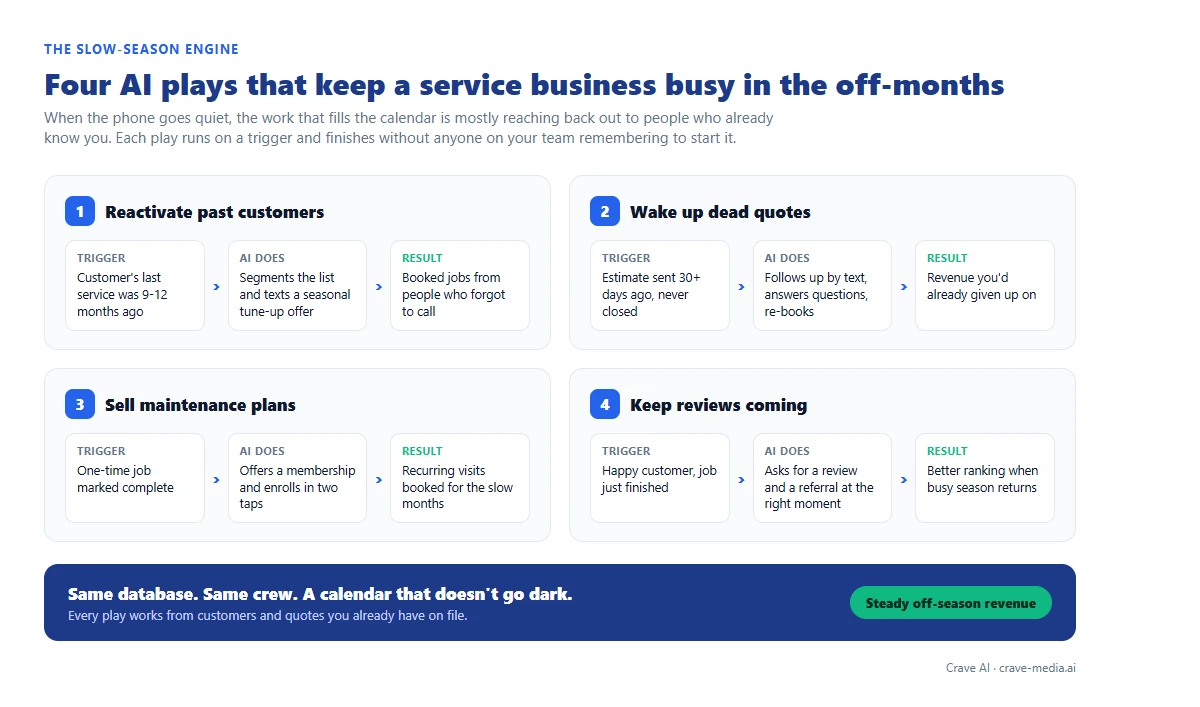
Four slow-season plays that all work from customers and quotes you already have on file. Each one fires on a trigger and finishes without your team starting it. Download as PDF
View interactive version
Reactivate the customers you already have
Your customer list is the most valuable thing your business owns, and most companies do nothing with it between jobs. Someone bought a water heater from you eighteen months ago. They liked the work. Then you never spoke to them again, and the next time they needed a plumber they Googled one.
A reactivation automation works the list for you. It looks at who you last served and when, sorts them by service type, and sends a seasonal message to the people who are due. An HVAC company can text everyone whose last tune-up was a year ago, right before the shoulder season when the techs have open slots. A landscaper can reach last spring's cleanup customers in February, before the calendar fills.
The message is short and feels personal because the system already knows the history:
"Hi Karen, it's been about a year since we serviced your AC. We've got openings for spring tune-ups before the summer rush hits. Want me to grab you a morning slot? - Comfort Air"
The customer didn't go looking. You showed up at the moment they would have eventually thought about it anyway. For a business with even a few hundred past customers, working that list during a slow month tends to book more jobs than anything else you could do.
Wake up the quotes that never closed
Think about every estimate you've sent in the last year that went nowhere. The customer got busy, or they were price-shopping, or they meant to call back and forgot. Most service businesses let those quotes die in a folder. That's money you already did the work to earn and then walked away from.
An automated follow-up sequence keeps those quotes alive. When an estimate passes 30 days with no booking, the system reaches out, asks if they still need the work done, and offers to answer any questions or get them on the schedule. It's not pushy. It's the polite nudge a good salesperson would do if your salesperson weren't already swamped.
The slow season is the perfect time to run this, because you've got the capacity to take the work that comes back. Some of those cold quotes turn into booked jobs with nothing more than a "are you still thinking about that fence?" text. We walk through the mechanics of this kind of timed outreach in our piece on the five workflows every service business should automate.
Turn one-time jobs into recurring revenue
The whole reason a slow season hurts is that your revenue is lumpy. You eat well in the busy months and starve in the quiet ones. Maintenance plans smooth that out, because a membership customer is a visit you've already got booked when the calendar would otherwise be empty.
The hard part has always been selling them. Asking every customer to sign up for a plan, tracking who said yes, remembering to schedule their visits, it's a lot of follow-through that falls apart when the team gets busy. Automation handles the asking and the tracking. When a one-time job is marked complete, the system offers the customer a plan that fits what they just had done and lets them enroll in a couple of taps.
"Glad we could get your drains cleared today, Mike. Customers on our home plan get two priority visits a year and skip the trip fee. Want me to set that up? It's $19/month."
Then the recurring visits schedule themselves, and those visits land in your slow months by design. A pest control or HVAC company that converts even a quarter of one-time jobs into plans builds a base of off-season work that didn't exist before. This is the same retention logic we broke down for pest control companies, and it applies to any business with repeat service.
Keep reviews and referrals flowing
Slow season is also when your online presence either grows or goes stale. The companies that show up first when busy season returns are the ones that kept collecting reviews while everyone else went dark.
An automated review request goes out a couple of hours after a job is finished, while the customer is still happy and still has their phone in hand. One tap and they're on your Google page. The same flow can ask your best customers for a referral, since a happy customer in March is just as willing to recommend you as one in July. Nobody on your team has to remember to send any of it.
The payoff isn't immediate, and that's fine. The reviews you bank during the quiet months are what push you up the map pack right when demand climbs again. You're using the slow time to set up the busy time.
What it takes to set up
None of this requires ripping out your current systems. The plays run on top of what you already use.
You need a customer list that's organized enough to sort by service type and last service date, which most field service software (Jobber, Housecall Pro, ServiceTitan) already tracks. You need a texting platform to send the messages, and an AI layer that reads each customer's history, writes a message that fits, and books the result back into your calendar. A company sending a few hundred reactivation texts a month usually spends somewhere around $50 to $100 in messaging costs to do it.
The build itself is a few days of setup, not a software project that drags on for months. Once it's running, it runs on its own.
Where to start
Don't try to launch all four at once. Pick the one that maps to the revenue you're losing fastest.
If you've got a big customer list and you're not touching it, start with reactivation. If you send a lot of estimates that don't close, start with quote follow-up. If your revenue swings hard between seasons, maintenance plans are the long-term fix because they put guaranteed work on the calendar. Reviews and referrals can layer in anytime, and they cost you almost nothing to run.
The thread tying all of it together is that a slow season is rarely a demand problem. It's a follow-up problem. The customers are out there, the quotes are in your folder, and the people who'd join a plan are waiting to be asked. Your team is busy doing the actual work. Let the automation handle the remembering. If you want help figuring out which play would move the needle for your business, reach out for a free look at your setup and we'll talk through it.

About the author
Zac Spencer is an online marketing specialist and the owner of Crave Media, based in Salt Lake City, Utah. Since 2013 he has managed hundreds of Google Ads accounts across dozens of industries — with budgets from a few hundred dollars to $250K a month — and founded Crave AI to build custom AI tools and automations for local service businesses.