

How missed call text back works for service businesses
You're elbow-deep in a water heater swap when your phone buzzes in your pocket. By the time you're somewhere you can answer it, the ringing has stopped. No voicemail. Just a number you don't recognize and a job you'll never know you lost.
That call was probably a homeowner with a problem and a budget. Most people calling a service business don't leave voicemails anymore. They hang up and dial the next company on the list, and whoever picks up gets the work.
Missed call text back is the automation built for exactly this moment. When a call goes unanswered, the system sends the caller a text within seconds, before they've finished dialing your competitor. It's one of the simplest automations a service business can run, and for phone-heavy trades it tends to pay for itself faster than anything else we build.
What missed call text back does
Any call you don't answer triggers an instant, personalized text message to the caller. Something like "Hey, this is Mike's Plumbing. Sorry we missed you! What can we help with?"
That one text changes the situation completely. The caller was about to become a stranger who tried you once. Now they're in a conversation with your business. They'll usually reply with what they need, because the problem is still sitting right in front of them. And once they've replied, they've mentally filed you as "the company I'm talking to" instead of "the company that didn't answer."
The text arrives while they're still holding their phone. That timing is the whole trick. We wrote about why the first few minutes decide who wins the job, and a missed call is the most extreme version of the problem: the lead doesn't sit in an inbox for three hours, it walks away in about ninety seconds.
The real cost of a missed call
Nobody tracks the jobs that ring out. They don't show up in your CRM or your ad reports. The only evidence is a call log full of two-ring entries from numbers that never called again.
Do some rough math on yours. Pull last month's call log and count the unanswered calls from numbers you don't know. If even a third of those were real prospects, and your average job is worth a few hundred dollars, the leak is probably bigger than your ad budget. You paid to make the phone ring, then lost the job at the last step because you were on a ladder.
An answering service is one fix, and for some businesses it's the right one. We compared the options in our post on AI answering services versus lead follow-up. But a live answering layer costs real money every month and still hands you a message you have to act on. Text back is cheaper, faster to set up, and puts the caller directly into a conversation instead of a queue.
The workflow, step by step
A missed call text back flow has five moving parts, and most of them run without anyone touching them.
It starts with the trigger. Your phone system knows when a call rang and nobody picked up, whether that's after four rings, on a busy signal, or straight to voicemail after hours. That unanswered call fires the automation.
Next comes a filter. The system checks the number against your contacts and recent jobs. Your supplier and the customer you talked to an hour ago don't get the automated text. New and unknown numbers do.
The first text goes out within about thirty seconds. It apologizes for missing them, says who you are, and asks what they need. Short and human. No links, no menu of options, no "press 1" energy.
When the caller replies, AI takes over the qualifying: what's the problem, where are they located, how urgent is it. If the reply says "water is coming through my ceiling," the system flags it as an emergency and calls your on-call tech instead of continuing to chat. If it's routine, it offers appointment slots straight from your calendar.
The last step is the handoff. Your team gets the full thread, the qualification answers, and a booked time on the schedule. Nobody has to piece together what happened from a voicemail transcript.
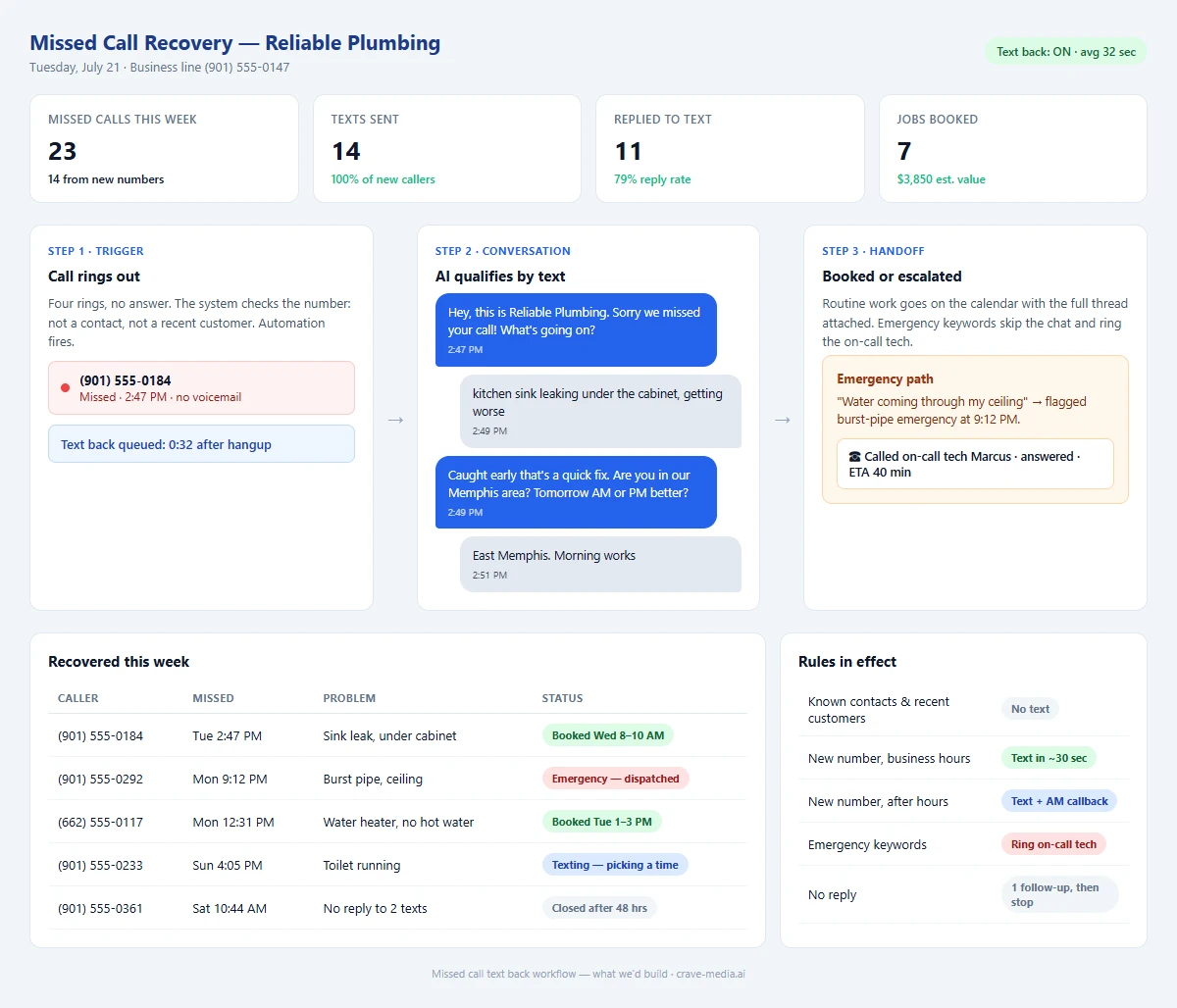
The full missed call text back flow: the unanswered call fires a text in about thirty seconds, AI qualifies the reply and books the job, true emergencies escalate to a live call, and the dashboard shows how many missed calls turned back into booked work. Download as PDF
View interactive version
What the conversation looks like
Show beats tell, so here's a real-shaped example for a plumbing company:
Text (32 seconds after the missed call): Hey, this is Reliable Plumbing. Sorry we missed your call! What's going on, and we'll get you taken care of.
Caller: my kitchen sink is leaking under the cabinet, not an emergency but its getting worse
AI: That's no fun. Under-cabinet leaks usually mean a supply line or drain fitting, and it's a quick fix when it's caught early. Are you in our Memphis service area? And does tomorrow morning or afternoon work better for a visit?
Caller: East Memphis. Morning works
AI: You're all set for tomorrow between 8 and 10 AM. You'll get a text when your plumber is on the way. Anything else we should know about the sink?
Four messages, maybe three minutes of the caller's time, and a job is on the books. The office finds a scheduled appointment with the address, the problem, and the full conversation attached. Compare that to a voicemail that says "uh, yeah, call me back about a sink thing" from a number that stops answering by dinnertime.
The tone matters as much as the speed. If the texts read like a robot, people disengage. We covered how to keep automated texting human in our piece on AI SMS follow-up that doesn't sound like a robot, and every rule there applies double when the person just watched you not answer the phone.
What it takes to set up
The basic version is genuinely light. If your business number runs through any modern phone platform, the missed-call trigger and a static text back can be live in an afternoon. Even that stripped-down version, one fixed message with no AI behind it, recovers callers you're currently losing outright.
The version that books jobs takes more wiring. The AI conversation layer needs your service list, your service area, your calendar, and your rules for what counts as an emergency. It has to know that "no hot water" is a today problem and "my faucet drips" is a this-week problem. That's the part we build custom as automated lead follow-up, because the qualifying questions for a plumber, a roofer, and an electrician are different, and generic scripts feel generic to the person texting back.
Business-hours logic is worth getting right, too. A text at 2 PM can offer "later today." A text at 11 PM should acknowledge the hour, promise a morning call, and still ask about the problem so the qualification happens while the lead is warm. Our post on after-hours lead automation walks through what that nighttime flow should do.
When you need it, and when you don't
If you or your techs answer the phone yourselves while working, you need this. Solo operators and small crews miss the most calls by nature of the work, and they feel each lost job the most. Same if your call log shows a pile of unanswered after-hours calls, which is normal for emergency trades.
If you have a staffed front desk that answers nearly everything during business hours, the payoff shrinks, and text back becomes a safety net for lunch breaks, sick days, and nights. Still worth having, but it won't transform your pipeline.
And if most of your inbound calls are existing customers with account questions, the contact filter handles them fine, but the recovered-revenue math gets thinner. This automation earns its keep on new business. The more your phone is your lead source, the more an unanswered ring costs you, and the more this one flow gives back.
Stop losing jobs to voicemail
Every service business misses calls. The difference is what happens in the next thirty seconds. For most companies the answer is nothing, and the caller quietly books with someone else. A missed call text back flow makes the answer automatic: the caller hears from you before they've moved on, the job gets qualified and scheduled, and your call log stops being a list of leads you'll never meet.
If you want to know how many jobs your missed calls are costing you, pull up last month's call log and count the unknown numbers that never called back. Then talk to us about what a text-back flow would look like for your business. The phone is already ringing. This just makes sure the ones you can't grab still turn into work.

About the author
Zac Spencer is an online marketing specialist and the owner of Crave Media, based in Salt Lake City, Utah. Since 2013 he has managed hundreds of Google Ads accounts across dozens of industries — with budgets from a few hundred dollars to $250K a month — and founded Crave AI to build custom AI tools and automations for local service businesses.