

AI tools for a pressure washing business in peak season
Pressure washing might be the most seasonal trade we work with. Most companies make the bulk of their annual revenue between March and September, and then the phone goes quiet until spring. That math changes how every decision works. A slow week in July isn't just a slow week. It's revenue you don't get back in January.
So when we think about AI tools for a pressure washing business, we don't start with anything exotic. We start with the two numbers that decide whether a season was good or great: how full your calendar was during the window, and how much each job was worth once your trailer was already parked in the driveway.
This post walks through what we'd build for a pressure washing company heading into (or fighting through) peak season. As with all of our blueprint posts, this isn't a case study. It's the plan we'd draw up if you walked in the door.
The season is short and the upsell is the profit
A driveway cleaning might run $175. A driveway plus a house wash plus the back deck runs closer to $380 or more, and it happens on the same trip, with the same fuel and the same drive across town. The bundled job is more than twice the revenue for maybe forty percent more work.
That's the core economics of this trade. Your cost structure is dominated by getting a rig and a person to a property. Once you're there, every additional surface is close to pure margin. The companies hitting real numbers are the ones converting one-surface calls into whole-property jobs. Lead volume has less to do with it than most owners assume.
And yet most owners can't answer basic questions about it. What percentage of your driveway-only customers ever added a house wash? What's your average ticket for bundled jobs versus single-surface jobs? Which upsell offer converts, and which one gets ignored? If you're running your season from a paper calendar and a text thread, you're guessing.
What we'd build first, a seasonal revenue planner
The first thing we'd put in front of a pressure washing owner is a dashboard we call a seasonal revenue planner. It's not complicated, and that's the point. It pulls from your booking calendar and job records and answers the questions that matter in a trade where the year is decided in six months.
The main view shows your booking pipeline by month: jobs on the books and projected revenue, charted against the same month last year. If it's April 20th and May is pacing 30% behind last May, you want to know that with time to fix it, not in June when the month is already written.
Next to that sits average job value by surface type. Driveways, house washes, decks, roofs, commercial flatwork. You see instantly which services carry the season and which ones fill gaps. Then the number we'd argue matters most: your upsell conversion rate. Of everyone who booked one surface, how many added a second once you offered it?
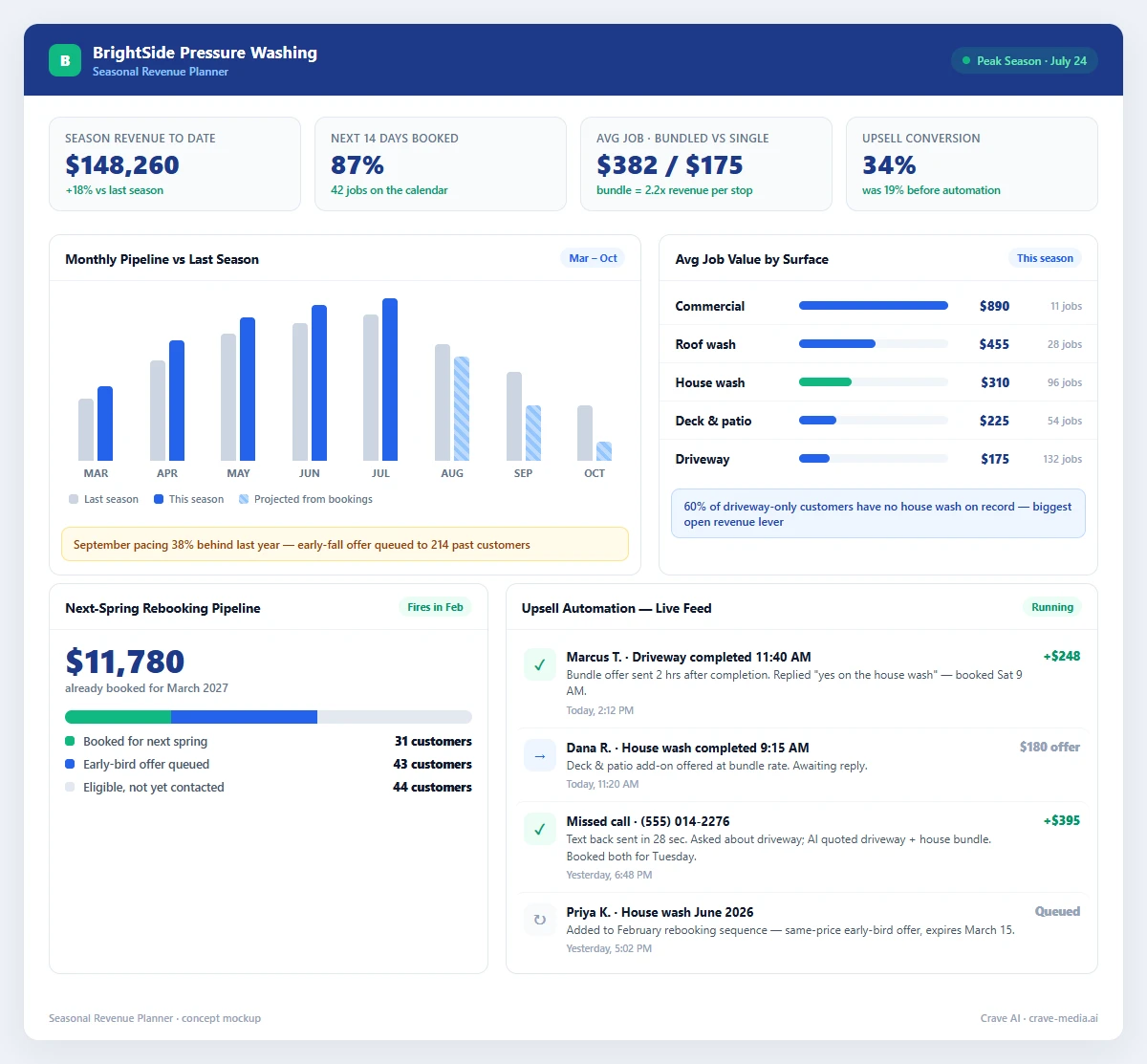
The seasonal revenue planner we'd build for a pressure washing company: monthly pipeline pacing against last season, job value by surface, upsell conversion, and the rebooking pipeline that fills next spring before it arrives. Download as PDF
View interactive version
The planner surfaces expensive gaps quickly. Say it shows that 60% of your driveway-only customers never added a house wash, and your bundled average is $380 against $175 for driveways alone. That gap, multiplied across a season of jobs, is usually the biggest single revenue lever in the business. Bigger than more ad spend. Bigger than a second crew.
The upsell that sends itself
Knowing your upsell rate is step one. Moving it is where the automation comes in.
Picture the flow. Your crew finishes a driveway cleaning and marks the job complete in the app. Two hours later, while the customer is still admiring the clean concrete, they get a text: "Your driveway turned out great! While we were there we noticed the siding could use some attention. Since we already know your property, we can bundle a house wash at 20% off. Want a quote?"
No salesperson made that call. Nobody on your team had to remember. The timing does the selling, because the customer is looking at the sharpest before-and-after contrast they'll ever see: their bright driveway against their dingy siding.
When the customer replies, the AI handles the conversation. It confirms the square footage from the original quote, offers two available slots from your real calendar, and books the job. If the customer asks something it can't handle, it hands the thread to you with full context. This is the same lead follow-up machinery we build for other trades, pointed at your existing customers instead of new leads, which is where pressure washing margins live.
The same logic runs at the front of the funnel too. During peak season you're on a wand most of the day, and roughly 30% of calls to pressure washing companies come in when nobody can answer. A missed call text back flow catches those, asks what surfaces they're looking at, and quotes the bundle from the start. The upsell works even better before the first job than after it: "Most driveway customers add the house wash while we're there. Want pricing for both?"
Booking next spring before this fall ends
The second automation we'd build attacks the other seasonal problem: the cold start every March.
Every completed house wash gets a rebooking sequence attached. The following February, before your competitors have taken the covers off their rigs, past customers get a text: "Spring's coming. Want us to put you on the schedule before it fills up? Same property, same price as last year if you book by March 15."
Some percentage of those book on the spot. Now look at what that does to your season. Instead of starting March with an empty calendar and a pile of ad spend, you start with your best weeks already anchored by repeat customers you spent zero dollars acquiring. New leads then stack on top of a base instead of building the whole season from scratch. We walked through the same principle for movers in our post on AI tools for a moving company in peak season: in a compressed season, the winner is usually decided before the season starts.
The planner tracks this as its own pipeline. You can see in January how much of next season is already booked, which is the kind of number that changes whether you buy that second trailer.
How it fits what you already run
None of this requires replacing your systems. If you're scheduling through Jobber, Housecall Pro, or a shared Google Calendar, the planner reads from what's already there. The texting automations connect to your existing business number. Job completion can trigger from your field app or from a one-tap text your crew sends when they pack up.
That last part matters for a trade where the whole company is often two people and a trailer. If an automation requires your crew to learn new software, it dies by week two. The versions of this that work are nearly invisible: crew marks the job done the way they always have, and the follow-up, the review request, and next year's rebooking all fire on their own. We covered the broader pattern in how to automate review requests without being annoying, and the same design rule applies here. The automation adapts to the crew, never the other way around.
Winter is the other half of the fit. The same system that runs your peak-season upsells can run slow-season re-engagement from November to February, pitching gutter add-ons and the commercial contracts that book year-round. The machine doesn't take the winter off just because the wand does.
What this looks like against your competitors
Most pressure washing companies treat every job as a one-and-done transaction. They clean the driveway, collect the check, and hope the customer remembers them in two years. No follow-up, no rebooking. Their entire business restarts from zero every single spring.
Against that field, a company running this system compounds. Every job feeds the next one: the driveway funds the house wash offer, the house wash feeds next February's rebooking list, and the rebooking list anchors a season that gets stronger every year. Same trucks, same crew. The difference is that nothing leaks.
If you want to see how we think about your trade specifically, the AI for pressure washing page breaks down the tools and automations we'd scope for a company your size. And if you'd rather just talk through your season, reach out and we'll walk through the numbers with you. Bring your call log from last July. That's usually where the money is hiding.

About the author
Zac Spencer is an online marketing specialist and the owner of Crave Media, based in Salt Lake City, Utah. Since 2013 he has managed hundreds of Google Ads accounts across dozens of industries — with budgets from a few hundred dollars to $250K a month — and founded Crave AI to build custom AI tools and automations for local service businesses.