

Google's AI Overview is answering your customers' questions. Are you in it?
Go to Google right now and search "why is my AC not cooling." Before you see a single blue link, before you see the map pack, there's a paragraph at the top of the page explaining possible causes, repair costs, and when to call a professional. That's Google's AI Overview, and it's already changing how your customers find you.
AI Overviews now appear in over 40% of local business queries, according to LocalFalcon's 2025-2026 tracking data. For informational questions about home services, that number climbs above 90%. When a homeowner types "how much does carpet cleaning cost" or "signs my water heater is failing," Google doesn't just show ten links anymore. It writes an answer and cites the businesses and websites it pulled from.
The businesses getting cited are picking up clicks. The ones that aren't are losing ground to competitors they might not even know about yet.
What AI Overviews are (and aren't)
If you've used Google recently, you've probably seen AI Overviews without realizing what they were. They show up as a block of text at the very top of search results, above the ads, above the map pack, above everything. Google's Gemini model writes these on the fly by pulling information from multiple sources across the web.
They're different from featured snippets. A featured snippet grabs a paragraph from one webpage and puts it in a box. An AI Overview reads dozens of sources, synthesizes the information, and writes something new. It might explain a problem, compare options, estimate costs, and then recommend a handful of local businesses, all in one answer block.
For service businesses, this matters because the AI Overview often answers the customer's question before they ever click on anything. Seer Interactive found that organic click-through rates dropped 61% on queries where AI Overviews appeared. But there's a flip side: businesses that get cited inside the AI Overview earn 35% more organic clicks than they were getting before. The traffic isn't disappearing. It's concentrating on the businesses Google trusts enough to cite.
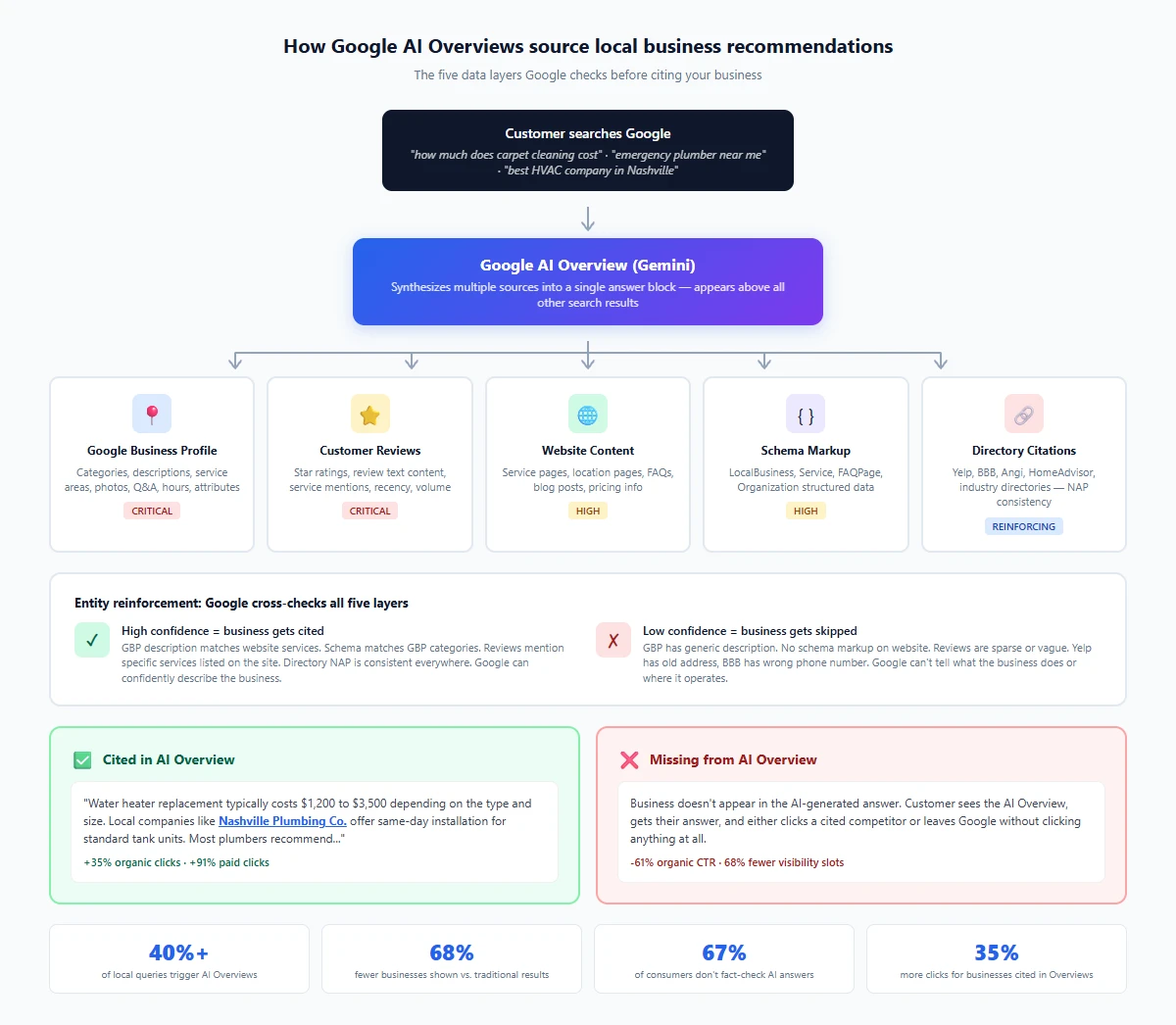
How Google's AI Overview assembles local business recommendations from five data sources. Businesses with gaps in any layer are less likely to be cited. Download as PDF
View interactive version
The five data sources feeding AI Overviews
Google's AI doesn't pull business recommendations from thin air. It checks five data layers, cross-references them against each other, and only cites businesses where the information lines up.
Google Business Profile
This is the single most important input. Your business name, categories, service descriptions, hours, attributes, photos, Q&A answers, and service areas all feed directly into how the AI understands your business. There's evidence of AI Overviews quoting GBP descriptions word for word. If your profile says "residential plumbing services" and nothing else, that's all the AI has to work with. If it says "emergency drain clearing, water heater installation, and sewer line repair in Nashville," the AI has specific services and a location to reference.
Customer reviews
Google's AI reads the actual text of your reviews, not just the star rating. When a customer writes "they replaced our tankless water heater the same day we called," the AI learns that you do tankless water heater replacements and that you offer same-day service. Ten reviews mentioning specific services teach the AI more about your business than a perfect 5.0 with nothing but "great job" attached to it.
Website content
Each service page on your site is treated as a separate data source. A plumbing company with individual pages for drain cleaning, water heater repair, sewer line inspection, and emergency services gives the AI five sources to pull from. A company with one combined "Our Services" page gives it one. The math is straightforward.
Schema markup
This is the machine-readable layer on your website that tells Google what your business is, what you offer, where you're located, and what areas you cover. We got into this in our schema markup post, and it matters even more for AI Overviews than for traditional search. When your schema data matches your GBP data, Google's confidence in your business goes up. When they conflict, Google skips you.
Directory citations
Yelp, BBB, Angi, HomeAdvisor, and industry-specific directories all reinforce your business as a real, consistent entity. AI systems evaluate what researchers call "entity reinforcement" — how consistently your business is described across independent sources. When your name, address, phone number, and service descriptions match everywhere, Google trusts the data. When they don't, you're less likely to appear.
Why proximity matters less than you'd think
In traditional local search, being physically close to the searcher is one of the strongest ranking factors. In AI Overviews, proximity has virtually no impact once a business is included.
Read that again, because it flips the usual logic. A well-optimized HVAC company across town can beat a poorly-optimized competitor who's two miles from the searcher. The businesses showing up in AI Overviews aren't necessarily the closest ones. They're the ones Google can confidently describe.
This also means the competition is broader. In the traditional map pack, you're mostly competing with businesses in your immediate area. In AI Overviews, you're competing with every business in your service area that has its data together. And because AI Overviews show 68% fewer businesses than traditional local packs, there are fewer spots to go around.
What customers see (and what they do with it)
When an AI Overview appears for a local service query, customers interact with it differently than they do with regular search results.
About 70% of users read the first few lines. Most don't scroll past the initial answer. If the AI Overview answers their question and recommends businesses, many customers take that recommendation without clicking through to compare ten listings. A BrightLocal study found that 67% of consumers don't fact-check AI-generated recommendations before choosing a local business. They read the overview, pick a name, and call.
This means the AI Overview is becoming the new first impression. Your Google Business Profile used to serve that function. Now, for a growing share of queries, customers are making decisions based on what Google's AI says about you before they ever see your GBP or website.
And the query types are shifting. In January 2025, 91% of queries that triggered AI Overviews were informational ("how to unclog a drain"). By October, informational had dropped to 57%, while commercial queries ("best plumber in Memphis") rose to 19% and transactional queries ("book AC repair near me") hit 14%. AI Overviews are showing up more often on the searches where customers are ready to spend money.
What you can do about it
Most of this comes down to giving Google clean, consistent, specific information about your business. Nobody getting cited in AI Overviews is doing anything exotic. They're doing the fundamentals well.
Fill out your Google Business Profile completely
Pick the most specific primary category (choose "Plumber" over "Home Services"). Add every relevant secondary category. Write a description that names your specific services and the cities you serve. Upload recent photos of your team, job sites, and completed work. Answer every Q&A entry. Post updates at least monthly. Half-filled profiles get half the attention.
Get reviews that mention specific services
Volume matters, but so does what the reviews say. Encourage customers to mention the service they received. "They replaced our water heater" is more useful to Google's AI than "five stars, great company." If you're not already sending automated review requests after each job, that's one of the simplest automations we build. It's the same review request system we designed for carpet cleaners, adapted for whatever field software you use.
Give every service its own page
Create individual pages for each service you offer. Each page should cover what the service is, how it works, who it's for, what's included, and what it typically costs. Create location pages for each city in your service area. Add FAQ sections that answer questions the way your customers would ask them. "How much does drain cleaning cost in Nashville?" is the kind of page that gets cited in an AI Overview.
Add or fix your schema markup
If you don't have LocalBusiness schema (or a subtype like Plumber, HVACBusiness, or Electrician) on your site, that's a gap. Add Service schema for each offering. Add FAQPage schema to your FAQ sections. Make sure the data in your schema matches what's in your Google Business Profile, because conflicts between the two cause Google to ignore both.
Match your directory listings
Check Yelp, BBB, Angi, HomeAdvisor, Facebook, and any industry directories for your trade. Your business name, address, and phone number need to match exactly everywhere. If you moved three years ago and your Yelp listing still has the old address, fix it. These mismatches seem trivial. They aren't.
The connection to traditional SEO
This isn't a separate project from your regular local SEO work. It's an extension of it. Everything that helps you rank in traditional local search also feeds AI Overviews. The difference is that AI Overviews are more selective about who gets in, and they're weighted more toward data consistency and content depth than raw backlink authority.
If you rank well in traditional search but your directory listings are inconsistent and your website has thin content, you might hold your position in the regular results while losing ground in AI Overviews. Cleaning up both is how you stay ahead.
We walked through a broader look at AI search visibility a few weeks ago covering ChatGPT, Gemini, and AI Overviews together. This post goes deeper on the Google side specifically. If you've already tackled the basics from that post, the Google Business Profile and schema work here is what to focus on next.
Where this is going
Google is expanding AI Overviews aggressively. They're live in over 200 countries and 40 languages now. The share of commercial and transactional queries triggering AI Overviews is growing every quarter. Google has also launched "AI Mode," a separate search experience that's even more AI-forward, with a 93% zero-click rate in early testing.
For local service businesses, this means more of your customers will get their answer from Google's AI before they ever see your website. The businesses feeding Google clean, specific, consistent data will get cited. Everyone else will wonder why the phone stopped ringing.
If you want to see where your business stands with AI search visibility, that's what our visibility service covers. We audit your data across all five layers, find the gaps, and build the structured content that Google's AI needs to recommend you.

About the author
Zac Spencer is an online marketing specialist and the owner of Crave Media, based in Salt Lake City, Utah. Since 2013 he has managed hundreds of Google Ads accounts across dozens of industries — with budgets from a few hundred dollars to $250K a month — and founded Crave AI to build custom AI tools and automations for local service businesses.