

An AI estimate pipeline for an insulation contractor before winter
The first real cold front of the year shows up on the 10-day forecast, and your phone notices before you do. A woman whose bedroom over the garage won't stay warm. A man still sore about last January's $340 gas bill. A couple who bought a 1978 ranch in August and have no idea what's up in the attic. You book a dozen attic inspections, send a dozen quotes, and by mid-November nobody in the office can say which of them signed and which are sitting in a kitchen drawer.
In October an insulation contractor has plenty of calls. The trouble is the six weeks between the quote and the install date, when the homeowner is warm enough to put off deciding and your crew calendar is filling up with whoever did decide.
So the AI tools we'd build for an insulation contractor all sit in that gap. Every inspection turns into a quote with a clock on it. The follow-up waits for the weather. Rebate paperwork lives on the job record, not in a truck console. And one panel tells the owner how much unsigned work is chasing how few open crew days.
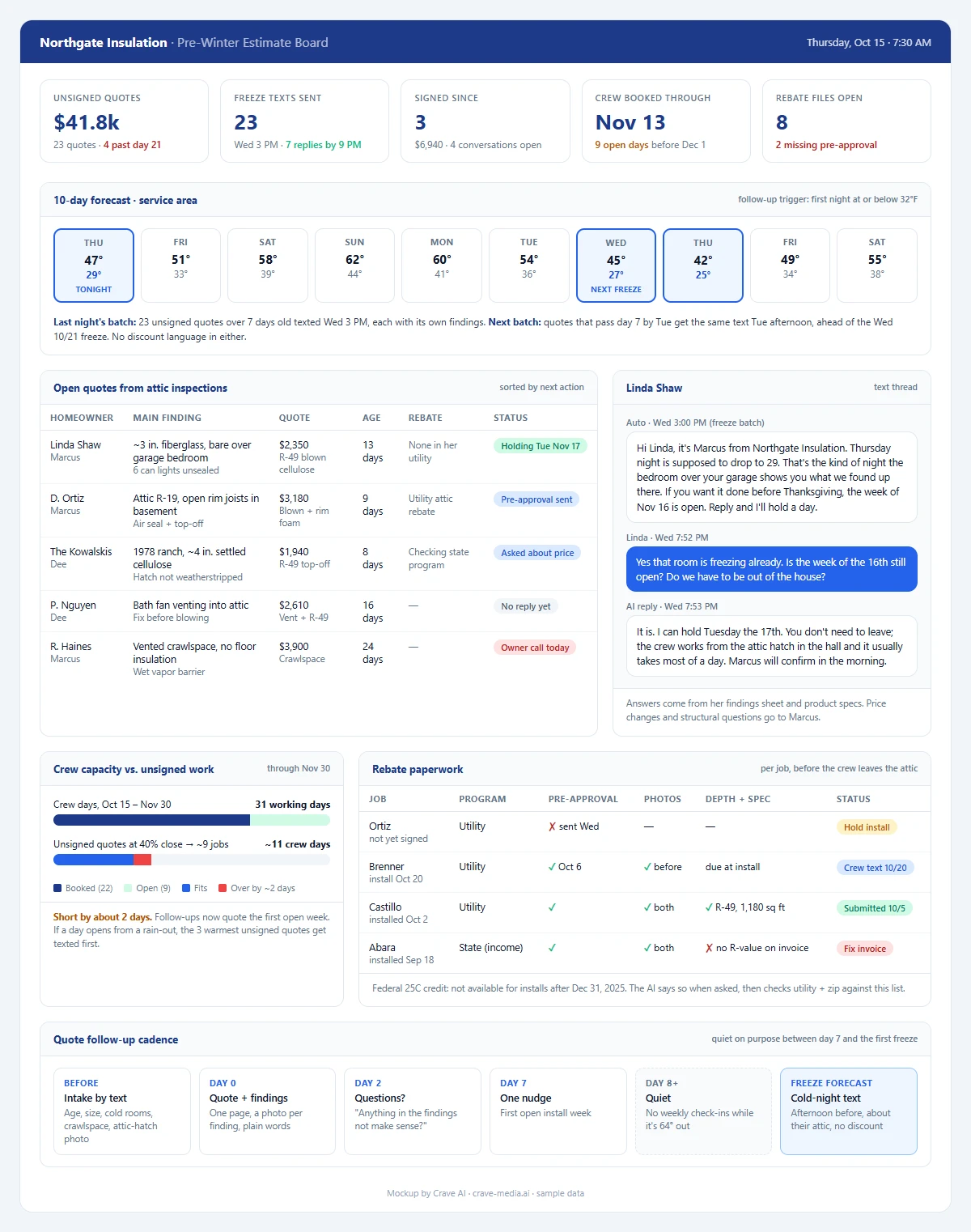
The pre-winter estimate board for an insulation contractor: open quotes from attic inspections, follow-ups queued against the first forecast freeze, open crew days versus unsigned quote work, and the rebate paperwork each job still needs. Download as PDF
View interactive version
The quote has to show them the attic
Insulation is a hard sell because nobody ever sees it. A roofer can point at the new roof. You're asking someone to pay $2,000 for something that'll sit above a hatch in the hallway ceiling for thirty years, so your quote has to carry more of the argument than a quote does in most trades.
It starts with intake. Whether the lead came from a web form, a missed call, or a text at 10 PM (about a quarter of insulation inquiries land after hours, by our industry numbers), the AI asks what your best estimator would ask on the phone. How old is the house, roughly how big, which rooms run cold, is there a crawlspace, and could they send a photo from the attic hatch? That photo alone often tells you whether it's a blown-in top-off or a bigger job. Then it books the inspection.
After the inspection, the estimator's notes and phone photos go into the job, and the AI drafts two things. One is the quote. The other is a one-page "what we found" sheet in plain words, a photo beside each finding: about 3 inches of old fiberglass over the main house, almost nothing over the garage bedroom, gaps around six can lights, an attic hatch with no weatherstripping. "R-49 blown cellulose, 1,400 sq ft, $2,350" means nothing to most homeowners. A photo of daylight around their own can light gets passed across the dinner table.
The quote and findings go out by text and email on day zero. Day two, a short check-in asking if anything in the findings didn't make sense. Day seven, one more nudge.
Then it goes quiet.
Hold your follow-ups for the first freeze
We'd build the whole pipeline around one rule: after day seven, stop texting unsigned insulation quotes until the forecast turns cold.
A homeowner who got your quote on October 2nd is in no hurry. It's 64 degrees out and the garage bedroom is fine. A weekly "just checking in" in that stretch competes with soccer practice and a dentist bill, and by the third one she's muted you. Then the forecast drops into the 20s, the furnace runs all night, and that bedroom reads 58 degrees at 6 AM. You want your text to be the last one she got from you before that morning.
So the system watches the 10-day forecast for your zip codes. When the first night at or below freezing shows up, every unsigned quote older than a week gets queued, and the text goes out the afternoon before the cold night. It's written about her house:
"Hi Linda, it's Marcus from Northgate Insulation. Thursday night is supposed to drop to 29. That's the kind of night the bedroom over your garage shows you what we found up there. If you want it done before Thanksgiving, the week of Nov 16 is open. Reply and I'll hold a day."
Replies get answered from her own findings sheet and your product specs. Is cellulose messy? Do we need to leave the house? What about the bath fan that vents straight into the attic? Price haggling, or anything structural the AI shouldn't touch, goes to Marcus with the thread attached.
There's no discount in that text, and we'd keep it that way. The forecast is doing the persuading.
The aging buckets are close to what we laid out for estimate tracking at a painting company, and the reply handling borrows from the quote follow-up system for electricians. Neither of those trades gets a free reminder from the sky every November.
Rebate paperwork, now that the federal credit is gone
For three years insulation sold with a federal tax credit stapled to it. The Energy Efficient Home Improvement Credit, section 25C, covered 30% of qualifying insulation and air sealing costs. The One Big Beautiful Bill Act, signed in July 2025, ended it about seven years early, and the IRS now lists it only for qualifying property placed in service by the end of 2025. An attic you insulate this fall doesn't qualify.
Plenty of your customers don't know that. They've seen three years of "30% back from the IRS" ads, and some of them will ask at 9 PM. An AI set up from an old FAQ will cheerfully promise them a credit that no longer exists, and you'll be the one explaining it in April. The first piece of setup is making it say the true thing: the federal credit ended for installs after 2025, and here's what we'll check for you instead.
What's left is local and changes often. Utility rebates for attic insulation and air sealing still exist in a lot of service areas. State home energy rebate programs, the federally funded ones, are open in some states, paused or not yet launched in others, and mostly income-qualified. We wouldn't let the AI decide anyone's eligibility. It asks for their utility and zip code, checks a short list you keep current, and says "you may qualify for this one, we'll confirm before we quote."
Where it earns its keep is the per-job paperwork, which is where contractors quietly lose money and goodwill. Requirements vary, but many utility programs want some combination of pre-approval before the install, before-and-after photos, a depth marker or measured depth, the product spec sheet, and an invoice that lists square footage and R-value. Skip the pre-approval and the customer's $400 rebate is gone, and they'll remember whose fault that was. The board shows each job's program, what's in, what's missing, the submit date, and whether the check has arrived. The morning of the install, the crew lead gets a text listing the photos that program wants.
With the credit gone, the quote has to stand on the heating bill alone, which puts even more weight on the findings sheet.
Crew capacity against unsigned quotes
The owner opens this panel first every morning in October.
On the left, crew days: what's booked, and through what date. On the right, unsigned quotes translated into crew days. Twenty-three open quotes feels like a healthy pipeline. Close 40% of them and that's about nine jobs, call it eleven crew days with two crawlspaces in the mix. If your one crew is booked through November 13, you have nine open days before December. The math doesn't fit, and Thanksgiving week is in the middle of it.
That changes what the follow-up says. When unsigned work outruns open days, the texts give the first open week and say plainly that it's filling. When a day opens up from a rain-out or a cancellation, the system texts the three warmest unsigned quotes first ("we had Tuesday open up, want it?") so the crew isn't sitting in the shop.
The mockup shows $41,800 in unsigned quotes against those nine days. The numbers are made up, the company is made up, and yours would come straight out of your job software.
The week of the first freeze
The board flags Thursday, October 15, at 29 degrees, the first freeze on the forecast. Twenty-three quotes go in the queue for Wednesday afternoon.
The texts go out at 3. Seven people reply before 9 PM. Linda wants the week of the 16th, so the AI holds Tuesday the 17th and pings Marcus to confirm. A homeowner named Ortiz asks whether his utility still pays a rebate. It does, it wants pre-approval first, and the form lands on his job checklist before he's off his phone. Two people ask about price, and those go to Marcus untouched.
By Thursday morning Marcus has three signed jobs, four live conversations, and a red flag on a $3,900 crawlspace quote at day 24 with no reply to anything. He calls that one himself.
After the install, next year's list
Every quote that didn't sign goes onto a list with its findings attached. Next September, before the forecast turns, those homeowners get a text about their own attic. It's the same idea as our customer reactivation automation, and it works better in insulation than most trades because the attic didn't fix itself over the summer.
Installed jobs get one question after their first winter: want to compare this January's heating bill with last year's? Some will say yes. A neighbor showing a $60 drop on the Facebook group does more selling than your yard sign.
When an insulation contractor needs these AI tools
A one-crew spray foam outfit working new construction for three builders can skip all of this. That work arrives on a builder's schedule, and a calendar plus a phone covers it.
The fit is a residential retrofit contractor with somewhere between 3 and 15 people, quoting attics and crawlspaces in the $500 to $5,000 range, with fall and early winter carrying the year. If you can't say how many September quotes are still open, or which of last year's rebate checks never showed up, you're already losing jobs and money you can't see.
The intake, follow-up, and paperwork tracking run on the same automations we build for other trades, connected to the job software you already use. The savings calculator and post-install proof tool we'd add next is on our AI for insulation contractors page.
Wait for the cold night
You can't make anyone care about their attic in early October, and texting them every week won't change that. What you can do is get the inspection and the photos done now, so that the night the furnace runs till dawn, your quote is the one with their own attic in it and a date on your calendar. Let the weather make the ask.
If you want to see your own quotes, crews, and rebate jobs on a board like this, tell us about your insulation business and we'll sketch it from what you already track.

About the author
Zac Spencer is an online marketing specialist and the owner of Crave Media, based in Salt Lake City, Utah. Since 2013 he has managed hundreds of Google Ads accounts across dozens of industries — with budgets from a few hundred dollars to $250K a month — and founded Crave AI to build custom AI tools and automations for local service businesses.