

AI tools for a window cleaning business before the holidays
On the Thursday before Thanksgiving a customer texts at 8:40 PM. Her kids are flying in Tuesday, her sister is bringing the new boyfriend, and she'd like the windows done before anybody sees them. She cleaned with you last November. You're booked solid through Wednesday. She'd have booked in October if anyone had texted her in October.
Window cleaning gets one good rush between the end of leaf season and the first hard freeze, and the deadline is set by somebody else's guest list. People want the work. They just ask for it late. So the AI tools we'd build for a window cleaning business this time of year mostly move bookings earlier and closer together: last year's customers get asked in October, street by street, with the screens and tracks priced into the same text. And one number tells everyone, customers included, how much room is left before the holiday.
That number is what most shops skip. We'd build it first.
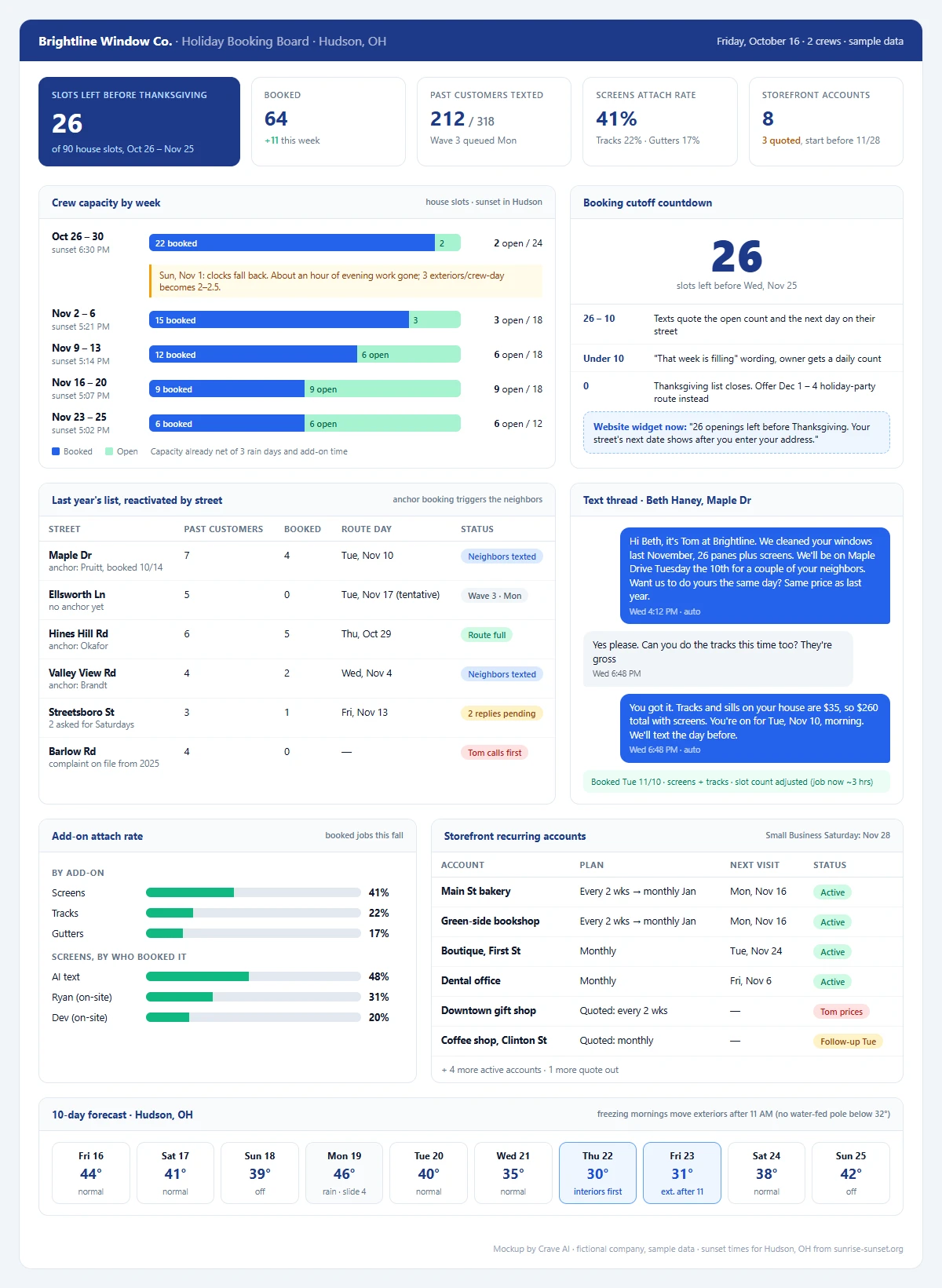
The holiday booking board for a window cleaning company: open slots left before Thanksgiving, weekly crew capacity after the clocks change, last year's customers grouped by street so one booking fills a route, add-on attach rates, and the storefront accounts that keep December and January busy. Download as PDF
View interactive version
Count the slots before anyone asks
Before a single text goes out, the system works out how many houses you can clean between now and the Wednesday before Thanksgiving. That number is smaller than it feels in mid-October, mostly because of light. Daylight saving time ends on Sunday, November 1 this year, and an hour of evening work disappears overnight. In Hudson, Ohio, the sun sets at 5:22 PM that day and around 5:01 PM by Thanksgiving week (times from sunrise-sunset.org). A crew that could fit three full exteriors into an October day may fit two in late November, and you don't do good glass by headlamp.
Cold takes its own bite. Most crews won't run a water-fed pole when it's below freezing, because the rinse water ices on the glass. Those mornings either start late or switch to interiors only. The system reads the 10-day forecast for your service area and marks freezing mornings on the calendar, so the office stops promising 8 AM exteriors on days the thermometer won't allow them.
Put those together with your crew count, your typical job length, and a guess at rain days, and you get a real number. For the fictional company in our mockup, Brightline Window Co. with two two-person crews, that works out to about 90 house slots from October 26 through November 25. Sixty-four are booked. Twenty-six are left.
For the next five weeks the AI quotes that 26 to anyone who asks "can you do before Thanksgiving?", and the booking widget on the website shows it too. Under 10, the texts start saying the week is filling. At zero the pre-Thanksgiving list closes.
Close the list instead of squeezing
We would be firm about this one. When the slots run out, stop selling Thanksgiving. Don't squeeze in two more by starting at 7 AM in frost and finishing the last house at 4:55 PM with a tech rushing the second floor. That customer is hosting 14 people who will stand at those windows during dessert, and every streak shows in low winter sun.
What the AI sells instead is the next real date. Early December has its own reason to want clean glass: office parties, open houses, the family that hosts Christmas Eve. So the text to a late asker reads something like, "We're full through Thanksgiving, but we're routing your street again December 3. That's still ahead of most holiday parties. Want it?" A good share of people will take it. The ones who won't would have been unhappy with a rushed job anyway.
Reactivate last year's list by street
Last fall's customers are the easiest bookings you will get, and the customer reactivation automation we've written about covers the general mechanics. In window cleaning the order you contact them in matters as much as the message.
Most shops would text the list in whatever order the software exports it, alphabetical or by last service date. We'd text it by street. The system groups last year's customers by street and neighborhood, then sends the first wave to the streets with the most past customers on them. The moment one house on Maple Drive books for Tuesday, November 10, the other six past customers on Maple Drive get a text that says so:
"Hi Beth, it's Tom at Brightline. We cleaned your windows last November, 26 panes plus screens. We'll be on Maple Drive Tuesday the 10th for a couple of your neighbors. Want us to do yours the same day? Same price as last year."
That's route density built by the booking itself. Two crews working seven houses on one street get far more glass done than two crews driving between seven addresses across three towns. The fall gutter post used the same street-block idea for routing; window cleaning makes it tighter, because a crew can walk a ladder from one driveway to the next.
The AI answers replies from the customer's own record, and the reschedule question is where it earns its keep. When Beth asks for Thursday, the useful answer is the next day a crew is already on Maple Drive, even if that's a week out, because a Thursday slot across town costs you forty minutes of driving at the darkest end of the year. Price questions get last year's ticket. If someone writes back that they moved, the record closes and the AI asks whether the new owners might want a quote. Anything about damage, a complaint from last year, or a commercial building goes to Tom.
Price the add-ons in the booking text
The add-ons are where the margin is, and a tech standing on a porch at 3:30 PM with the light going is the worst person to sell them. So the AI offers them before the visit, priced, using last year's record.
Screens are the obvious one. If last year's ticket included screens, the text assumes them. If it didn't, the confirmation asks once: "Want the screens washed too? For your house that's $45." Tracks and sills are a smaller ask that a lot of people say yes to, because tracks are what guests notice when they open a window. Gutters fit the calendar too. In a normal year most of the leaves in northeast Ohio are down by the week before Thanksgiving, so a gutter clean on the same visit makes sense, and it's the kind of bundled ticket we described for pressure washing upsells.
Each add-on also changes the slot count. Screens and tracks can add most of an hour to a two-story house, so the countdown adjusts when someone says yes. Otherwise you'd sell 26 slots of plain exteriors and discover you have time for 21 with everything attached.
The mockup tracks attach rate by add-on and by who made the booking. In our sample numbers, screens get added on 48% of jobs booked by text and 20% of the ones one tech books on site. Made-up figures, but if your real ones split like that, the difference is probably whether anyone asked.
Storefronts keep the calendar alive after Thanksgiving
Residential work drops off a cliff after the holiday. Storefronts don't. Shops on and around the town green in Hudson care about their glass most in the weeks after Thanksgiving, starting with Small Business Saturday on November 28. The windows are their holiday display.
So the AI runs a separate, slower list for commercial accounts. In late October it texts or emails the shop owners you already serve, plus any you've quoted, with a plain offer: every two weeks from mid-November through December, then monthly. Each visit gets a confirmation the day before, photos after, and an invoice on whatever schedule the shop wants. If the glass looks good all through December, the owner has every reason to keep you on through spring.
Those accounts are what get a small company through January. Two crews can't live on residential work in a northeast Ohio winter, and nine storefronts on a monthly schedule is two or three stops a week in January that you sold back in October.
A week in November at Brightline
It's Monday, November 9. The board shows 14 slots left before Thanksgiving. Thursday the 12th is forecast to start at 27 degrees, so the system has already moved Thursday's first two jobs to interiors and pushed the exteriors to after 11.
Overnight, a past customer on Ellsworth Lane booked for the 17th. By 9 AM the other four past customers on Ellsworth have their texts, and two book before lunch. One of them adds tracks, and the countdown drops by two slots, not one, because the job now runs long.
At 7:15 PM a new lead asks through the website if Brightline can do her windows "before the 26th." The AI tells her the truth: 11 slots left, the next open day near her is Friday the 20th, and it can hold it for her tonight. She takes it and adds screens.
Wednesday afternoon a downtown gift shop replies to the storefront offer and wants the every-two-weeks plan to start before Small Business Saturday. That one goes to Tom, because commercial pricing is his call. He signs it Thursday.
By Friday the count is down to 3, and they're gone by Saturday noon. Monday morning the website widget switches to "Booking December 1-4 for holiday parties," and Brightline stops taking Thanksgiving work on purpose.
How it connects to your current tools
None of this replaces your job software. The customer list, last year's prices and pane counts, and the calendar all come from wherever you keep them now. Most window cleaners already have the data. It just isn't sorted by street or turned into a count of open slots.
The pieces we'd connect: your job software for customers and bookings, a texting number your customers already know, a weather forecast for your zip codes, and the booking widget on your site. Those are the same automations we build for other trades, set up around your season instead of a generic one.
Setup is mostly cleaning up the list. Old phone numbers, customers who moved, and anyone who asked not to be texted get removed before the first wave goes out. Then the first week runs in draft mode, where Tom reads every reply before it sends.
Where AI tools fit a window cleaning business
A solo operator with 60 residential customers doesn't need any of this. Sit down one evening in mid-October, sort your list by street, and text them yourself. You'll be done by the weekend, and the results will be most of what a system would get you.
The fit is a company with two to four crews, a few hundred past customers, and a slice of commercial work, where the owner can't hold the whole calendar in their head anymore. If you've ever booked two houses on the same street on different days of the same week, or found out in December that half of last year's customers never got asked, that's the work this would fix. Our AI for window cleaning page covers the year-round side, including spring pre-booking.
Close the list on purpose
Go back to the woman who texted at 8:40 PM on the Thursday before Thanksgiving. With the board running, she got her text in mid-October, saw that Brightline would be on her street November 10, and booked it with screens. Her sister's boyfriend never knew the difference. The late asker that Thursday night is somebody else, and the honest answer to them is December 3.
Saying "we're full" with a real date attached is a better sale than a rushed yes. If you want to see your own streets, slots, and storefronts on a board like this, tell us about your window cleaning business and we'll sketch it from your customer list.

About the author
Zac Spencer is an online marketing specialist and the owner of Crave Media, based in Salt Lake City, Utah. Since 2013 he has managed hundreds of Google Ads accounts across dozens of industries — with budgets from a few hundred dollars to $250K a month — and founded Crave AI to build custom AI tools and automations for local service businesses.