

How an electrician could use AI to never miss a quote follow-up
You sent a $4,500 panel upgrade quote last Thursday. The homeowner said they'd "think about it." Now it's Tuesday and you haven't heard back. You're between jobs, your truck is loaded, and following up on that quote is somewhere near the bottom of your mental to-do list, behind the service call in Midtown and the rewire estimate you still need to write up.
So you don't follow up. Neither does anyone else on your team. The homeowner eventually calls another electrician, one who happened to check in at the right moment, and books with them instead.
This happens constantly in the electrical trade. Not because the work is bad or the price is wrong, but because independent electricians don't have a system for staying in front of quotes after they go out. You're busy doing the work. Follow-up falls through the cracks. And those cracks are expensive.
We'd build an AI quote follow-up system for electrical contractors that handles this automatically, from the moment a quote is sent until the customer books or declines. No extra staff. No CRM you'll never open.
The quote follow-up problem in electrical work
Electrical services sit in an awkward spot when it comes to sales. Your average ticket runs $150 to $600 for standard work, but the bigger jobs (panel upgrades, whole-house rewires, generator installations) land in the $2,000 to $8,000 range. Those bigger jobs are where your real margin lives, and they're exactly the ones that require a decision window.
A homeowner who needs an outlet installed will book on the spot. A homeowner staring at a $4,500 panel upgrade quote needs time. They're going to compare prices, Google whether their panel really needs replacing, and ask their neighbor who "knows a guy."
During that decision window, you're invisible. You sent the quote, maybe mentioned you'd be happy to answer questions, and moved on to the next call. The homeowner is sitting with your quote and two others, and whichever company stays in touch without being pushy tends to win.
Large electrical franchises know this. They have office staff or sales teams whose entire job is calling back on open quotes. A five-person shop in Memphis doesn't have that luxury. Your office manager (if you have one) is answering phones, scheduling jobs, and handling invoices. Quote follow-up gets pushed to "when I have a minute," which turns into never.
What an AI follow-up system would do
The system we'd build connects to your quoting tool (whether that's ServiceTitan, Housecall Pro, Jobber, or even a spreadsheet) and monitors every outbound quote. When a quote is sent and the customer hasn't responded within a set window, the AI takes over.
It sends a text message tailored to the specific quote, not a generic "just checking in" template. If the quote was for a 200-amp panel upgrade, the follow-up might address common concerns about that job: how long it takes, whether permits are included, what happens during the inspection. If the quote was for a generator install, the follow-up might mention lead times on equipment or upcoming storm season.
The timing is deliberate. The first follow-up goes out 48 to 72 hours after the quote, when the homeowner has had time to review it but hasn't gone cold yet. If they don't respond, a second message goes out five to seven days later with a different angle, maybe a question about their timeline or a mention of scheduling availability. A third and final touchpoint goes out around the two-week mark.
If the customer responds at any point (a question, a "not yet," a "we went with someone else"), the system routes that response to you or your office manager immediately. The AI doesn't try to close the deal. It reopens the conversation and hands it off to a human.
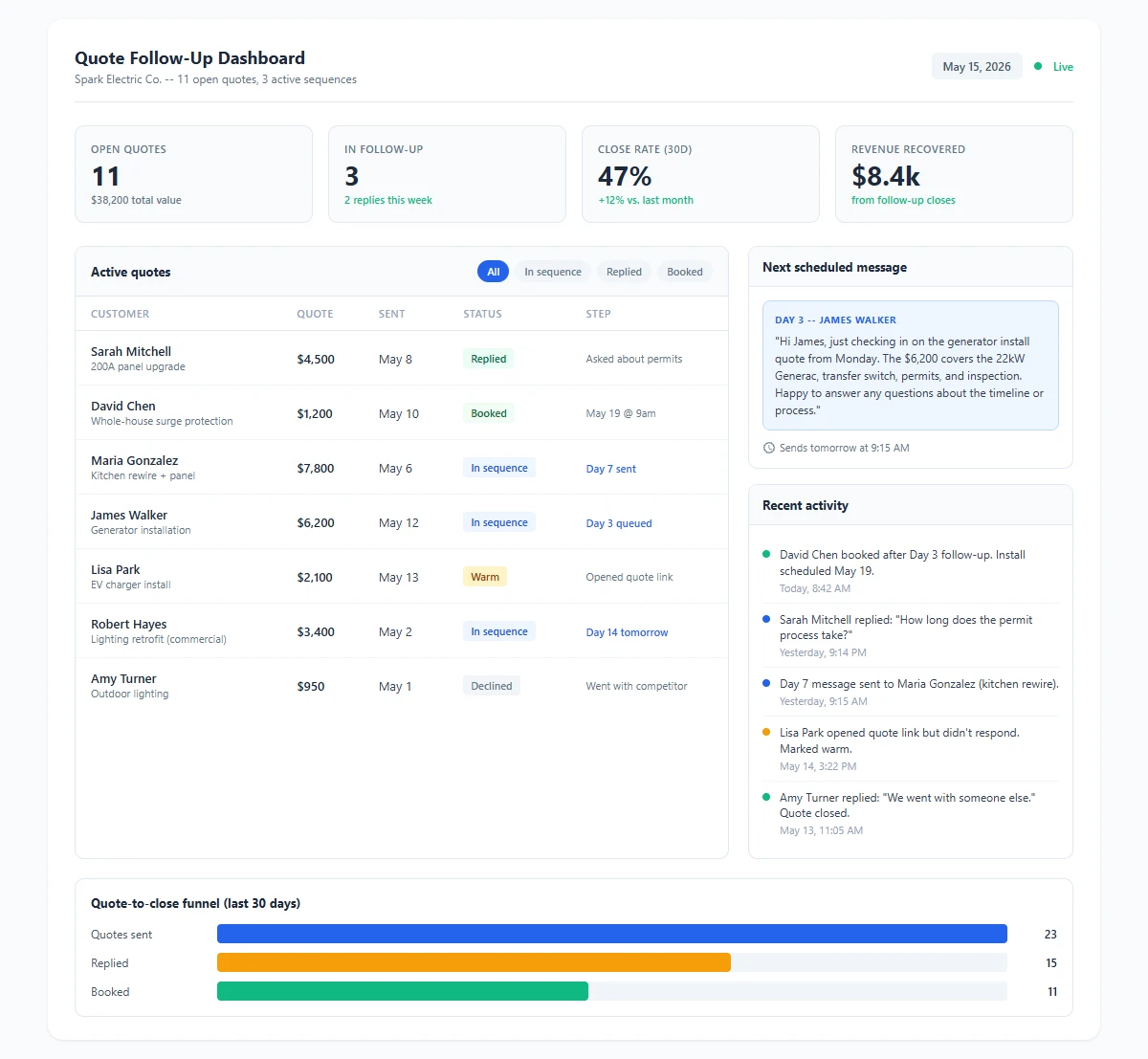
Quote follow-up dashboard for an electrical contractor showing open quotes, automated follow-up sequences, and conversion tracking from quote to booked job. Download as PDF
View interactive version
Say you quoted a 200-amp panel upgrade for $4,500. A follow-up sequence for that job might go like this:
The day-3 text: "Hi Sarah, just checking in on the panel upgrade quote from last week. The $4,500 covers the 200-amp upgrade, all permits, and the city inspection. If you have any questions about the process or want to talk timing, just reply here."
If Sarah doesn't respond, the day-7 text takes a different angle: "Hey Sarah, quick note. We have some availability opening up in the next two weeks if you're ready to move forward on the panel upgrade. No rush, just wanted to flag it since scheduling fills up. Let me know if you want to lock in a date."
And a final check-in at day 14: "Hi Sarah, just a last check-in on the electrical panel quote. If you've decided to go a different direction, no worries at all. If you still have questions or want to revisit the quote later, we're here. Thanks for considering us."
Three messages over two weeks. Each one adds something (information, availability, a graceful close) rather than just repeating "have you decided yet?"
A Tuesday morning with the system running
Let's walk through what a typical morning looks like once this system is live.
You pull into your first job at 8:15. Before you left the house, you checked your phone and saw two notifications from the follow-up system. The first is a reply from a homeowner named David who got a quote for whole-house surge protection last week. He texted back "How long does the install take?" at 9 PM last night. The system logged his response and flagged it for you.
You reply while drinking your coffee: "About 2-3 hours for the install. We handle the permit too. Want to get on the schedule?" David says yes and asks about next week. You forward it to your office manager to book.
The second notification is a status update. Of the 11 open quotes your company currently has out, three are in the follow-up sequence, two have responded and are marked as "warm," and six are either booked or closed out. You can see all of this in a simple dashboard on your phone without calling the office.
Meanwhile, the system sent a day-3 follow-up to a rewiring quote overnight. Another homeowner got a day-7 message about scheduling availability for a lighting retrofit. You didn't write either message. You didn't even know they went out. But if either homeowner responds, you'll know within minutes.
By 10 AM, you've done a full hour of electrical work and also moved two sales conversations forward. Before the system, those conversations would have died on the vine because nobody had time to send a text.
How it connects to what you already use
This isn't a replacement for your field service software. It's a layer on top of it. The AI automation plugs into your existing quoting workflow and picks up where most electrical contractors stop: the follow-up after the quote goes out.
It works with ServiceTitan, Housecall Pro, Jobber, and most other field service platforms. The system reads new quotes from your account and triggers the sequence automatically. If you're sending quotes from a PDF or a spreadsheet (plenty of shops still do this), you can forward the quote to the system and it picks it up from there.
Responses come back as text messages to your business number. Your office manager sees them in the dashboard. You see them on your phone. Nothing changes about how you schedule, dispatch, or invoice. The only thing that changes is that your quotes don't disappear into the void anymore.
The setup takes about a day. We'd need access to your quoting tool, your business phone number for SMS, and a conversation with you about your typical quote types so the follow-up messages sound right. After that, it runs in the background. You adjust the timing or messaging whenever you want, but most shops set it and forget it.
Why this matters more for electricians than most trades
Homeowners are nervous about electrical work before they even pick up the phone. They're thinking about safety, about whether you're properly licensed, about whether the price is fair for something they can't evaluate themselves. A $4,500 quote for a panel upgrade might be completely reasonable, but the homeowner has no frame of reference. They don't know what a panel upgrade involves. They just know it's a lot of money for something inside their walls.
That anxiety is why quotes go cold. The homeowner isn't rejecting your price. They're stuck, unsure whether to move forward, unsure what questions to ask, and a little embarrassed to admit they don't understand the scope.
A follow-up text that addresses the process (permits, inspection, timeline, what happens during the work) at the right moment reduces that anxiety. It gives the homeowner new information to process and a low-pressure way to ask questions. That's why the follow-up messages include specifics about the quoted job, not generic "just checking in" language.
The franchises already do this. Mr. Electric, Mister Sparky, and the other national brands have systems and staff dedicated to following up on leads and open quotes. When a homeowner gets a quote from a franchise and a quote from your shop, and the franchise follows up three times while you follow up zero, guess who gets the job? It's not always about price. It's about who stays present during the decision.
An independent electrician with 5 to 15 employees can't hire a salesperson to chase quotes. But an AI system that costs a fraction of that salary does the same work on every quote and never forgets.
What the numbers look like
Most electrical contractors we've talked to estimate their quote-to-close rate sits between 30% and 50%. The spread is wide because it depends on the type of work, the market, and whether anyone follows up at all.
Companies that follow up consistently on quotes (by any method, AI or human) typically close 10 to 15 percentage points higher than those that don't. On a shop doing $50,000 a month in quoted work, a 10% improvement in close rate is an extra $5,000 in monthly revenue. Over a year, that's $60,000 in jobs you were already quoting but losing to silence.
The system doesn't generate new leads. It doesn't replace your marketing. It just makes sure the leads you already have don't slip away because nobody had time to send a text. When you're already doing the hard part (running the call, diagnosing the problem, writing the quote), losing the job because of a missing follow-up is the most frustrating kind of lost revenue.
If you're running workflows that could use automation across other parts of your business too, the same infrastructure that powers quote follow-up can handle review requests after completed jobs, appointment reminders, and seasonal maintenance nudges.
Where we'd start
If you run an electrical services company and quote follow-up is a known weak spot, this is one of the fastest AI tools to get value from. The scope is narrow: just open quotes and timed text messages. You can measure ROI by comparing close rates before and after.
We'd start with a conversation about your quoting volume and the types of jobs that go cold most often. Panel upgrades and rewires tend to have the longest decision cycles, so those are usually where the biggest gains show up. From there, we'd build the message sequences, connect to your quoting tool, and have the system running within a week.
No six-month implementation. You keep doing electrical work. The system keeps your quotes warm.
If you want to see what this would look like for your shop specifically, reach out and we'll walk through it.

About the author
Zac Spencer is an online marketing specialist and the owner of Crave Media, based in Salt Lake City, Utah. Since 2013 he has managed hundreds of Google Ads accounts across dozens of industries — with budgets from a few hundred dollars to $250K a month — and founded Crave AI to build custom AI tools and automations for local service businesses.