

What custom AI tools cost, and what you get for it
Almost every agency that builds custom AI tools will talk to you for an hour without saying a number. We get why. The honest answer to "what does it cost" is "it depends," and that's a frustrating thing to hear when you're just trying to figure out if this is a $2,000 decision or a $40,000 one.
So this post does the thing most of those conversations avoid. We'll put real ranges on the table, explain what makes a custom AI tool cheap or expensive, and walk through how a small business can tell whether the price is worth paying. If you're weighing custom AI tools cost against what you're spending now on software, you should be able to leave this page with an actual ballpark in your head.
One caveat before the numbers. We build these tools for service businesses, so we're not a neutral party. But quoting wildly inflated prices would just lose us the project to someone cheaper, and quoting too low would mean we lose money building it. The ranges below are roughly what a fair shop charges, ours included.
Why nobody wants to publish a price
Off-the-shelf software has a pricing page because every customer gets the same product. Jobber is Jobber whether you're a plumber in Memphis or an electrician in Tucson. Custom is the opposite. The whole point is that the tool is shaped around your business, so the price moves with what your business needs.
That said, "it depends" is a cop-out when it's the only answer you give. The factors are knowable, the ranges are real, and you can get a useful estimate from a single conversation. An agency that won't give you a ballpark until you've sat through three meetings is managing you, not informing you.
The actual ranges
The work breaks down into a few tiers, smallest to largest.
A single automation is the cheapest thing you can buy. This is one workflow that runs without a person: a quote goes out, then a text follows up three days later, then another at day seven, then it pings your team if the customer replies. No dashboard, no AI analyzing anything, just a reliable sequence that does the thing your team keeps forgetting. Something like that usually lands in the low four figures to build, sometimes less if it's plugging into tools you already have.
A custom dashboard is the next step up. This is a screen that pulls your data together and shows you the numbers your off-the-shelf software won't, like margin by job type or close rate by lead source. Our HVAC revenue tracker is a good example of this category. Expect a few thousand dollars, with the price climbing based on how many data sources it has to pull from and how clean that data is when we get to it.
A connected system is where the number gets bigger. This is several tools working together: a storm lead pipeline that captures leads, qualifies them, tracks insurance status, and runs different follow-up depending on the answer. Multiple moving parts, real AI making decisions instead of just following rules, integrations with your CRM and phone system. These run into five figures, and the range there is wide because "a system" can mean three connected pieces or ten.
Then there's the ongoing cost, which is smaller than people fear. Once a tool is built, you're mostly paying for hosting and occasional upkeep, often a modest monthly amount rather than the per-seat subscription you'd pay a SaaS company forever. You own the tool. You're not renting it.
What pushes the price up or down
Four things move the number more than anything else, and you can usually predict your own cost by thinking through them honestly.
The first is complexity. A tool that follows a fixed set of rules ("if no reply in 3 days, send message B") is cheaper than one that adapts, like a follow-up system that reads what a customer wrote and changes its response. The second kind is genuinely AI, and it costs more because it's doing something harder.
The second is integrations. If your tool needs to talk to your CRM, your scheduling software, your phone system, and QuickBooks, every one of those connections is work. A standalone tool that lives on its own is faster and cheaper to build than one wired into five other systems.
The third is the state of your data. This one surprises people. If your customer records are clean and consistent, we can build on top of them quickly. If half your jobs are logged in a CRM, a quarter live in a spreadsheet, and the rest are in someone's head, a chunk of the budget goes to cleaning that up before the tool can use it. Messy data is the most common reason a quote comes in higher than expected.
The fourth is how many tools you're buying. One automation is one project. A system that runs your whole post-storm response is several projects that have to work together, and the coordination itself adds cost. Buying one well-chosen tool is how most small businesses should start.
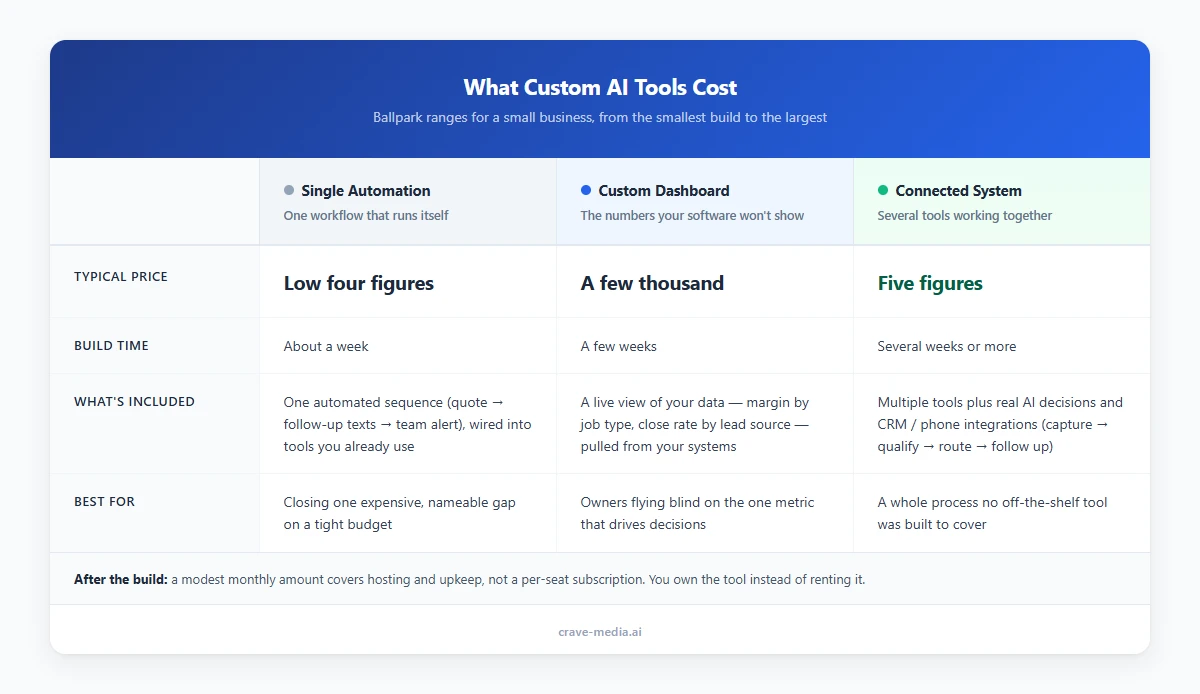
What custom AI tools cost across three tiers, from a single automation to a connected system, with the build time and the kind of business each one fits. Download as PDF
View interactive version
What you get that a subscription doesn't
The fair question is why you'd pay a few thousand dollars once when you could pay $99 a month for software that already exists. The honest answer is that you shouldn't, unless the off-the-shelf tool is leaving money on the table. We cover that decision in depth in our custom vs off-the-shelf breakdown, but here's the short version of what your money buys.
You get a tool built around your workflow instead of the average of ten thousand other companies' workflows. A roofer needs an insurance-review stage. No generic CRM has one, because most industries don't. Custom means the tool matches how you actually work, not how the software vendor assumed you work.
You get the specific number you've been exporting to a spreadsheet to find. If you've ever pulled your data into Excel every week to see margin by job type, you already know the gap. A custom dashboard closes it and gives you back that hour.
And you get ownership. A SaaS subscription is rent you pay forever, and the price tends to go up. A custom tool is yours. The monthly cost after the build is for keeping it running, not for permission to keep using it.
How to tell if it's worth it
The math is less complicated than the pricing makes it sound. Put a dollar figure on the problem, then compare it to the build.
Say a landscaping company runs 120 design consultations a year and closes 30% of them. If better follow-up moves that to 38%, that's about ten more jobs. At a $2,800 average, you're looking at roughly $28,000 in new revenue from leads you were already getting. A follow-up tool that costs a few thousand dollars pays for itself well inside the first year, and keeps paying after that.
The same logic works for any problem you can name. A water damage company that misses after-hours calls knows what an average job is worth. A pest control company watching customers churn knows the monthly cost of a lost account. When you can put a number on the leak, the build either clears that bar or it doesn't, and the decision makes itself.
When you can't put a number on it, that's your answer too. "We could probably be more efficient" isn't a problem a custom tool should solve, because you can't tell whether it worked. Start with better reporting and find the expensive problem first.
If you're on a tight budget
Most small businesses should not start with a five-figure system. Start with the one automation that fixes your most expensive, most nameable problem. Maybe that's after-hours lead capture, maybe it's the follow-up sequence your team never gets to. Buy the smallest thing that closes the biggest leak.
A good shop will tell you which one that is instead of selling you the whole platform. If the first tool earns its keep, you'll have both the proof and the cash flow to add the next one. Building this way means you're never out more than the value you've already gotten back.
Questions to ask before you pay
A few questions separate a fair quote from a bad one. Ask what the tool costs to run after it's built, because a low build price with a heavy monthly fee is just a subscription in disguise. Ask what happens to the tool if you stop working with the agency, since you should own what you paid to build. Ask how they handle your messy data, because if they don't mention it, they haven't thought about it. And ask them to tie the price to the problem: what does this fix, and what is that worth to you?
If the answers are specific, you're talking to someone who's built this before. If they're vague, keep looking.
What you're really paying for
Custom AI tools cost more upfront than a software subscription, and less per problem solved, if you have the right problem. A small business with one expensive, nameable gap can usually close it for low four figures and watch it pay back in a season. A business that just wants to "do something with AI" should keep its money until the gap has a dollar sign on it.
If you want a straight answer on what your specific situation would cost, our free AI audit takes about five minutes and ends with a real recommendation. Sometimes that recommendation is to build something. Sometimes it's to fix the software you already pay for. Either way, you'll get a number instead of "it depends."

About the author
Zac Spencer is an online marketing specialist and the owner of Crave Media, based in Salt Lake City, Utah. Since 2013 he has managed hundreds of Google Ads accounts across dozens of industries — with budgets from a few hundred dollars to $250K a month — and founded Crave AI to build custom AI tools and automations for local service businesses.