

How a Garage Door Company Could Automate Emergency Dispatch With AI
It's 6:14 on a Tuesday morning. A homeowner backs out for work, hits the opener, and nothing happens. The door is dead, the car is stuck inside, and the kids have to be at school in forty minutes. So they grab their phone and start calling garage door companies. The first one that picks up gets the job.
You weren't going to pick up. You were asleep, or already loading the van, or three feet under a torsion bar at someone else's house. For garage door shops, roughly 55% of calls come in after hours, and that early-morning panic call is the exact moment your business is least able to answer.
That gap, between when the call comes in and when a human responds, is where most of the money in this trade leaks out.
The whole game is catching the call and routing it fast
A garage door emergency isn't a "let me get three quotes and think it over" purchase. The car is trapped or the door won't close and the house is sitting open. The customer wants someone today, ideally this morning. Whoever responds first, and sounds like they know what they're doing, usually books the job.
So the entire competitive question for a small shop comes down to two things. Did you capture the call when it came in? And did you get the right tech moving toward it before someone else did? Tickets in this work run anywhere from $150 for a quick spring adjustment up to $800 for a full opener-and-hardware job, and the work is steady all year. Miss the 6 a.m. calls consistently and you're handing a competitor a few thousand dollars a month without ever knowing it happened.
Why this is genuinely hard for a 2-to-10-person shop
You're not losing those calls because you're lazy. You're losing them because of how the work is structured.
A garage door tech spends the day with both hands occupied and often in a noisy garage with a phone buried in a tool bag. Springs are under serious tension, openers come down from ladders, and you can't safely stop mid-task to qualify a new lead. When you're the owner and also one of the two installers, every call that lands while you're working is a coin flip on whether it gets answered at all.
The big-box installers and the national lead-gen outfits don't have that problem. They have a call center, or at least someone whose only job is to answer. They pick up at 6 a.m. because somebody is paid to. That's the matchup you're in, and it's why so many shops quietly decide the after-hours calls just aren't catchable. They are. You just need something answering for you that doesn't need to be awake.
This is the same dispatch math we walked through for an emergency plumbing operation, and the shape of the fix is similar even though the trade is different.
What the emergency dispatch dashboard would track
We don't build "an AI." We build a specific tool that does one job well, and for a garage door shop that job is catching and routing the emergency. This is what we'd put in front of you on a single screen.
Every inbound call and text, captured 24/7, whether or not a human was available to answer. Nothing rings out and disappears. If you miss it, the system already has it.
An AI qualification step that asks the things a good dispatcher would, in plain language: what kind of door and opener, is a car or person trapped, is the door stuck open (a security problem) or stuck closed, and whether there's a safety flag like a broken torsion spring still under tension. That last one matters because a snapped spring is dangerous to mess with, and knowing about it changes which tech you send and what they bring.
A triage layer that sorts those into urgency tiers, so a trapped car at 6 a.m. jumps the line ahead of a "my opener is getting loud" call that can wait till Thursday.
Routing to whoever is on call, with an ETA the customer actually sees, plus the response-time clock running on every lead so you can see how fast you're really reacting. The dashboard would surface your after-hours capture rate as a headline number, and break conversion down by lead source so you can tell which of your ad dollars are turning into booked jobs.
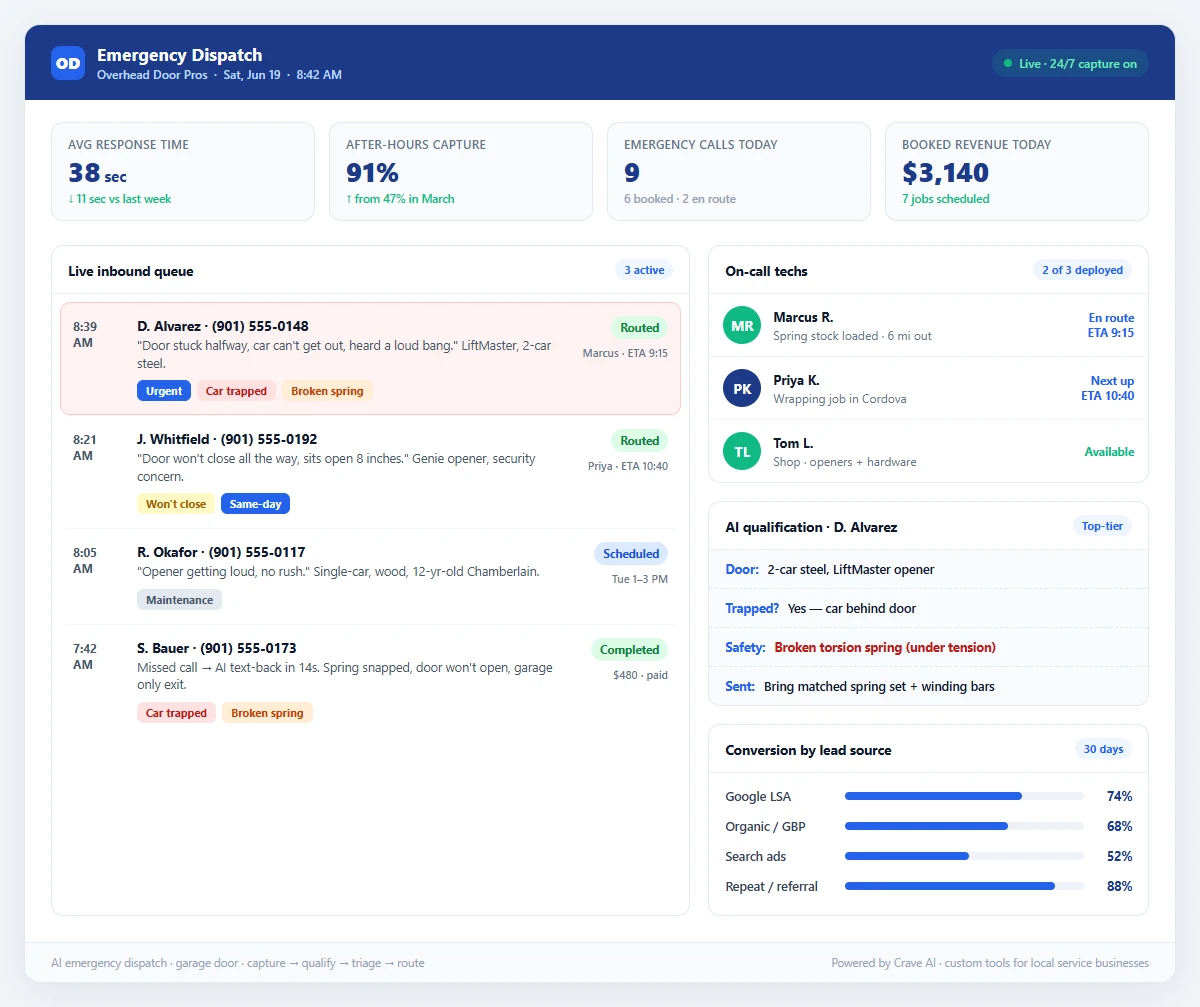
An AI emergency dispatch dashboard for a garage door company, showing the live inbound queue, AI-qualified lead cards, on-call tech routing with ETA, and response-time metrics. Download as PDF
View interactive version
The sequence that runs while you're under a door
The point of all this is that it works without you touching it.
A call comes in and goes unanswered for fifteen seconds. Instead of dropping into a voicemail nobody listens to until lunch, the system texts the caller back almost immediately: a real-sounding message that acknowledges the problem and starts asking the qualifying questions. Most people will text back at 6 a.m. even when they won't leave a voicemail, because texting feels lower-effort and they're already standing in the garage staring at the broken door.
The AI reads the answers, scores the urgency, and does one of two things. If it's clearly a same-day emergency, it routes the lead straight to your on-call tech with the address, the door type, and the safety flags, and it sends the customer an ETA so they stop calling your competitors. If it's not urgent, it offers a booking window and gets it on the calendar. Either way, if the customer goes quiet partway through, it follows up once or twice instead of letting the lead rot.
By the time you climb out from under the door you were working on, the new job is already qualified, slotted, and on its way to the right person. You didn't answer a single ring.
If you've read our piece on automating after-hours lead capture, this is that same idea sharpened for a trade where the after-hours call is the emergency, not just an inconvenience.
Saturday morning, a trapped car, the flow in action
Picture a Saturday at 7:40 a.m. A family is leaving for a soccer tournament two towns over. They hit the button and the door grinds halfway up, then stops, with the car nosed in behind it. They call your shop. You're out of town at your daughter's game and your one Saturday tech is already on a job across the county.
Nobody picks up. Fifteen seconds later their phone buzzes with a text from your number asking what's going on. The dad taps out: "Door stuck halfway, car can't get out, need someone now." The AI asks one follow-up about the opener brand and whether they heard a loud bang earlier (a spring tell). He says yes, there was a bang. The system tags it as a broken spring with a trapped vehicle, marks it top-tier urgent, and pushes it to your on-call tech with a note to bring spring stock for that door size.
The tech accepts from his phone. The customer gets a text: "Marcus is on the way, ETA 9:15, he'll have the right springs." That family stops calling around. You find out about the whole thing when you check your phone at halftime and see a booked $480 job you slept through. The same call, a year ago, would have gone to whoever answered first.
How it fits what you already run
A fair worry here is that this means ripping out everything you use and learning some new platform. It doesn't.
This sits on top of your existing phone number and forwards through it, so customers call the same number they always have. It hands qualified, scheduled jobs into the CRM or scheduling tool you're already in, whether that's Jobber, Housecall Pro, or a spreadsheet and a group text. We shape the tool around your setup, not the other way around. And to be honest, if you already have a great office manager who answers every call by the second ring during business hours, you may not need any of this for daytime calls. The value is in the hours nobody's covering. We'd cover those and leave the rest alone. There's a longer version of that "do you even need custom" question in our take on custom AI versus off-the-shelf software.
What changes when you stop losing the 6 a.m. call
The competitive shift is straightforward. Right now, that 55% of calls coming in after hours mostly goes to whoever happens to be awake and reachable, which is rarely the small local shop and often the big installer with a call center. When something is answering for you around the clock, you stop ceding that whole block of demand by default.
You're no longer competing on who's awake. You're competing on the work itself, which is the competition a good local shop usually wins. The customer who got a 6 a.m. text back, a real ETA, and a tech who showed up with the right springs is not going to call the big-box store next time. They're going to call you, and tell their neighbor to call you too.
Where we'd start
We wouldn't try to automate your whole operation on day one. We'd wire up the one thing that's quietly costing you the most, which is the unanswered after-hours call.
The first build would be the instant text-back and AI qualification on missed calls, pointed at your existing number, routing to one on-call phone. That alone tends to recover a meaningful chunk of the after-hours 55% within the first few weeks, and it gives us real numbers to tune the urgency triage and routing against. From there we add the dashboard, the source-level conversion tracking, and the deeper scheduling hooks.
If you run a garage door shop and you know you're losing early-morning calls but can't prove how many, that's exactly the thing worth measuring first. You can see the kind of dispatch tooling we'd build on the garage door AI page, or look at the broader set of custom AI tools we put together for local service businesses. Tell us how your calls come in now, and we'll show you what catching the 6 a.m. ones would look like.

About the author
Zac Spencer is an online marketing specialist and the owner of Crave Media, based in Salt Lake City, Utah. Since 2013 he has managed hundreds of Google Ads accounts across dozens of industries — with budgets from a few hundred dollars to $250K a month — and founded Crave AI to build custom AI tools and automations for local service businesses.