

What an AI dashboard does for water damage restoration
It's 11 PM on a Tuesday and a water heater just let go in someone's finished basement. They're standing in two inches of water, phone in hand, calling the first restoration company that comes up. If you answer in two minutes, you get a job that pays and a customer who's relieved. If their call rolls to voicemail or a sleepy answering service, they hang up and dial the next company on the list. By morning the water has wicked up the drywall and the mold clock has already started.
That's the whole business in one moment. About 65% of water damage calls come in after hours, and the homeowner on the other end isn't comparison shopping. They're scared and they're picking whoever picks up. Your response time isn't just how you win the work. It decides how big the job is, because mold starts growing within 24 to 48 hours of the water event, and a crew on site that night means extraction and drying instead of demolition and reconstruction a week later.
That's the part AI is genuinely good at. We'd build AI tools for a water damage restoration company around two things: an emergency response dashboard that tracks how fast you answer every call and where each job sits, and an automated first response that texts a panicking homeowner mitigation steps and dispatches your nearest crew in seconds. Neither replaces your project managers. Both make the difference between a 4 a.m. miss and a job booked while your competitor sleeps.
Why response time is the whole game
Most trades can absorb a slow callback. A homeowner getting quotes on a kitchen remodel will wait a day. A homeowner with water spreading across the floor will not. The job goes to whoever responds first, and the gap between first and second place is measured in minutes.
There's a second clock running underneath the first one, and it's the one that decides your margin. A water event that gets extracted and dried inside the first day stays a water event. Let it sit and the water moves into the wall cavities, the subfloor, and the insulation, and now you're tearing out and rebuilding. The franchise down the road knows this, which is why they pay for a 24/7 call center. Most independent restoration companies are running emergencies through a personal cell phone and an answering service that takes a message. That's the gap.
The trouble is you can't manage what you can't see. If a call comes in at 2 a.m. and the on-call tech doesn't pick up for 40 minutes, nobody finds out unless the customer complains. The lost calls are invisible. The slow nights are invisible. You feel busy, the trucks are moving, and you have no idea you're missing a third of your after-hours calls because nothing tells you.
What the dashboard would track
The dashboard we'd build puts the whole operation on one screen, and it leads with the number that matters most: how fast you're responding. Every inbound emergency gets a timestamp when it lands and another when a human or the AI responds. The gap between them is your response time, logged for every call, averaged by day and by hour. For the first time you can see that your weekday afternoons are tight but your 1 a.m. to 5 a.m. window is leaking jobs.
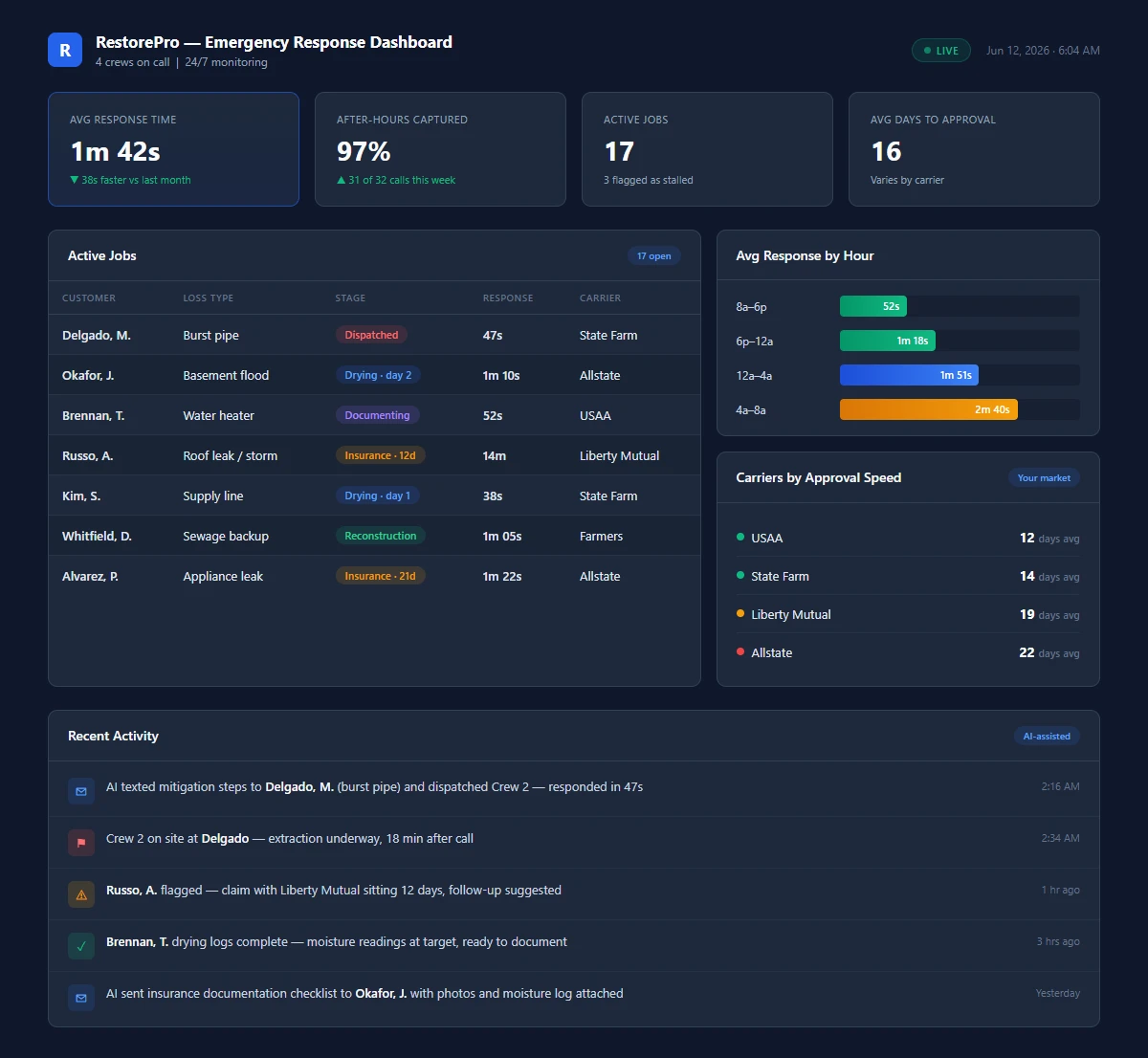
An emergency response dashboard tracking response time on every call, after-hours capture, active jobs from dispatch through reconstruction, and which insurance carriers are slowest to approve. Download as PDF
View interactive version
Next to that sits every active job and the stage it's in. Restoration isn't one task, it's a chain: dispatch, extraction, drying, documentation, insurance submission, approval, reconstruction, payment. A job can stall at any link, and the expensive stalls are the quiet ones. A drying job that should have been read three days ago. A claim that's been sitting with the adjuster for two weeks. The board shows you where each job is and flags the ones that have gone still, so a stuck job gets a phone call instead of being discovered at month end when the cash doesn't show up.
Then there's the insurance side, which is where restoration money actually lives and dies. Most of your work gets paid by a carrier, not the homeowner, and carriers don't pay at the same speed. The dashboard tracks how long each one takes to approve in your market, so you can see that Allstate is running 22 days while State Farm clears in 14. That tells you two things: how to set the homeowner's expectations honestly on day one, and which adjusters need a follow-up nudge instead of being treated like every other file.
The last piece is the crew view. When an emergency comes in, you need to know who's closest and who's free, not who you happen to think of first. The board shows your crews, where they are, and what they're on, so dispatch goes to the truck that can actually get there fastest.
The first response that runs without you
The dashboard shows you what's happening. The automation handles the 2 a.m. moment when nobody on your team is awake to handle it.
When an emergency request comes in, the AI responds in under a minute instead of letting it sit until someone checks the phone. It does two jobs at once. First, it calms the homeowner and limits the damage with immediate steps: shut off the water supply if you can reach it, move what you can off the floor, don't run the HVAC. Those few sentences, sent within seconds, can be the difference between a wet floor and a soaked wall. Second, it gathers the details that matter, where the water's coming from and how far it's spread, and dispatches your on-call crew with the address and the situation already in hand.
This is the same engine behind the after-hours lead response we'd set up for any emergency trade, and it's close cousin to the AI dispatching we built out for plumbers, pointed at the restoration timeline. The homeowner feels handled in the first 60 seconds, which is exactly when they decide whether to keep waiting on you or call someone else. Your crew rolls with the full picture instead of a half-awake phone call. And every one of those interactions lands on the dashboard with a response time attached, so the after-hours window stops being a black box.
A burst pipe at 2 a.m., handled
A request comes in at 2:14 a.m.: water coming through a kitchen ceiling, second-floor bathroom above. Nobody on your team is awake. Here's what happens anyway.
By 2:15 the homeowner has a text: turn off the water at the bathroom shutoff or the main if you can reach it safely, move anything you can off the kitchen counters and floor, and a crew is on the way. The AI has already pulled that the nearest on-call truck is 18 minutes out and sent the dispatch with the address and a one-line summary. The tech's phone buzzes with the job, not a vague "call this person back."
You see none of this until you open the dashboard with your coffee at 6 a.m. The job's already on the board, marked dispatched at 2:16, crew on site at 2:34, extraction underway. Response time logged: 47 seconds. The homeowner who would have been a missed voicemail is now a drying job instead of a reconstruction, and the only reason you know it happened at all is the line on your activity feed. That's the night your competitor's answering service took a message nobody returned until 8.
How it fits what you already run
If you're on a platform like Encircle or DASH for job documentation, this dashboard sits on top of what you have instead of replacing it. It pulls your jobs and crew schedule, layers on the response-time tracking and the insurance approval timeline, and gives you the one combined view those tools don't quite put together. It's a custom tool built around how you already dispatch, not another system to migrate into in the middle of storm season.
If you're running emergencies off a cell phone and a whiteboard, the dashboard becomes your system, and the automation layer becomes your after-hours team. We'd wire up the intake so a call or web request triggers the instant response and the dispatch, then build the job board and the carrier tracking around how you actually work a file from first contact to final payment.
Setup runs about a week. We'd need your crew roster, the carriers you deal with most, your typical job stages, and access to wherever your jobs live now. From there we build the response clock, set the rules for when a job has gone quiet, and turn on the after-hours first response.
What changes when you can see the clock
The first thing that moves is the after-hours capture rate. When every 2 a.m. call gets an instant answer and a dispatch, you stop quietly losing a third of your emergencies to whoever happened to pick up. That's revenue you were already generating demand for and leaving on the table.
The job mix shifts too. Faster response means more jobs that stay extraction-and-drying instead of becoming demolition-and-rebuild. That sounds like smaller tickets, but it's the opposite where it counts: simpler jobs close faster, the customer is happier, and you turn the crew to the next emergency instead of babysitting a reconstruction you could have prevented. And the insurance tracking pulls cash forward, because a claim that gets a nudge on day 12 pays sooner than one nobody looks at until day 30.
The quiet win is that you finally look like the franchise without the franchise overhead. A homeowner at 2 a.m. can't tell whether the company texting them mitigation steps has 200 trucks or four. They just know somebody answered when the water was rising, and that's the company they'll call again and name to their neighbor.
The first thing we'd wire up
If you run a restoration company and you've ever wondered how many after-hours calls you're actually missing, that's the place to start, because right now the honest answer is you don't know. We'd turn on the response tracking and the instant first response first, since those two protect the most revenue the fastest, then build out the job board and the insurance timeline once the intake is humming.
The data already exists in your calls and your crew's heads. The system just catches it, answers in seconds when no one's awake, and puts the whole night on a screen you can actually act on. If you want to see what this would look like for your company, with your crews, your carriers, and a real 2 a.m. call, get in touch and we'll walk through it.

About the author
Zac Spencer is an online marketing specialist and the owner of Crave Media, based in Salt Lake City, Utah. Since 2013 he has managed hundreds of Google Ads accounts across dozens of industries — with budgets from a few hundred dollars to $250K a month — and founded Crave AI to build custom AI tools and automations for local service businesses.