

Automated review responses for a local business, done right
Scroll through the Google reviews of almost any busy local business and you'll find the same reply stacked forty times. "Thank you for your kind words! We appreciate your business!" Under a five-star review about a water heater. Under a five-star review about a clogged drain. Under a four-star review that says the tech was great but showed up two hours late.
That last one is where templates hurt you. Nobody reads your replies to decide whether to thank you. The person reading is a stranger deciding whether to call you, and what they see is a company that pasted a thank-you onto a complaint about lateness without reading it.
Automated review responses for a local business can work well. They just have to be sorted first. Some reviews can get a reply with no human involved. Some should get an AI draft that a person approves. And a few should never be answered by software at all, no matter how good the draft looks. This post walks through how we'd set up that sorting, what the replies should sound like, and when the whole thing isn't worth building.
Templates vs AI drafting
There are two ways people automate this today, and both have a real flaw.
Templates are the older approach. You write three or four canned replies, maybe one per star rating, and a tool posts the right one. It's cheap and predictable. It also reads exactly like what it is. After the fifth identical reply, anyone scrolling your profile can tell nobody is reading the reviews, which is the opposite of what a reply is supposed to say.
AI drafting fixes the sameness. A model reads the review and writes a reply that mentions the water heater, the tech by name, and the fact that the customer's dog liked him. That's better. The flaw is that a model will happily write a warm, fluent reply to anything, including a review that accuses your tech of damaging a floor. Fluent is not the same as safe. An AI can apologize for something you didn't do, promise a refund you didn't approve, or confirm details about a customer's job in public.
You need both, and the work is deciding which reviews get which treatment before a single word gets written.
Three lanes for every review
Every new review gets read by the system before any reply exists. It checks the star rating, reads the text for specific signals, and tries to match the reviewer to a real job in your scheduling software. Then it drops the review into one of three lanes.
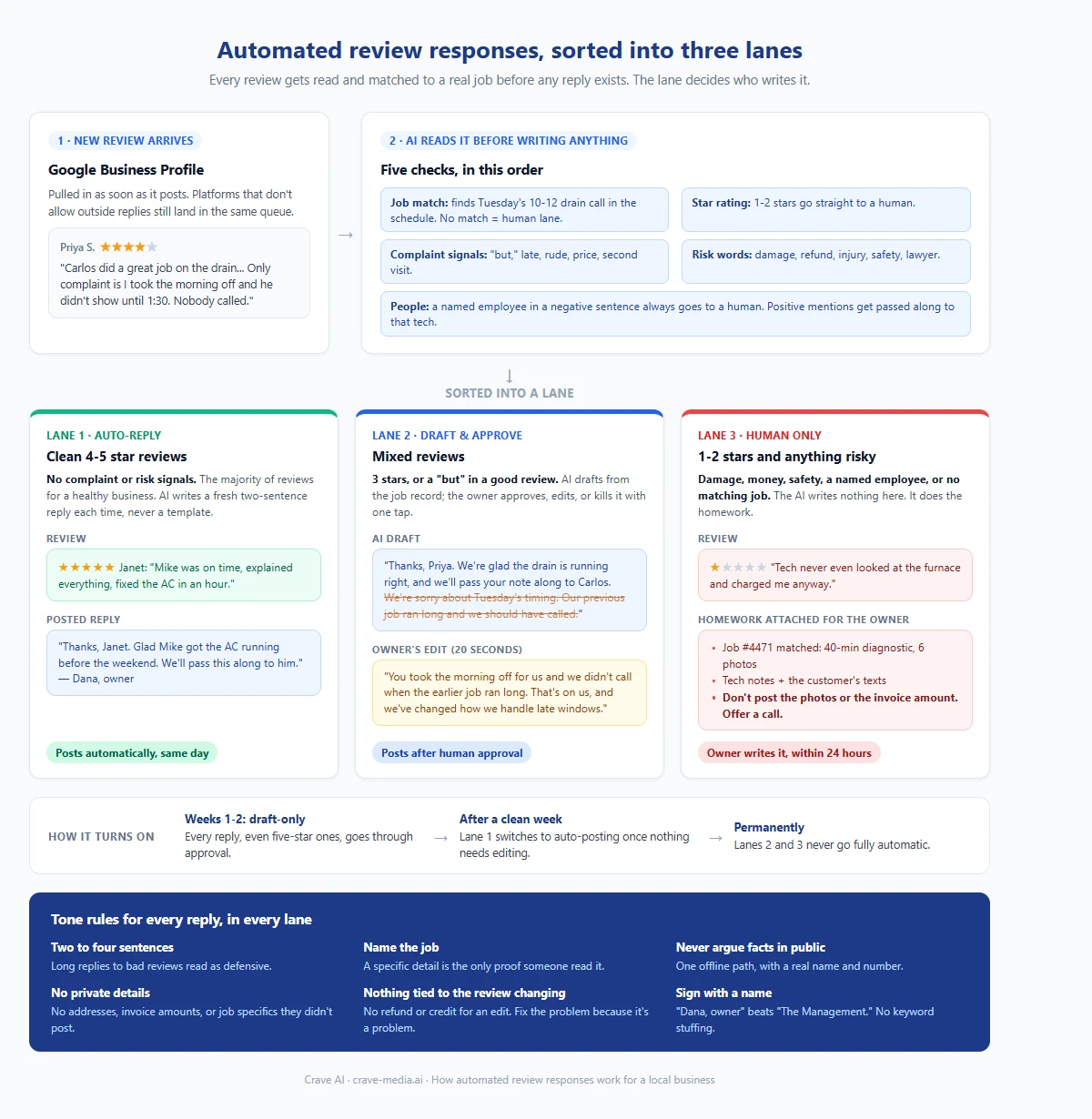
How automated review responses get sorted for a local business: clean positive reviews get an automatic reply that names the job, mixed reviews get an AI draft a manager approves, and negative or risky reviews go straight to a human with the job record attached. Download as PDF
View interactive version
Lane one: auto-reply
Four and five star reviews with nothing negative in the text. "Mike was on time, explained everything, fixed the AC in an hour." These are the majority for most healthy businesses, and they're where automation saves the most time for the least risk.
The reply still gets drafted fresh by AI each time, and it's short: the reviewer's first name, the actual job, and thanks passed along to the tech if the review named one. "Thanks, Janet. Glad Mike got the AC running before the weekend. We'll pass this along to him." A five-star review doesn't need a paragraph back.
Lane two: draft and approve
Anything mixed. Three stars, or four and five stars with a "but" in the middle. "Great work, but nobody told me the tech was running late." Also any positive review that mentions price, a specific promise, or a second visit.
Here the AI writes a draft and sends it to whoever owns reviews, usually the owner or office manager, as a text or a message in the approval queue. They approve it with one tap, edit it, or kill it.
Here's what this would look like in practice. A four-star review comes in on a Thursday night:
"Carlos did a great job on the drain and cleaned up after himself. Only complaint is I took the morning off and he didn't show until 1:30. Nobody called."
The system matches it to Tuesday's 10-to-12 window, sees the job ran 90 minutes past it, and drafts:
"Thanks, Priya. We're glad the drain is running right, and we'll pass your note along to Carlos. We're sorry about Tuesday's timing. Our previous job ran long and we should have called you when it did."
The manager reads it, likes the first two sentences, and changes the last one: "You took the morning off for us and we didn't call when the earlier job ran long. That's on us, and we've changed how we handle late windows." Same length. The AI got the facts and the structure right. The manager added the part a stranger will believe, which is that something changed.
That edit took twenty seconds, and it's why this lane never goes fully automatic. A mixed review answered well is often the most persuasive thing on your whole profile, because it shows a prospect exactly what happens when something goes wrong.
Lane three: human only
One and two star reviews. Plus anything, at any star rating, that mentions damage, a refund, a safety issue, an injury, a lawyer, a named employee in a negative way, or a reviewer the system can't match to any job.
The AI doesn't write a reply in this lane. It does the homework instead. It pulls the job record, the invoice, the tech's notes, and any texts with the customer, and puts them next to the review so you're not digging through three apps at 9 PM. It can flag what not to say: "Invoice shows the customer declined the recommended part replacement. Don't mention this publicly."
Then you write it, usually in four sentences or fewer.
When a human has to reply
Everything on the lane-three list is there because a wrong reply to it can cost you more than the review did.
Damage and money claims are the obvious ones. Any sentence in a public reply can read like an admission or a promise, and a model trying to be agreeable will write "we're so sorry our tech damaged your floor" before anyone has looked at the floor.
A reviewer you can't match to a job is the sneaky one. It might be a customer who booked under a spouse's name. It might be a competitor, or a review meant for another company with a similar name. The system should flag it and hold off. If you're confident it's fake, Google has a process to report a review that violates its policies, and that report is a better first step than a public reply calling someone a liar.
Reviews that name an employee negatively need a human for a simpler reason. That employee will read the reply. So will their coworkers.
Tone rules for every reply
Whatever lane a review lands in, the same rules apply to the reply. We'd write these into the AI's instructions and hold the humans to them too.
The first two are about length and proof. Two to four sentences for most replies, because long replies to negative reviews read as defensive even when they're not. And name the job, plus the tech when it helps. A specific detail is the only thing that proves a person read the review.
The rule that gets broken most is arguing the facts in public. Say a customer writes that your tech "never even looked at the furnace," and your records show a 40-minute diagnostic with photos. Every instinct says to post the photos. Don't. The stranger reading along can't check who's right, so they see a business fighting with a customer. Say you see it differently and give one offline path with a real name: "That's not how we understood the visit, and I'd like to go through it with you. Please call me at [number] and ask for Dana." Then settle it on the phone.
Related: don't repeat private details. No addresses, invoice amounts, or anything about the job the customer didn't already put in their review. Posting the receipt feels transparent to you and reads as retaliation to everyone else.
Don't tie anything to the review changing, either. Offering a refund or credit in exchange for editing or removing a review drifts into what the FTC's 2024 rule on consumer reviews was written to stop. That rule went into effect in October 2024, targets incentives tied to a review's sentiment and tactics that suppress negative reviews, and carries civil penalties. Fix the problem because it's a problem, and let the customer decide what to do with their review.
Skip the keywords. "Thanks for choosing the best HVAC company in Germantown for AC repair in Germantown!" helps nobody and looks like you're gaming the listing, because you are. And sign with a name. "Dana, owner" beats "The Management" every time.
What it takes to set up
The pieces are less exotic than they sound.
Reading and replying to Google reviews can be done through the Google Business Profile API, which has an endpoint for posting and updating replies, so a system with access to your profile can publish lane-one replies directly. Google has also been testing its own AI-suggested replies inside Business Profile this year, rolling out to a limited set of accounts, so you may see a draft button show up in your dashboard. That's a fine drafting tool. It doesn't do the sorting, which is the part that matters.
Not every review site lets outside software post replies, and the rules differ by platform. For the ones that don't, the draft lands in the approval queue and someone pastes it in. It takes ten seconds.
Matching reviews to jobs means connecting your scheduling or field service software, whatever you run, from Jobber to a spreadsheet. The AI's voice comes from your own history: we'd feed it twenty or thirty of your best past replies so it sounds like you and not like a hotel chain.
And we'd run the whole thing in draft-only mode for the first two weeks. Every reply, even the five-star ones, goes through approval. You'll catch the phrases you hate and the tone that's a little off, and once lane one goes a full week without an edit, you turn on auto-posting for it. Lanes two and three never go fully automatic.
This sits naturally at the end of an automated review request flow. The request goes out after the job, the review comes in, and the reply goes out the same day without anyone remembering to check. It's the kind of automation we build as one connected system instead of two tools that don't know about each other.
When to skip it
If you get five reviews a month, don't build this. Put a recurring fifteen-minute block on your calendar every Monday, read the week's reviews, and reply yourself. You'll write better replies than any system, and it costs nothing.
The math changes when volume does. A business with a few crews collecting thirty or more reviews a month, or anyone with multiple locations, is spending real hours on replies, or more often isn't replying at all and letting the pile grow. That's where the lanes pay for themselves. If you're not sure which side you're on, our write-up on DIY automation vs a custom build has a quick test for it.
One honest expectation to set: replying to reviews is good customer service, and it helps the humans reading your profile. It isn't a secret lever for AI search. We covered what moves AI recommendations separately, and it's mostly the reviews themselves, not your answers to them.
The reply is for the next customer
The person who left the review has already made up their mind about you. The reply is for the stranger who reads it three months from now, comparing you with two other companies and looking for any sign of who they'd be dealing with.
A calm, specific answer to a one-star review can win you more calls than another five-star review would. So let the machine handle Janet's thank-you, and spend the time you get back on the reply to the customer who's angry. If you want help setting up the lanes for your reviews, tell us what your review volume looks like and we'll tell you whether it's worth building or whether a Monday calendar block will do.

About the author
Zac Spencer is an online marketing specialist and the owner of Crave Media, based in Salt Lake City, Utah. Since 2013 he has managed hundreds of Google Ads accounts across dozens of industries — with budgets from a few hundred dollars to $250K a month — and founded Crave AI to build custom AI tools and automations for local service businesses.