

Zapier-style DIY automation vs custom-built: an honest guide
We build custom automations for a living, and a surprising number of our first calls end with us saying some version of "honestly, just use Zapier." That's not great for our invoicing, but it's the truth: for a lot of small business workflows, a $30-a-month DIY connector tool is the right answer, and paying someone to build the same thing custom would be lighting money on fire.
So this is our attempt at the honest version of the DIY automation vs custom question for a small business. Where Zapier-style tools are genuinely enough. Where they quietly stop working and start costing you jobs. And what you're paying for when you have something built instead.
If you've never touched any of this, one primer sentence: tools like Zapier and Make let you wire two apps together with a rule. When a form gets submitted, add a row to a spreadsheet. When an invoice is paid, post to a Slack channel. You pick the trigger, you pick the action, no code involved.
When DIY automation beats custom
If the workflow fits in one sentence, you probably don't need us.
"When someone fills out my website form, add them to my CRM and text me." Zapier does that in twenty minutes for less than your coffee budget. Same for pushing new QuickBooks invoices into a spreadsheet, posting five-star reviews to your Facebook page, or dropping form leads into a Google Sheet your office manager checks every morning.
The pattern in all of those: one trigger, one or two actions, no judgment calls in the middle. The data goes from point A to point B unchanged, and if it arrives five minutes late nobody loses a job over it.
DIY connectors are also the right call early. A two-person operation that gets six leads a week shouldn't be commissioning software. Wire up the obvious handoffs yourself, feel where the friction is, and let the pain tell you what's worth building properly later. Some of our best custom projects started as a customer's Zapier account, because by the time they called us they knew exactly which parts mattered.
Where the connectors break
Every business that leans on DIY automation hits the same walls, usually in the same order.
The first one is judgment. A connector moves data; it doesn't make decisions about it. The moment your workflow needs to read a customer's reply and do something different depending on what it says, trigger-action wiring runs out of road. Missed-call text back is the cleanest example. Sending "sorry we missed you, what do you need?" is one action, and Zapier can manage it. Reading "my water heater is leaking through the ceiling" and treating it differently than "just wondering about pricing" is not. The valuable half of that automation is the half the DIY tool can't do.
The second wall is silent failure. When a zap breaks, and they do break, it doesn't crash. It just stops. An app updates its API, a field gets renamed, your trigger app logs you out, and leads stop arriving in the CRM. Nobody notices for three weeks because there's no error on anyone's screen, only a slow month everyone blames on the weather. We've sat with owners piecing together how many form fills evaporated this way, and the number is never zero.
The third is sprawl. Automation number one is tidy. By automation fifteen, you have a web of zaps built over two years, half by an office manager who no longer works there, with names like "New Zap 3 copy." They fire in an order nobody fully understands, two of them fight over the same spreadsheet, and everyone is scared to touch anything. You don't have an automated business at that point. You have a haunted one.
And underneath all three, the pricing turns. DIY tools charge per task, which feels free at low volume and gets real as you grow. A busy season that pushes you into the next pricing tier can take that $30 subscription north of $300 a month, and unlike a custom build, you never stop paying it.
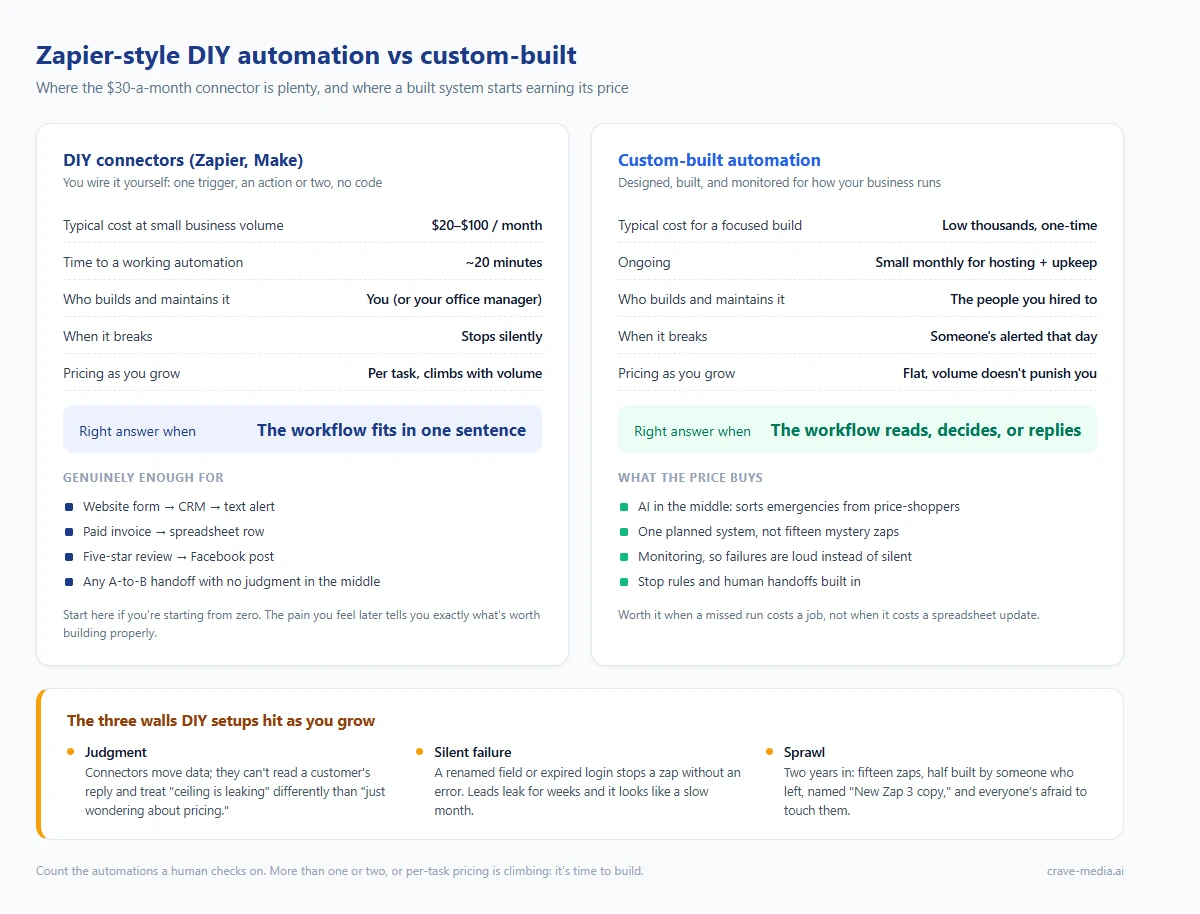
Where DIY connector tools and custom-built automation each win, and the walls most small businesses hit as they grow. Download as PDF
View interactive version
What a custom build adds
When we build an automation for a client, the wiring between apps is the boring part. What you're paying for is the stuff around it.
Judgment, first. A custom build can put AI in the middle of the workflow, reading replies, sorting the emergency from the price-shopper, drafting the response a human approves. That's the difference between an automation that forwards messages and one that handles them. Our invoice follow-up write-up walks through a version of this: the sequence itself is simple, but knowing to stop the instant a payment lands, and routing "I need a payment plan" to a person instead of a fourth reminder, is where the tool earns its keep.
Second, it fails loudly. A built system gets monitoring. When something breaks, a specific person finds out that day, and it's their job to fix it. No three-week silent lead leak.
Third, it's one system instead of a pile. The fifteen zaps become one flow with an owner, documentation, and a shape somebody chose on purpose. When you want to change how leads are routed, you change it in one place.
There's a fair objection here: can't a really sharp office manager build all this in Zapier with enough paths and filters? Sometimes, yes. Zapier has grown branching logic and even some AI steps. But at that complexity you're no longer doing DIY automation, you're doing unpaid software development in a no-code costume, and the person doing it has another full-time job. The question stops being whether the tool can and becomes whether anyone at your company should.
The cost math
Rough numbers, because vague answers are useless. A DIY setup runs $20 to $100 a month at typical small business volume, plus the hours someone spends building and babysitting it. A focused custom automation from us is usually a one-time build in the low thousands, with a small monthly for hosting and upkeep. We published the full breakdown in what custom AI tools cost, so we won't rehash every tier here.
The math flips on two hinges. Volume is one: per-task pricing punishes growth, one-time builds don't. The other is what a failure costs you. If a broken zap means a spreadsheet is a day behind, DIY forever. If it means after-hours emergency calls go unanswered, the reliability is the product, and that's what the custom price is buying.
How to decide
Our actual advice, the same thing we say on those first calls:
Start DIY if you're starting from zero. Wire the one-sentence workflows yourself this week. You'll automate the easy 60% for almost nothing, and you'll learn more about your own operation than any consultant could tell you.
Go custom when the workflow needs to read, decide, or reply; when a silent failure costs real revenue; or when your zap collection has become something everyone's afraid to touch. If you're not sure which side you're on, count how many of your automations need a human to check whether they ran. More than one or two is your answer.
And if the real answer is that you don't need automation at all yet, only better habits or better software, that's a legitimate outcome too. We wrote about the custom vs off-the-shelf decision more broadly, and "neither, yet" is an answer we've given more than once.
Duct tape is fine until it's load-bearing
Zapier is duct tape, and we mean that kindly. Duct tape is genuinely great. It's cheap, it's fast, everyone can use it, and half the fixes it makes never need anything more.
You just don't want it holding up the part of the business that answers customers at 2 a.m. When the workflow starts carrying weight, when a missed run means a missed job, that's when it deserves a real structure under it. If you're trying to figure out which side of that line your operation is on, tell us what you've got wired up and we'll give you the same honest answer we'd give over a beer, including "keep the duct tape" if that's the truth.

About the author
Zac Spencer is an online marketing specialist and the owner of Crave Media, based in Salt Lake City, Utah. Since 2013 he has managed hundreds of Google Ads accounts across dozens of industries — with budgets from a few hundred dollars to $250K a month — and founded Crave AI to build custom AI tools and automations for local service businesses.