

How to become the answer AI assistants quote
Ask ChatGPT what a water heater replacement costs in your town and read the answer it gives. Somewhere in there is a price range, a timeline, maybe a note about permits. That information came from somebody's website. One plumber in your market wrote a sentence clear enough for a machine to repeat, and now that sentence, with that plumber's name attached, is the answer everyone gets.
This is the part of AI visibility most businesses never touch. Directories, reviews, and your Google Business Profile decide whether a model knows you exist. Your content decides whether the model has anything to say once it finds you. And models don't summarize websites the way people assume. They quote. They lift the sentence that answers the question and leave everything around it behind.
So the practical question is narrower than "how do I rank in AI search." It's: does your site contain sentences worth lifting?
Why models quote instead of summarize
An assistant answering "how much does drain cleaning cost in Mesa" is doing retrieval under risk. It pulls a handful of pages, scans them for something that answers the question directly, and repeats the safest candidate. Safe means the sentence stands on its own: a fact, ideally with a number in it, that doesn't need the rest of the page to make sense.
Most local business websites contain zero sentences like that. They contain paragraphs like "We're proud to offer fast, affordable drain cleaning backed by decades of experience." A model can't do anything with that. There's no fact to extract, no number to repeat, nothing that answers what the customer asked. The page is about the business instead of the question, so the model moves on to a page that isn't.
The page it lands on is usually a competitor's, or worse, a national directory that publishes cost tables for every service in every city. When an assistant cites Angi's price range instead of yours, that's not the model being unfair. Angi wrote the sentence and you didn't.
The anatomy of a quotable sentence
Watch what assistants lift and a pattern shows up fast. Quotable sentences share four properties.
They're self-contained. "It takes about a week" fails because "it" lives three sentences back. "A full sewer line replacement takes two to four days" survives being ripped out of context, which is exactly what will happen to it.
They contain a real number. Price ranges, timelines, capacities, years. "Affordable" is not a number. "$189 to $350 depending on cleanout access" is, and a model asked about cost will walk past forty adjectives to get to it.
They're attached to a place. "Drain cleaning in Mesa typically runs..." gives the model the geographic match it's checking for. Generic national content gets outranked by anything that names the market.
And they're dated or datable. Models discount claims that could be ten years old. A price range on a page with a visible "updated September 2026" gets repeated with confidence; the same range on an undated page gets hedged or skipped.
None of this is exotic. It's the difference between writing about your services and answering the questions your phone rings with, in prose that survives being quoted one sentence at a time.
Publish the numbers you're hiding
Here's where we'll commit to advice most marketers soft-pedal: put your prices on your website. Ranges, not quotes, with the caveats that make them honest. The standard objection is that competitors will see them. Your competitors already know your prices. The people who don't are your customers and the AI assistants they ask, and both of them are being sent to whoever published a number.
The questions assistants get asked about local services are overwhelmingly the ones owners treat as trade secrets. What does it cost. How long does it take. Do you charge for estimates. What's the service call fee. Every one of those you answer in plain text is a query you become quotable for. Every one you hide is a query answered by a directory's national average, which is usually lower than your real price anyway, so the secrecy isn't even buying you anything.
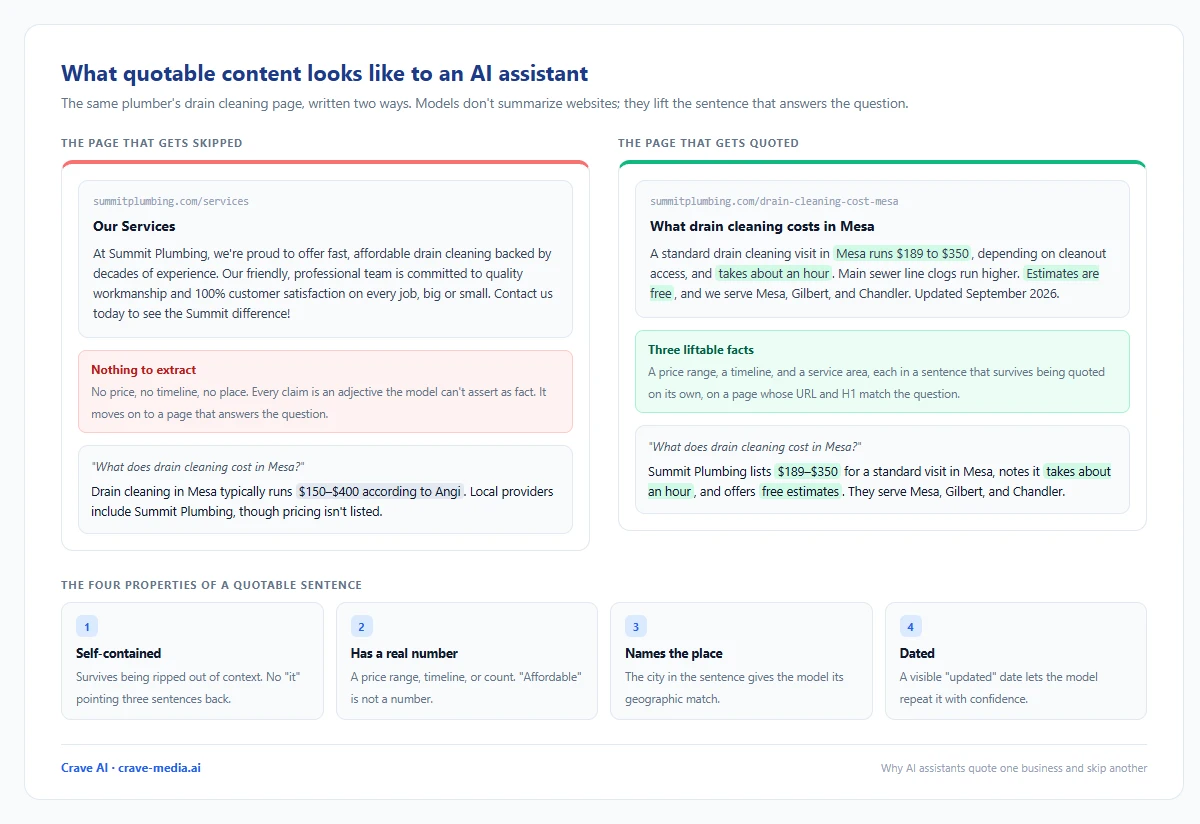
The same business, two ways of writing the same page. The left version gives a model nothing to extract. The right version hands it a price range, a timeline, and a service area, and the AI answer quotes all three with the business's name attached. Download as PDF
View interactive version
Structure the page so the answer is findable
A quotable sentence buried in paragraph nine of a rambling page may as well not exist. Retrieval favors pages whose structure telegraphs what they answer.
The reliable format is one question per page, answered immediately. The H1 states the question roughly the way a person would ask it. The first two sentences answer it, numbers included. Everything after that is supporting detail: what affects the price, what the process looks like, when the answer doesn't apply. This front-loading feels backwards to anyone trained to build suspense. Machines don't reward suspense, and neither do humans who searched a specific question at 9 PM.
Subheadings do the same signaling job one level down. An H2 that reads "What affects the cost" tells the model what the next three paragraphs contain. An H2 that reads "Our commitment to excellence" tells it nothing, because it is nothing.
A short FAQ block at the bottom of a service page earns its space twice: the question-answer format is the exact shape an assistant needs, and marked up with FAQ schema it becomes machine-readable in the most literal sense. We covered the markup side in schema markup for service businesses. Schema doesn't make weak content quotable, but it makes strong content unambiguous, and ambiguity is what kills citations.
One warning. Structure without substance produces the worst outcome: a page shaped like an answer that contains none. Ten templated city pages with the same 400 words and the city name swapped don't become ten quotable pages. Models cross-check against reviews, your profile, and each other, the same confidence math your Google Business Profile feeds. A page that claims what nothing else corroborates gets treated accordingly.
What never gets quoted
Some content does nothing in AI answers, and businesses keep investing in it anyway.
Superlatives are invisible. "The area's most trusted electrician" cannot appear in an AI answer, because no model will assert your marketing claim as fact. Mission statements, "why choose us" pages, and passion-for-quality copy fall into the same hole. They aren't wrong. They're just unquotable, and a site made entirely of them is a site an assistant finds and then has nothing to say about.
Information trapped in images and PDFs is nearly as bad. The price list that exists only as a photographed flyer, the service menu in a downloadable brochure. If the fact isn't in the page's text, for retrieval purposes you never published it.
Find out what you're quotable for right now
The test costs nothing. Ask ChatGPT and Gemini five questions a real customer would ask about your services, phrased with your city in them. What does X cost, who does Y, how long does Z take. Note whose numbers come back. If the answer cites a directory or a competitor, you've found a page you need to write, and you know precisely what sentence needs to be on it.
Becoming quotable is one layer of the whole visibility job, and it sits on top of the foundations we walked through in the AI search optimization checklist: the profile, the directories, the reviews, the schema. Content is the layer where you stop merely being known to the model and start being useful to it. It's also the layer we build for clients as part of our AI visibility service, and if you'd rather see the gaps than guess at them, get in touch and we'll run your market's questions and show you who's getting quoted today.
The assistants aren't going to stop answering these questions. The only open question is whose sentences they use. Write the ones you want read back.

About the author
Zac Spencer is an online marketing specialist and the owner of Crave Media, based in Salt Lake City, Utah. Since 2013 he has managed hundreds of Google Ads accounts across dozens of industries — with budgets from a few hundred dollars to $250K a month — and founded Crave AI to build custom AI tools and automations for local service businesses.