

Why your Google Business Profile feeds AI answers
Ask Gemini for a good HVAC company in your town and read the answer closely. The hours it quotes, the services it says you offer, the "family-owned" detail, the note that you handle emergency calls. Almost none of that came from your website. It came from your Google Business Profile.
For most local businesses, the profile now matters more to AI search than the website does. That sounds backwards after twenty years of website-first marketing, but the mechanics are plain: your Google Business Profile is the most structured, machine-readable document about your business that exists anywhere on the internet. When a model needs facts about you, it reaches for the cleanest source first. You wrote that source, probably in twenty distracted minutes three years ago, and you may not have opened it since.
The good news is that the same twenty minutes, spent deliberately, moves the needle further than almost anything else you can do for AI visibility.
Why the model trusts your profile more than your website
Your website says whatever you want it to say. Google knows this, and so does every model trained to be skeptical of marketing copy. A homepage claiming "the area's most trusted roofer" is an assertion. A verified business profile with a confirmed address, a category selected from Google's own taxonomy, and 214 reviews attached is evidence.
The profile also arrives pre-digested. A website has to be crawled, parsed, and interpreted; a paragraph about your services might mention six things you do and four you don't, in prose a model has to untangle. The profile hands over the same information as labeled fields. Category: plumber. Services: water heater installation, drain cleaning, repiping. Hours: open now. Serves: these five zip codes. There's no interpretation step, so there's nothing to get wrong.
For Google's own AI surfaces, the pipeline is even shorter. AI Overviews and Gemini sit on top of the same Maps and knowledge graph data that powers the map pack, and your profile is the front door to that data. When an AI Overview says a business is open until 7 and takes walk-ins, it's reading the profile, full stop. Assistants outside Google's walls get there a step slower, through web search results and the listing data that syndicates out to the wider directory ecosystem, but a large share of what they find traces back to the same profile. We mapped that wider ecosystem in the directories that feed AI search results; the profile is the hub most of those spokes copy from.
The fields doing the heavy lifting
Not every field pulls the same weight. A few of them decide most of what AI says about you.
Your primary category is the strongest single signal on the profile. It answers the model's first question, "what is this business," in one authoritative word. Businesses regularly get this wrong in ways that are invisible on Google search and costly in AI search. A company set to the generic "contractor" category doesn't come up when someone asks for a bathroom remodeler, because the model took the profile at its word. Check the primary category, make it the most specific one that fits, and add the secondary categories for real service lines. Ten seconds per decision, and each one redraws the set of questions you're eligible to answer.
The services list works the same way, one level down. Every service you add is a fact the model can repeat; every one you skip is a job you do that the model doesn't know about. The businesses that filled this section out carefully get described in specifics ("they do tankless water heater installation") while their competitors get a shrug ("they appear to offer plumbing services"). Specific descriptions win recommendations, because the model sounds confident repeating them.
Hours matter more than they seem to. "Who can I call right now" is one of the most common shapes of local AI query, and the model filters by stated hours before it weighs anything else. If your profile says you close at 5 but you answer emergency calls all night, you're invisible for the exact queries you most want. If you have a 24/7 line, the profile needs to say so.
The description and attributes fill in the texture. Attributes are checkboxes, which makes them model-safe facts: veteran-owned, wheelchair accessible, free estimates, onsite parking. The description is the one free-text field you control, and models quote it, so treat it as the two sentences you'd want repeated verbatim to a customer. Plain language, what you do, where, and what makes you the sane choice. No slogans; a model quoting "your comfort is our passion" helps nobody.
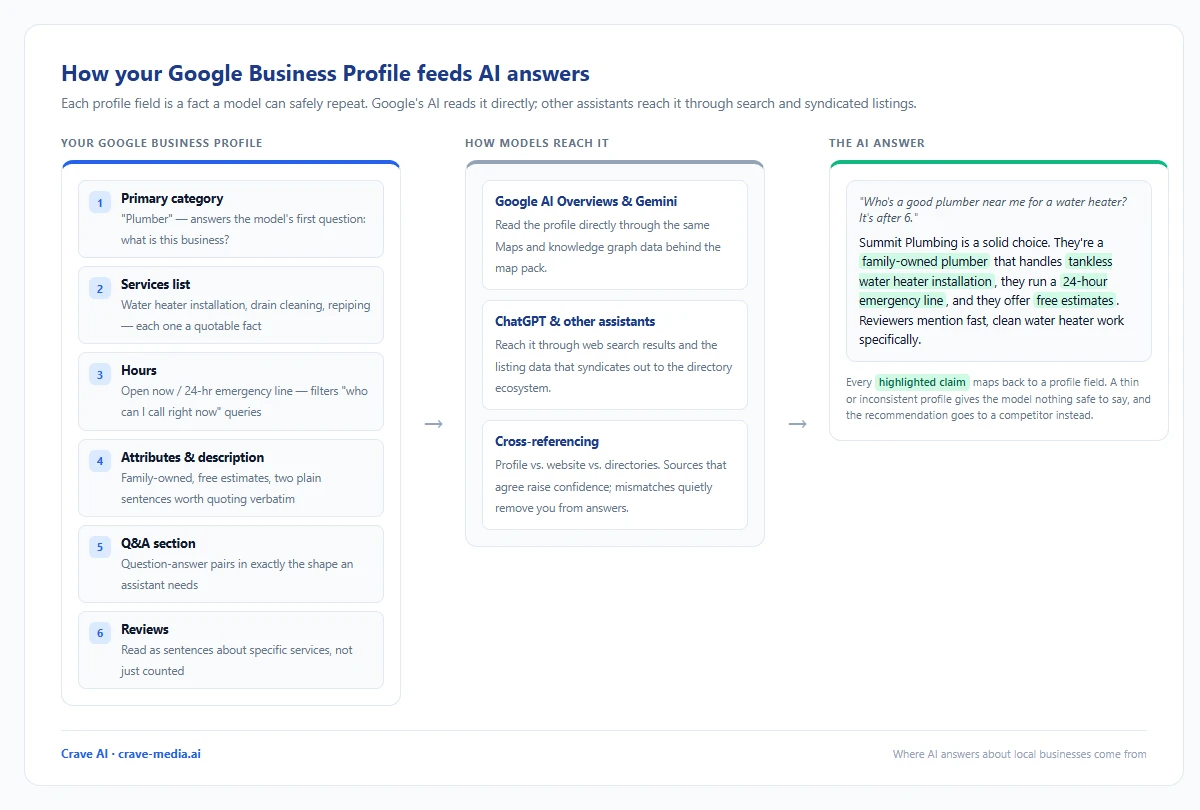
How Google Business Profile fields become sentences in an AI answer. Google's own AI surfaces read the profile directly, other assistants reach it through search and syndicated listings, and each field maps to a claim the model can safely repeat. Download as PDF
View interactive version
The Q&A section nobody is using
Scroll down any local business profile and you'll find a Questions & Answers section that is, at most businesses, a ghost town. Maybe one question from 2021, answered by a random member of the public instead of the owner. It reads as clutter, so owners ignore it.
Look at what the format is, though: literal question-and-answer pairs, attached to a verified business, in the exact shape an assistant needs when a user asks the same question. "Do you work on mobile homes?" "Is there a fee for estimates?" "Do you handle insurance claims?" When a model can lift the answer from your own Q&A, you become the business it can answer questions about, and the one it can't gets left out of the conversation.
You don't have to wait for customers to ask. Post the ten questions your office answers on the phone every week, and answer them yourself as the owner. It's an hour of work. Of everything in this post, it's the piece your competitors are least likely to ever do.
An inconsistent profile is worse than a thin one
Models cross-reference. Before naming you in an answer, an assistant is weighing your profile against your website, your Yelp listing, the data-aggregator records, and whatever else it can retrieve. When those sources agree, confidence goes up. When your profile says you close at 5, your website footer says 6, and an old directory listing has your previous address, the model doesn't average it out. It gets quietly less certain about everything, and uncertain businesses don't get recommended.
This is the part of the job that feels like bookkeeping, and it is. Same name, same address, same phone number, same hours, everywhere they appear. Your reviews feed the same confidence math, and they deserve their own discussion; we wrote up how reviews shape AI recommendations separately. The short version is that review text gets read as evidence about specific services, which means the profile where those reviews live is doing double duty.
A twenty-minute profile audit
Open your profile in Google's business dashboard and check five things in order. First, the primary category: is it the most specific one that describes your core business? Second, the services list: is every service you sell on it, named the way a customer would say it? Third, hours, including whether your after-hours availability is represented. Fourth, the description: two plain sentences you'd be glad to hear a machine repeat. Fifth, Q&A: seed it with the questions your phone rings with.
Then run the test we suggest in every post in this series. Ask ChatGPT and Gemini for your service in your city, phrased the way a neighbor would ask, and see whether the answer describes you specifically or vaguely, or skips you. We walked through what that test tells you in what Gemini and ChatGPT know about your business. Most owners who run it find at least one wrong or missing fact being repeated to customers right now, and most of those facts live on the profile.
Keeping the profile accurate is the unglamorous center of our AI visibility service, alongside the directory cleanup and content work that feeds the rest of the answer. If you'd rather have us run the audit and show you exactly what the models are saying about you, get in touch and we'll pull the report.
Your Google Business Profile used to be a box you checked so the map pack would take you seriously. Now it's the primary source for machines that answer customers directly. It deserves the same attention your homepage gets, and it repays that attention faster.

About the author
Zac Spencer is an online marketing specialist and the owner of Crave Media, based in Salt Lake City, Utah. Since 2013 he has managed hundreds of Google Ads accounts across dozens of industries — with budgets from a few hundred dollars to $250K a month — and founded Crave AI to build custom AI tools and automations for local service businesses.