

How AI search decides where a service area business works
A two-truck plumbing shop in Dublin, Ohio does a dozen jobs a month in Hilliard. Hilliard is about six miles down the road. The owner, call him Tom, asks ChatGPT for "a good plumber in Hilliard" one night out of curiosity. He gets three names: two shops with Hilliard addresses and a Columbus franchise. He asks the same thing about Dublin and his shop comes up second.
Nothing is wrong with his business. The assistant just has no evidence that he works in Hilliard. That's the core problem for any service area business in AI search: you go to the customer, so there's no storefront tying you to a town, and the model has to piece your coverage together from whatever scraps of the web mention you next to a place name. If every scrap says Dublin, you're a Dublin plumber, and the dozen Hilliard jobs might as well not exist.
An assistant has to guess your coverage
Google gives service-area businesses a specific setup. Its Business Profile guidelines say that if you don't serve customers at your address, the way a plumber working out of his house doesn't, you should hide that address. In its place you list up to 20 service areas by city or ZIP code, and Google asks that the whole area stay within about two hours of driving from where you're based.
That list helps, but less than most owners assume. When Google explains how local results are ranked, it names relevance, distance, and prominence, and the service-area list isn't mentioned. We wouldn't count on it to get you named in a town by itself. ChatGPT, Perplexity, and the rest publish even less about how they decide. Nobody outside those companies knows the recipe.
You can see what they cite, though. Run enough local prompts, read the sources listed under the answers, and the same kinds of pages keep turning up: profiles, review sites, directories, and the occasional plumber's own page about a specific suburb.
Where the town evidence comes from
Think of it as a pile of mentions, each one pairing your business name with a place. The model weighs the pile. Five kinds of mentions do most of the work.
Your Business Profile service areas
Start here because it takes ten minutes. List the towns you drive to every week, by name, not a giant county you touch twice a year. If Hilliard is a dozen jobs a month, it belongs on the list. Our post on why your Google Business Profile feeds AI answers covers the rest of the profile; for coverage, the service-area list is the field to fix first.
Reviews that name the town
Reviews are the hardest evidence to fake, and we'd guess that's why they carry so much weight. A review that says "came out to our place in Hilliard the same afternoon our water heater went" ties your name to Hilliard in a customer's own words, on a site the assistant already reads.
You can't script reviews, and you shouldn't try. You can make the town come up naturally. When the text asking for a review goes out, have it mention the job: "Thanks for having us out to Hilliard for the water heater." Some customers will echo it. Some won't. Over a year, a few dozen reviews mentioning Hilliard is a real signal that didn't exist before. We wrote more about how reviews shape AI recommendations, including why the wording inside the review counts as much as the star count.
Pages on your site for real towns
A page about your work in Hilliard gives a model something to match a "plumber in Hilliard" question against. Most town pages are junk, though. More on that below.
Directory listings and their addresses
This one sneaks up on people. You hid your address on Google, but your Yelp, BBB, Angi, and chamber of commerce listings probably still show a city, usually whatever city your mailing address is in. Thirty listings all saying "Dublin, OH" is thirty votes for Dublin and zero for anywhere else. You can't change where you're based, and you shouldn't fake it. Many of those directories have a service-area or "areas served" field, though, and most owners leave it blank.
Job photos and project write-ups
A photo captioned "Tankless swap, Hilliard, October 2026" on your site, your Facebook page, or your profile is a small dated fact about where you work. One of them does nothing. Forty over a year starts to add up, and it costs the tech three seconds when he posts the photo.
Why "all of central Ohio" reads as nothing
Look at your website footer and your About page. There's a decent chance one of them says something like "proudly serving all of central Ohio" or "Columbus and surrounding areas."
It sounds generous. It also gives a model answering "plumber in Hilliard" nothing to go on, because the customer typed a town and your page never named one. "Surrounding areas" can't be matched to anything.
Write the sentence you'd want read back instead: "We do water heater, drain, and repiping work in Dublin, Hilliard, Powell, and Upper Arlington, usually same-day for leaks." Put a version of that on your homepage and your main service pages. We covered what makes a sentence liftable in how to become the answer AI assistants quote, and the town list follows the same rules.
Town pages, and when to skip them
The cheap version is a template: one page per town, the same 400 words with "Hilliard" swapped for "Powell" swapped for "Grove City," maybe a stock photo of a water tower. Some agencies still sell these by the dozen. Google's spam policies name the pattern directly. Their doorway abuse section lists "multiple domain names or pages targeted at specific regions or cities that funnel users to one page" as an example. Spam risk aside, a templated page gives an assistant nothing to quote, since every version says the same thing.
A town page earns its spot when it's full of things only someone who works there would know:
- Jobs you've done there this year, with the kind of house and the problem ("1950s ranches still on their original galvanized supply lines")
- What those jobs cost, as real ranges
- Permit notes from your own pulls in that town, if the process differs from your home base
- How fast you can usually get there, and from where
- A couple of reviews from customers in that town
Three town pages written from real jobs beat twenty swapped ones. If you can't fill a page for a town with things from actual work there, skip the page. Put the town in your service sentence and your profile list and let reviews and photos carry it until you have enough material.
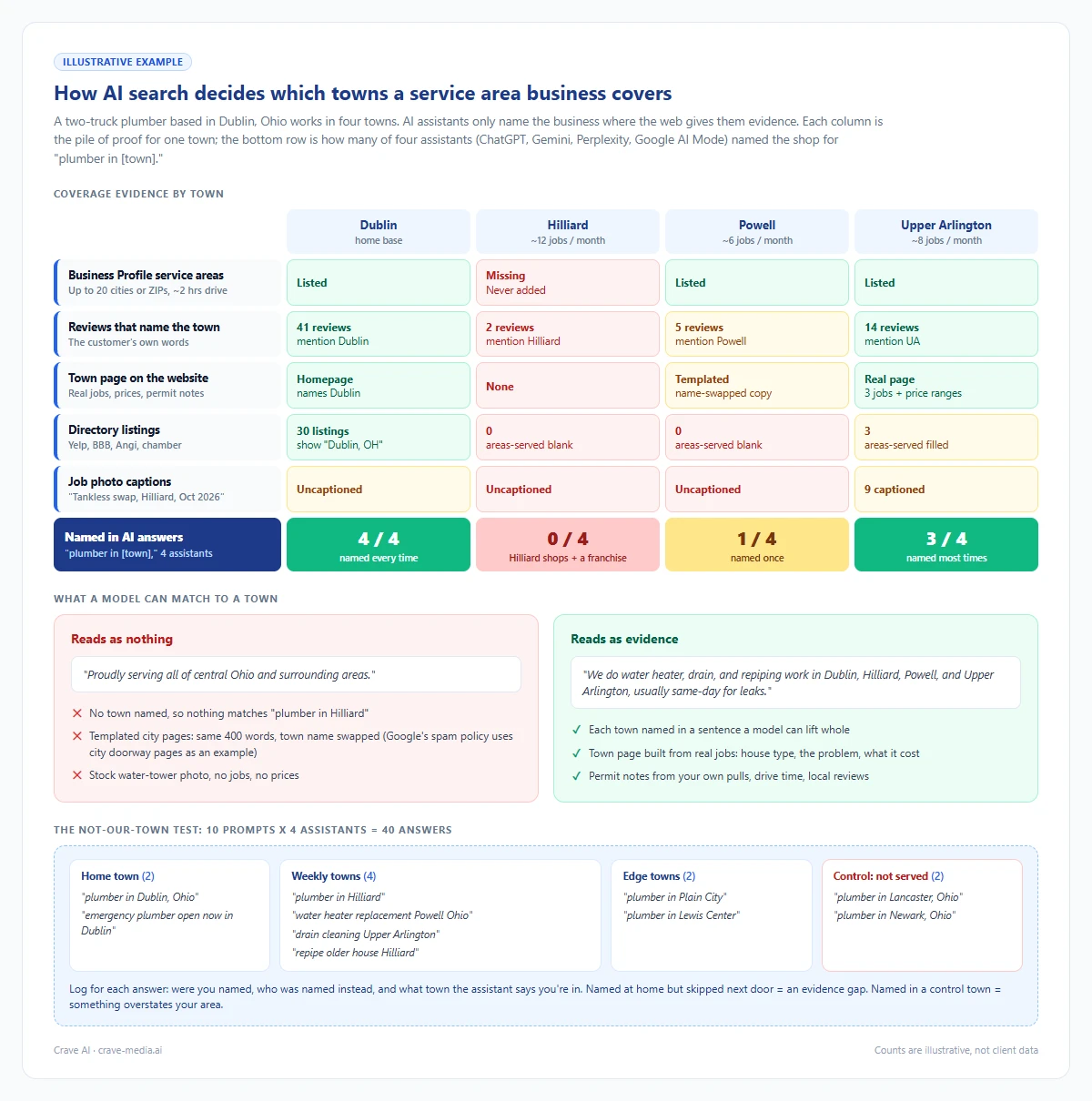
How AI assistants piece together a service area business's coverage: each town needs its own evidence, and the towns with the thinnest pile are the ones where the business doesn't get named. Download as PDF
View interactive version
Run the not-our-town test
You can find out where you stand in about forty minutes. Write ten prompts in the form your customers use, built around towns:
- Your home town, your main service: "plumber in Dublin, Ohio"
- Your home town, an emergency: "emergency plumber open now in Dublin"
- Four towns you work in every week: "plumber in Hilliard," "water heater replacement Powell Ohio," and so on
- Two towns at the edge of your area that you'd like more of
- Two towns you don't serve at all, as a control
Run all ten in ChatGPT, Gemini, Perplexity, and Google's AI Mode, each in a fresh chat. That's forty answers. For each one, write down whether you were named, which competitors were named instead, and what town the assistant says you're in.
The pattern usually jumps out. If you're named for Dublin and skipped for Hilliard across all four assistants, that's an evidence gap, and the five sources above tell you where to fill it. If one assistant names you in Hilliard and the others don't, look at what that one cited. If you show up for the control towns you don't serve, something is overstating your area, and that's worth fixing too, because those calls waste your dispatcher's time.
Save the forty answers. Run the same ten prompts again in sixty days. The monthly prompt-check routine from our tracking post works fine here if you'd rather fold it into something you already do.
Prove you've been to Hilliard
Tom's list is short and none of it involves a new website: Hilliard on his profile list, a review-request text that says "thanks for having us out to Hilliard," techs who type the town into photo captions, and one page about the galvanized repipes he's been doing in those 1950s ranches, with what they cost. Give it a season, then run the ten prompts again and see whether ChatGPT still sends Hilliard to the Columbus franchise.
Pick the one town you most want calls from and start its pile this week. If you'd like someone to run the forty-answer test and build the pile with you, that's what our AI visibility work covers, and you can reach us here.

About the author
Zac Spencer is an online marketing specialist and the owner of Crave Media, based in Salt Lake City, Utah. Since 2013 he has managed hundreds of Google Ads accounts across dozens of industries — with budgets from a few hundred dollars to $250K a month — and founded Crave AI to build custom AI tools and automations for local service businesses.