

AI estimate tracking for a painting company
Late August is the strangest month on a painter's calendar. You're busier than you've been all year, and you're also six weeks from the point where exterior work stops making sense. Somewhere in your truck, or your email, or a notes app, there are a dozen estimates you sent in July that never got signed. Some of those people are still deciding. Some already hired the guy who called them back first. You don't know which is which, and you don't have an afternoon to find out.
That's the gap the AI tools a painting business needs are built to close. Not a chatbot, not a fancy website. An estimate board that knows how old every open quote is, what it's worth, whether it's exterior work that has to happen before October, and what the next move is. Below is the version we'd build, with a mockup of what it looks like on a Thursday in late August.
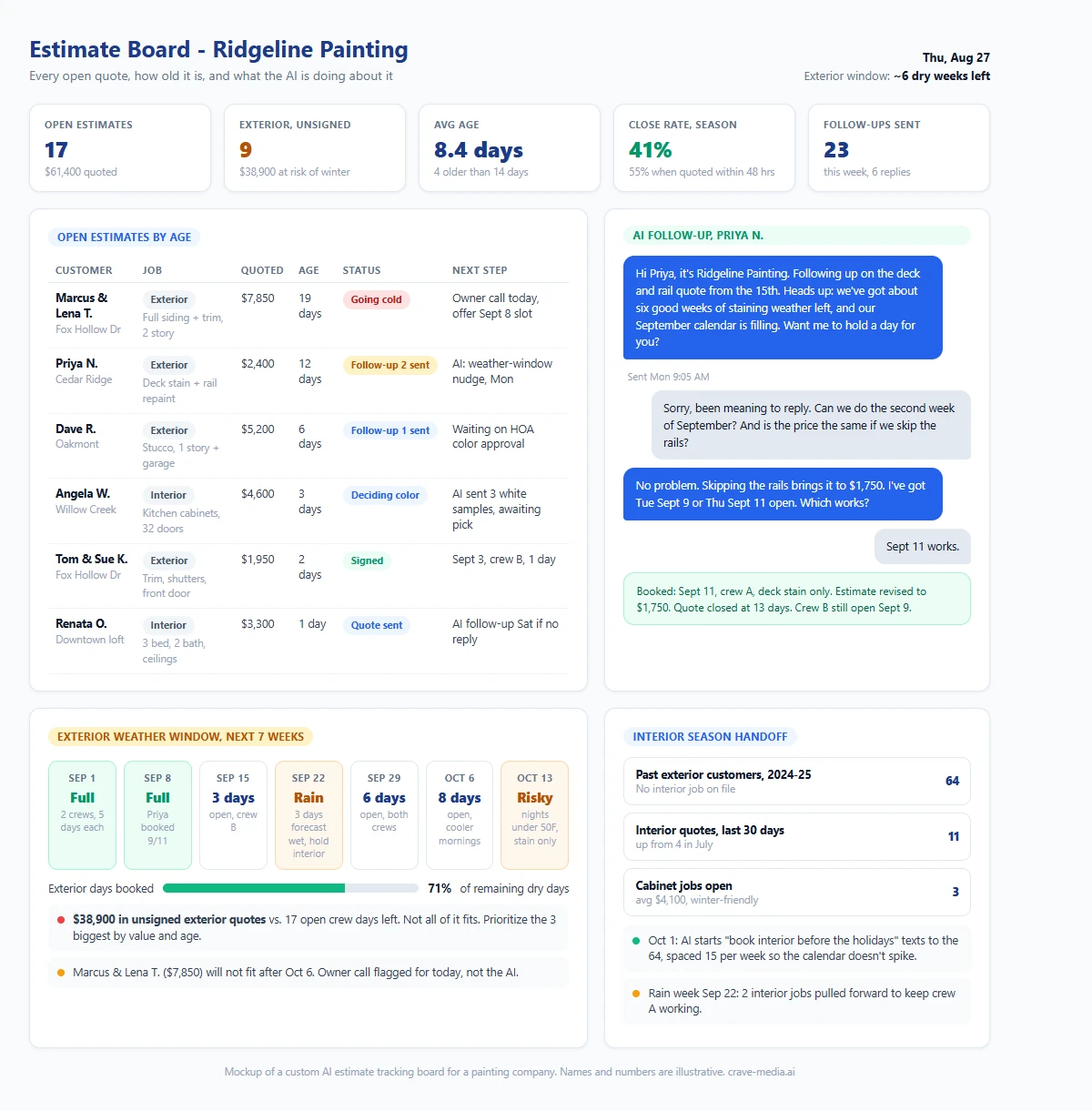
The estimate board at a glance: every open quote sorted by age, an AI follow-up that turns a stalled deck quote into a September booking, the remaining exterior weather window mapped against crew days, and the interior handoff that keeps crews busy once the weather turns. Download as PDF
View interactive version
The estimate you forgot is the job you lost
Painting quotes die of neglect more than they die of price. A homeowner requests three or four bids, meets three or four painters, and then life happens. The kids go back to school. The quotes sit in a kitchen drawer. Two weeks later one painter texts to check in, and that painter gets the job, often without ever being the cheapest.
Most painting companies know this and still can't do anything about it, because following up requires remembering. The owner is on a ladder all day. The office, if there is one, is a spouse with a laptop after dinner. Estimates go out in a burst after a week of site visits and then nobody looks at them again until the phone rings. When it doesn't ring, the quote just fades.
An estimate board fixes the remembering part. Every quote that leaves your company gets a birthday, a dollar value, a job type, and a next step. The board sorts by age, so the quotes that are about to go cold sit at the top where you can't miss them. In the mockup, Marcus and Lena's $7,850 siding job has been sitting for 19 days. That's not a follow-up text anymore. That's an owner phone call, today, with a specific September date in hand, and the board says so.
Follow-up that runs while you're on the ladder
Here's the part the AI handles on its own. When a quote crosses day three with no reply, the system sends a short check-in from your business number. Day seven, another one, a little more direct. Day twelve, it offers something concrete: a date. The messages are written once, in your voice, and the AI fills in the specifics from the estimate itself, so the customer hears about their deck and their rails, not a generic "following up on your project."
The replies are where it earns its keep. Look at the Priya conversation in the mockup. She'd been sitting on a $2,400 deck and rail quote for twelve days. The follow-up mentioned the weather window and the filling calendar, which is true and useful, and she wrote back asking about the second week of September and whether she could drop the rails. The AI answered both, quoted the revised $1,750 from the line items in the original estimate, offered two open crew days, and booked one. The owner found out when the confirmation hit the board. Thirteen days to close, zero owner minutes spent.
We walked through the mechanics of this in our electrician quote follow-up blueprint, and the plumbing is the same: a business texting number, your estimates as the data source, and an AI layer that knows which questions it can answer and which ones need a person. "Is the price the same without the rails" is answerable from the quote. "Can you match the other guy's bid" is not, and that reply gets routed to you with the thread attached. It's the same routing we use in our lead follow-up builds, pointed at quotes instead of fresh leads.
Exterior quotes have an expiration date
This is what makes painting different from most trades we build for, and why the board has a weather panel. An unsigned interior quote in August is a normal open quote. An unsigned exterior quote in August is a countdown. Most exterior coatings want surface and air temperatures above roughly 50 degrees, including overnight, and by mid-October in a lot of the country the nights stop cooperating. Stain has a little more room. Full siding jobs don't.
So the board does the math you'd do if you had time. It takes the remaining dry weeks, subtracts the days already booked, and shows you how many exterior crew days are left. Then it puts that number next to the total value of unsigned exterior quotes. In the mockup that's 17 open crew days against $38,900 in quotes that haven't signed. Those don't all fit. Some of that work is going to slide to next spring or go to a competitor no matter what you do, and the board's job is to make sure the jobs that slide are the small ones, not the $7,850 one.
The follow-up messages change tone accordingly. An interior quote gets a friendly check-in. An exterior quote gets the honest version: we have about six good weeks left, the calendar's filling, want us to hold a day. It's what you'd say on the phone if you had time to call, and homeowners respond to it because it's true. The same seasonal logic sits behind our pressure washing peak-season blueprint; the difference is that a washer's season ends in a shrug and a painter's ends in a hard stop.
Crew scheduling against the forecast
The weather panel also feeds scheduling, which is where a lot of painting companies quietly lose a week or two every fall. A rain week cancels the exterior jobs, and then it leaves a crew idle unless there's interior work ready to pull forward. Pulling interior work forward means someone already had it quoted, signed, and sitting in a queue.
The board handles that by keeping the two pipelines side by side. When the forecast turns the week of September 22 wet, the system flags two signed interior jobs that could move up and asks whether to text those customers. If the answer is yes, crew A keeps working and the exterior jobs shift a week without anyone having to rebuild the calendar by hand. Cabinet refinishing is the ideal filler here, since it's indoor, high-ticket, and customers rarely mind an earlier date.
Crews get matched to jobs by type and daylight, too. A two-story siding job wants full days and the crew that's fast on ladders; trim and shutters can take a Friday afternoon. The board shows the open slots and the jobs that fit them. You drag.
Handing off to interior season
The last panel on the board is the one most painting companies never build, and it's the one that decides whether winter is quiet or dead. Every exterior customer you've painted in the last two years is a warm interior lead. They know your crew, they've seen your prep work, and they have rooms they've been meaning to do. Almost nobody markets to them.
The board keeps that list. In the mockup it's 64 past exterior customers with no interior job on file. Starting October 1, the AI begins working through it, fifteen texts a week, offering to get interior rooms done before the holidays. Spacing it out matters. Blast all 64 on the same Monday and you'll book three weeks of work into one and have nothing in November. Fifteen a week fills the calendar evenly and gives you a slow-season plan that starts before the slow season does. We covered the general version of this in our slow season automation post; painting just has an unusually clean trigger, because the season change is on the calendar.
Interior quotes need their own follow-up cadence, and it's a gentler one. There's no weather countdown, but there's a different stall: color. A homeowner who can't pick a white will delay a $4,600 cabinet job for a month. So when an interior quote sits, the follow-up offers help instead of a deadline. Three sample whites, a photo of a similar kitchen, an offer to bring the fan deck by. Angela's cabinet job in the mockup is at day three with "deciding color" as the status, and the AI's move was to send samples. We'd argue color paralysis is a service problem, not a sales problem, and the companies that treat it that way close more cabinet work.
When a spreadsheet is enough
If you're a solo painter sending a few quotes a week, a spreadsheet with a date column and a Friday habit gets you most of this. Sort by date, text the old ones, done. The generic CRMs also do the tracking part fine, and if you're already using one and you're disciplined about it, don't rip it out.
Where the custom build pays for itself is at the point where you're sending more quotes than one person can remember, which for most painting companies is somewhere between two and four crews. At that volume the follow-up doesn't happen, the exterior countdown gets ignored until it's too late, and the interior list never gets built because nobody has the hour it takes. The build itself is your estimating tool or spreadsheet as the source of truth, a business texting number, a weather feed, and an AI layer wired to your calendar, the same foundation as most of the custom automations we put together. Figure a few weeks to set up, most of it spent getting your old estimates imported and your follow-up messages sounding like you, then a monthly cost that's mostly texting volume. Against a single recovered $5,000 exterior job, the math isn't close. The rest of the picture is on our AI for painting contractors page.
Sign them before the leaves turn
A painting company's fall is decided in the next six weeks, and it's decided by follow-up more than by bidding. The quotes are already out. The customers already met you. What's missing is a system that remembers every one of them, tells the exterior ones the truth about the weather, and books the interior ones before the calendar goes quiet.
If you've got a stack of July estimates you haven't looked at, tell us about your painting business and we'll sketch the board that fits it, including the part where the AI texts them for you this week.

About the author
Zac Spencer is an online marketing specialist and the owner of Crave Media, based in Salt Lake City, Utah. Since 2013 he has managed hundreds of Google Ads accounts across dozens of industries — with budgets from a few hundred dollars to $250K a month — and founded Crave AI to build custom AI tools and automations for local service businesses.