

AI quality control dashboards for commercial cleaning companies
Commercial cleaning runs on a math problem most trades never face. A residential job that goes badly costs you one $150 customer. A commercial contract that goes badly costs you $2,000 to $5,000 a month, every month, plus the reference you needed to land the next building. One lost office contract can erase the margin from a whole quarter.
So when we think about AI tools for a commercial cleaning business, we don't start with leads. Landing new contracts matters, but the sales cycle is long and slow, and no dashboard shortcuts a procurement committee. The faster win is on the other side of the business: keeping the buildings you already have. That's a quality control problem, and quality control is mostly an information problem, which is exactly what software is for.
This is one of our blueprint posts, so the usual disclaimer applies. It's not a case study. It's the plan we'd draw up if a commercial cleaning owner walked in the door.
You find out about problems at the worst possible time
The brutal part of commercial cleaning is that your work is invisible when it's good and invisible when it's bad. Your crews clean at night. The property manager walks in at 8 a.m. and either notices nothing, which means you did your job, or notices a trash can that didn't get emptied, which means the building's opinion of you just moved and nobody told you.
Property managers don't call about the first missed trash can. They notice it, say nothing, and start keeping an informal score. By the time a complaint reaches you, it's usually the third or fourth thing they've noticed, and the version of events you hear has hardened into "the quality has been slipping." Then the contract review meeting arrives and you're negotiating from behind, defending your renewal against a list you've never seen.
The companies that keep contracts for a decade aren't the ones that never miss a trash can. They're the ones who find out the same night and fix it before the score starts.
What we'd build, a quality dashboard that reads by building
The first thing we'd put in front of a commercial cleaning owner is a dashboard with one row per building. Each row carries a quality score built from three feeds: your own supervisor inspections, issues reported by the client, and completion logs from the crews. Green buildings need nothing from you. A building trending yellow gets your attention this week, months before it costs you the account.
The inspection feed is the backbone. Supervisors already walk buildings; the difference is that their walkthrough happens on a phone with a scored checklist per area, so "Building C looked fine" becomes restrooms 92, lobby 98, break rooms 74. Scores make drift visible. A building that slides from 96 to 88 over six weeks looks fine on any single walkthrough, and looks like a problem on a chart.
The client feed matters just as much, because it moves complaints out of the property manager's mental notebook and into your system. Give every building contact a dead-simple way to report an issue, a portal link or even just a text number, and the complaint that would have waited for the quarterly review instead lands on your operations board the same morning, tagged to the building and floor.
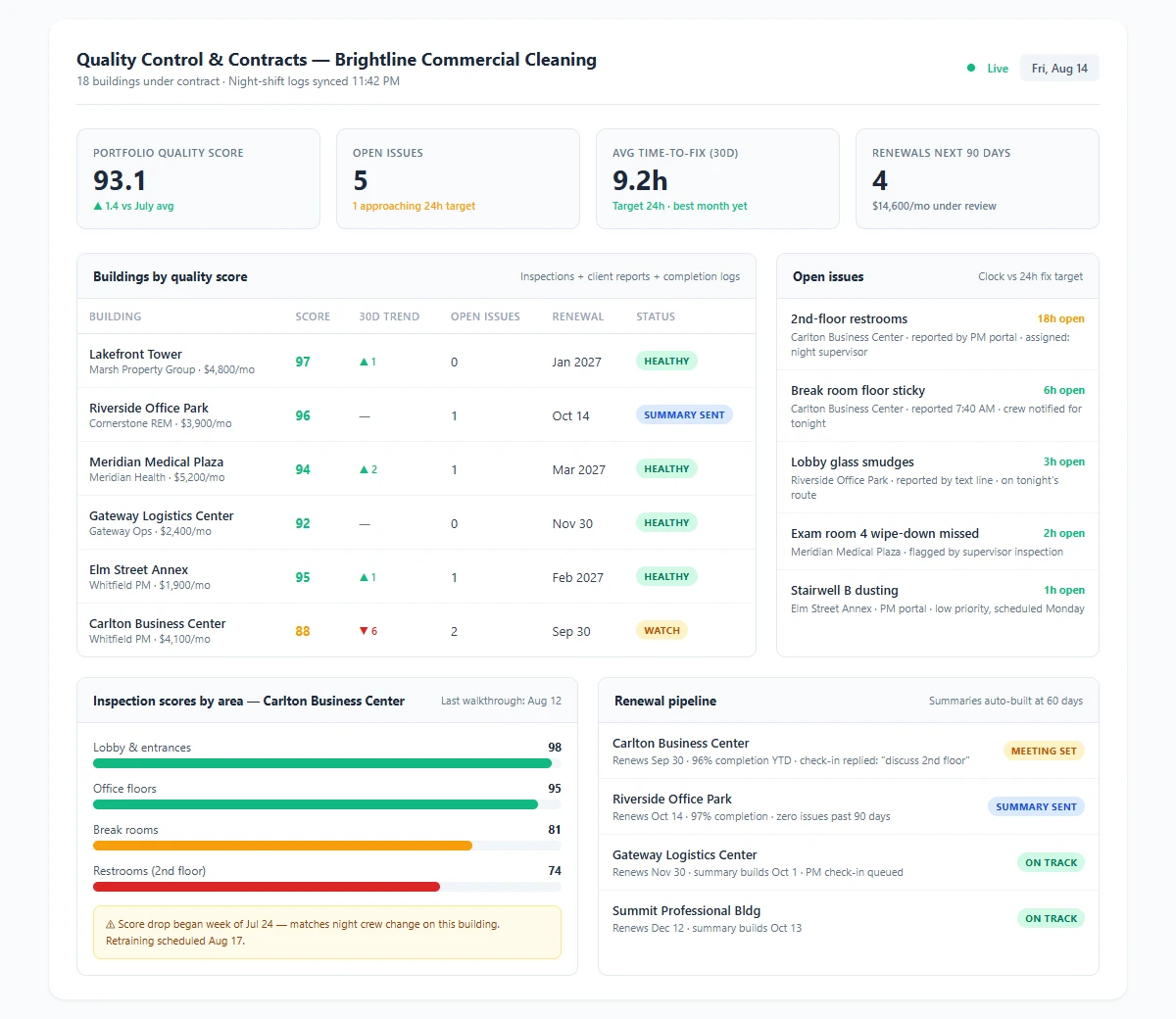
The quality control and contract dashboard we'd build for a commercial cleaning company: per-building scores from inspections and client reports, open issues with a clock on them, and the renewal pipeline. Download as PDF
View interactive version
Play out a real month on that screen. The dashboard shows Building C took two restroom complaints in thirty days, both on the second floor. You pull the inspection log and see the second-floor scores dropped right when the night crew changed three weeks ago. That's a training gap with a start date. You retrain the new crew, the scores recover, and when the property manager mentions it at the quarterly meeting, you get to say it was caught and fixed in week one. Try reconstructing that story from memory and a clipboard.
A clock on every complaint
Tracking complaints is table stakes. The number we'd actually put on the wall is time-to-fix: the hours between an issue being reported and the client confirming it's resolved.
Commercial clients are more forgiving than most owners assume. Property managers deal with vendors all day, and they know things go wrong. What they're really evaluating is what happens next. A missed floor that's corrected the same night with a "fixed, here's the photo" message builds more trust than a month of nobody noticing anything. A missed floor that takes three follow-up emails is how a $4,000-a-month account starts reading other companies' proposals.
So every issue in the system carries a timer. Reported at 7:40 a.m., assigned to the night supervisor by 8:00, marked complete at 11:15 that night, client notified with a photo at 11:20. The AI handles the choreography: routing the issue to whoever runs that building, nudging when a timer is about to blow past the standard you've set, and sending the closure message so the property manager sees the fix without your office lifting a finger. Your dashboard shows average time-to-fix per building, and that number is the single best predictor of whether a renewal will be easy.
The renewal that starts 60 days early
Most commercial cleaning companies treat renewals the way students treat exams: nothing for months, then cramming the week before. The client brings up renewal, someone scrambles to remember how the year went, and if there's been a rough patch recently, the rough patch is the whole story.
We'd flip the calendar. Sixty days before each contract's renewal date, the system builds a service summary on its own: scheduled cleanings completed, issues raised, average time-to-fix, inspection score trend. Then it drafts a check-in to the property manager. Something like: "Your renewal is coming up in a couple of months. Before we send anything over, is there any feedback or anything you'd want changed for next term?"
That one message does two jobs. It surfaces problems while there's still sixty days to fix them, and it makes you look like the most organized vendor they work with, which for a property manager juggling forty vendors is nearly the whole ballgame. When the actual renewal conversation happens, you walk in with a one-page summary showing 97% completion and every issue resolved inside a day. The conversation starts from your numbers instead of their vague impressions.
Almost nobody does this. Waiting passively for renewal is the industry default, which is precisely why the pre-renewal check-in reads as remarkable to the client receiving it.
No new work for the night shift
Everything above depends on data, and cleaning crews aren't going to become data entry clerks at 2 a.m. Fair enough. The system has to feed itself from actions that already happen.
Crews already mark buildings complete in whatever scheduling tool you use, and that log flows in as-is. Supervisors already walk buildings, so the scored checklist replaces the paper one rather than adding a step. Client reports come from the client. The AI assembles the rest: scores, trends, timers, summaries, check-ins. Nobody on the night shift touches any of it, which matters in an industry where crews turn over, shifts run overnight, and English isn't everyone's first language. If a tool needs training beyond "tap the areas you checked," it will quietly die by the second month.
We covered the residential version of this in our post on technician dashboards for cleaning companies, and the reporting bones are similar to the general contractor dashboard we sketched for construction. The commercial twist is that everything keys on the building and the contract, because in this business the building is the customer.
The retention side has a family resemblance to what we'd build for pest control companies, with one big difference: a pest control company defends hundreds of small accounts, and you're defending twenty large ones. At that scale, saving a single account a year pays for the entire system several times over.
Keeping the building beats replacing it
Nothing in this blueprint helps you strip a floor. Your competitors buy the same machines and quote the same rates, and a procurement committee can always find someone a nickel cheaper per square foot.
What they can't easily copy is a company where problems get found the same night, fixed inside a day, and turned into evidence at renewal time. That operational layer is invisible in a bid and unmistakable over a contract year, and it compounds: every renewal you keep is a reference, and references are how the long B2B sales cycle finally tilts your way.
If you want to see what this would look like scoped for your account list, the AI for commercial cleaning page breaks down the tools we'd quote, and our AI tools page covers how the dashboards get built. Or reach out and bring your contract list with renewal dates. Most owners can name the building they're worried about before we finish asking the question.

About the author
Zac Spencer is an online marketing specialist and the owner of Crave Media, based in Salt Lake City, Utah. Since 2013 he has managed hundreds of Google Ads accounts across dozens of industries — with budgets from a few hundred dollars to $250K a month — and founded Crave AI to build custom AI tools and automations for local service businesses.