

An AI showroom follow-up system for a flooring company
A couple spends forty minutes in your showroom on a Saturday. They like a white oak engineered plank and a waterproof LVP that looks close enough to fool their mother-in-law. They leave with four sample boards in a tote bag and say they'll be in touch. The boards go on their kitchen floor. Three weeks later they're still there, the couple has a quote from a big-box store, and nobody from your shop has said a word to them since Saturday.
Most of the AI tools a flooring business gets pitched are about getting more people in the door. A store with a showroom usually has plenty of people coming in. The money leaks in the weeks after they walk out, while they live with your samples and make up their minds.
What we'd build is a showroom follow-up system. Every sample checkout becomes an open lead, the follow-ups are written around the boards that went home, and the stretch from measure appointment to signed contract finally gets a number on it.
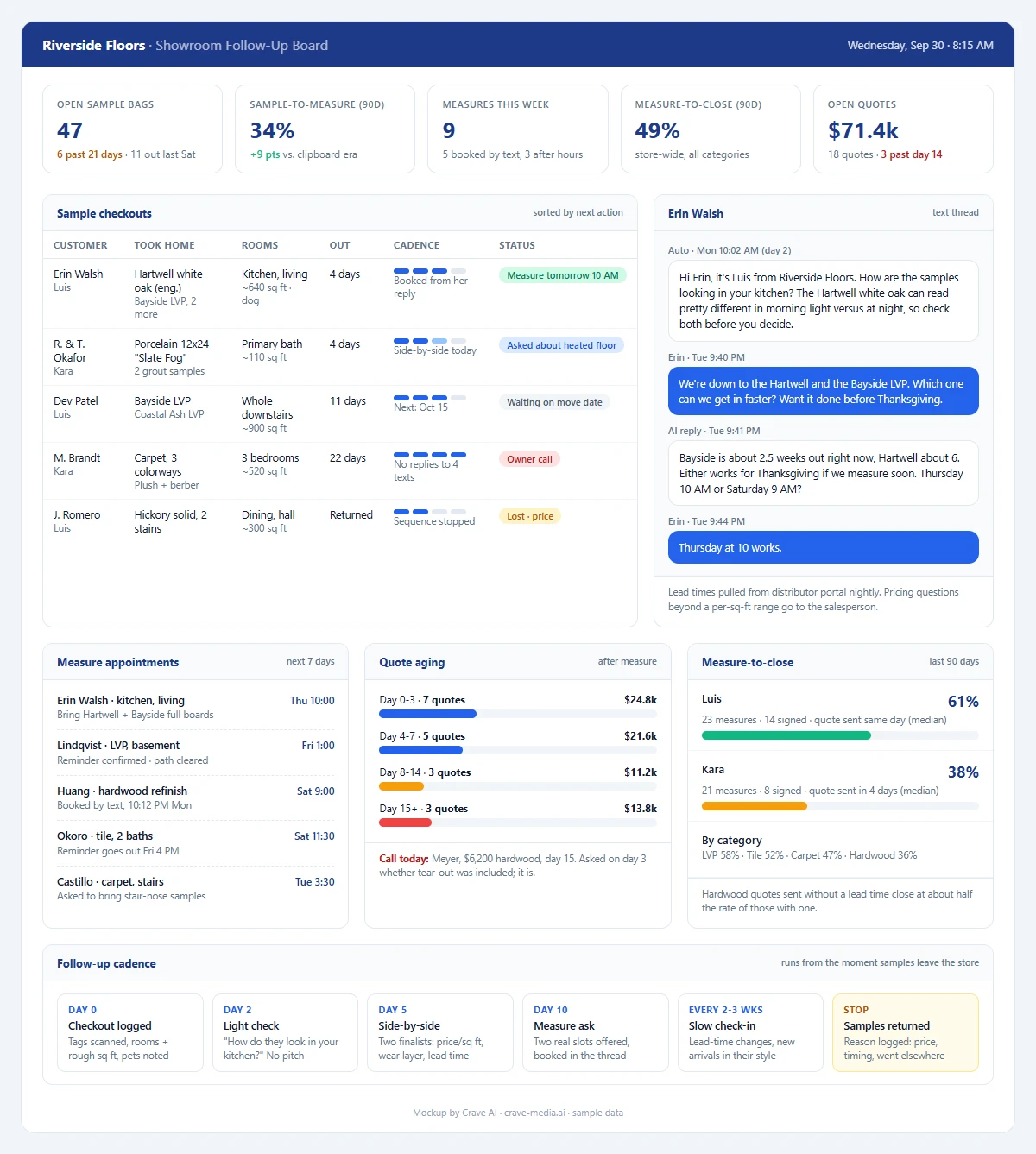
The showroom follow-up board: every sample bag that left the store logged as an open lead, follow-up cadence by day, this week's measure appointments, and quote aging from measure to signed contract. Download as PDF
View interactive version
Every sample bag is an open lead
Look at what a sample checkout already tells you. Name, cell number, which rooms, roughly how big, whether there's a dog, and a shortlist of three or four products out of the few hundred on your walls. No web form has ever handed you a lead that good. In most showrooms it goes on a clipboard by the door, and the clipboard exists mainly to get the boards back.
The system starts at that desk. The salesperson scans the sample tags or taps them into a tablet, adds the rooms and a rough square footage, and that's the record. It takes about as long as the clipboard. From then on the bag has a clock on it, and the board shows every open checkout: who has what, for how many days, and what anyone has said to them since.
Two days later the first follow-up goes out. It's a question about light:
"Hi Erin, it's Luis from Riverside Floors. How are the samples looking in your kitchen? The Hartwell white oak can read pretty different in morning light versus at night, so it's worth checking both before you decide. Any questions, just text back."
She was going to look at the boards that evening anyway.
The AI does its real work on the replies. People text real flooring questions, and the answers are mostly sitting in spec sheets you already have. "Will the dog scratch the LVP?" gets the wear-layer answer for that product, in plain words. "The gray one looks kind of blue at night" gets two warmer options that are in stock right now. "What's the whole downstairs going to run?" gets a per-square-foot range and an offer to measure, since a real number needs a real measure. Anything the AI isn't sure about goes to Luis, thread attached.
Around day five, the customer gets a side-by-side of the two boards they keep circling: installed price per square foot, wear layer or hardness, water resistance, current lead time. Then the ask for a measure. After that the cadence drops off hard. A flooring decision can take weeks, especially when it's waiting on a move or a tax refund, and a store that texts every three days for a month gets blocked. We'd go to every two or three weeks after the first ten days.
It stops for good when the samples come back with a "we went another way." The system logs that, and the reason if they'll give one. Give it a few months and you'll know whether you're losing on price or just losing to whoever called first.
Lead times close more jobs than discounts
When a flooring quote stalls, don't discount it. Most stalls are a decision problem: two finalists, one spouse on each, and no reason to pick this week over next month. Knocking 10% off doesn't break that tie. It teaches the customer that waiting pays.
Lead time breaks it. If one finalist ships in about two weeks and the other is six weeks out, that's often the deciding fact, and you're the only one who has it. The system pulls current lead times from your supplier notes or distributor portal and drops them into the comparison text, so "we want it in before Thanksgiving" becomes a choice they can make tonight.
Measure-to-close is the number to watch
A customer who lets someone into the house to measure has mostly decided to buy floors. Whether they buy them from you is still open. And a measure costs you real money to give away, an hour or two of a trained person plus the drive, which plenty of stores eat because the big boxes advertise free measures.
The system books the measure from the text thread and sends a reminder the day before with a note to clear a path to the rooms. That's the same appointment reminder automation that cuts no-shows in any trade. Then the quote goes out and a second clock starts.
Quote aging gets its own panel. Day zero, the quote goes out with a short list of what's in it: tear-out, underlayment, transitions, baseboards, furniture moving or not. Day three, a check-in asking whether anything needs explaining, because a homeowner holding your number next to a big-box number often isn't comparing the same scope. Day seven, a nudge with the lead-time update. Day fourteen, the quote turns amber and goes to a person. On a job in the $1,500 to $8,000 range, a two-week-old quote is worth a phone call. The cadence is the one we laid out for estimate tracking at a painting company, stretched for a slower sale.
Then the report, which is the part we'd build first if we could only build one. Measure-to-close by salesperson, by product category, by lead source. In the mockup, one salesperson closes 61% of measures and another 38%, and the gap turns out to be quote speed: one sends quotes the same day, the other takes four. That's invented data for a store that doesn't exist. The real problem is that most flooring software only creates a job record once something sells. Lost measures never get a record at all, and you can't find a pattern in records that don't exist.
Once a customer signs, the texts switch to install prep. Furniture plan, who's moving the piano, room access, and acclimation instructions for their exact product, since manufacturers set those and solid hardwood and LVP can differ a lot.
A week with the board running
Saturday, eleven households leave with samples. By Monday afternoon all eleven have the light-check text, and four reply: a pet question, a price on 900 square feet, two thank-yous.
Tuesday at 9:40 PM, Erin texts that she and her husband are down to the Hartwell oak and the Bayside LVP and want to know which is faster. The AI answers with current lead times, about two and a half weeks against six, and offers Thursday or Saturday for a measure. She takes Thursday at 10. Nobody at the store was awake. Our industry data puts about 30% of flooring inquiries after hours, and plenty of them look like this one, two people at a kitchen table with the boards on the floor.
Thursday's measure turns into a quote Friday morning. On day three Erin asks whether quarter-round is included. It is, and the AI points her to the line. She signs the following Wednesday.
Over the same week the board puts a three-week-old sample bag with zero replies in front of the owner, and a $6,200 quote sitting at day fifteen. Both get phone calls.
When a flooring business needs these tools
An installer with no showroom, living on contractor referrals, doesn't need any of this. Those leads arrive pre-sold, and a decent CRM in your job software is plenty. The kitchen remodeling quote system we wrote about is closer to your world.
It pays off once retail traffic is a real share of the business. Two dozen or more sample bags a month, a second salesperson, or no idea what percent of last quarter's measures became jobs: any one of those means the follow-up is leaking somewhere you can't see. Long sales behave alike across trades. The solar sales pipeline had the same shape, won by whoever stayed in touch without turning into a pest.
Flooring tends to peak after the holidays, so October and November are a good window to build it and load past sample and quote records before January. The texting runs on the same lead follow-up layer we build for every trade, and the board is a custom AI tool wired into the software you already use. The material selection and lead-time tracker we'd add next is on our AI for flooring page.
The sale happens on their kitchen floor
Your showroom already did the hard part. It got two people to cut a wall of options down to four boards and carry them home. Nobody decides in the showroom, though. They decide on a Tuesday night, with the boards lying between the stove and the island, and one of them asking whether the dog will ruin the light one. Be in that text thread.
If you want to see your own sample checkouts and measures on a board like this, tell us about your flooring business and we'll sketch it from what you already track.

About the author
Zac Spencer is an online marketing specialist and the owner of Crave Media, based in Salt Lake City, Utah. Since 2013 he has managed hundreds of Google Ads accounts across dozens of industries — with budgets from a few hundred dollars to $250K a month — and founded Crave AI to build custom AI tools and automations for local service businesses.