

AI report delivery for a home inspection company
A buyer goes under contract on a Tuesday. Their inspection contingency (the "option period," if you work in Texas) runs out in a week or so, and in that window they need the inspection done, the report read, repair requests written, and the seller's answer back. Every hour the report sits in your software waiting to be finished is an hour the agent spends refreshing their inbox. They notice. They don't say anything. They just send the next buyer to someone else.
Most talk about AI tools for a home inspection business goes straight to report writing: AI that describes photos, AI that drafts findings. We'd leave that alone. The report is your judgment and your liability, and the software you already use for it is good. The money in this trade sits around the report: how fast it reaches the buyer, and which agents keep sending you work. Also which ones quietly stopped two months ago while you were busy, because you probably haven't noticed yet.
Our build for this trade is a report and referral desk. It puts a clock on every report from the end of the inspection to the buyer's inbox, scores every agent who has ever referred you, and runs the follow-up that turns an agent who sent you one buyer into one who sends fifteen a year.
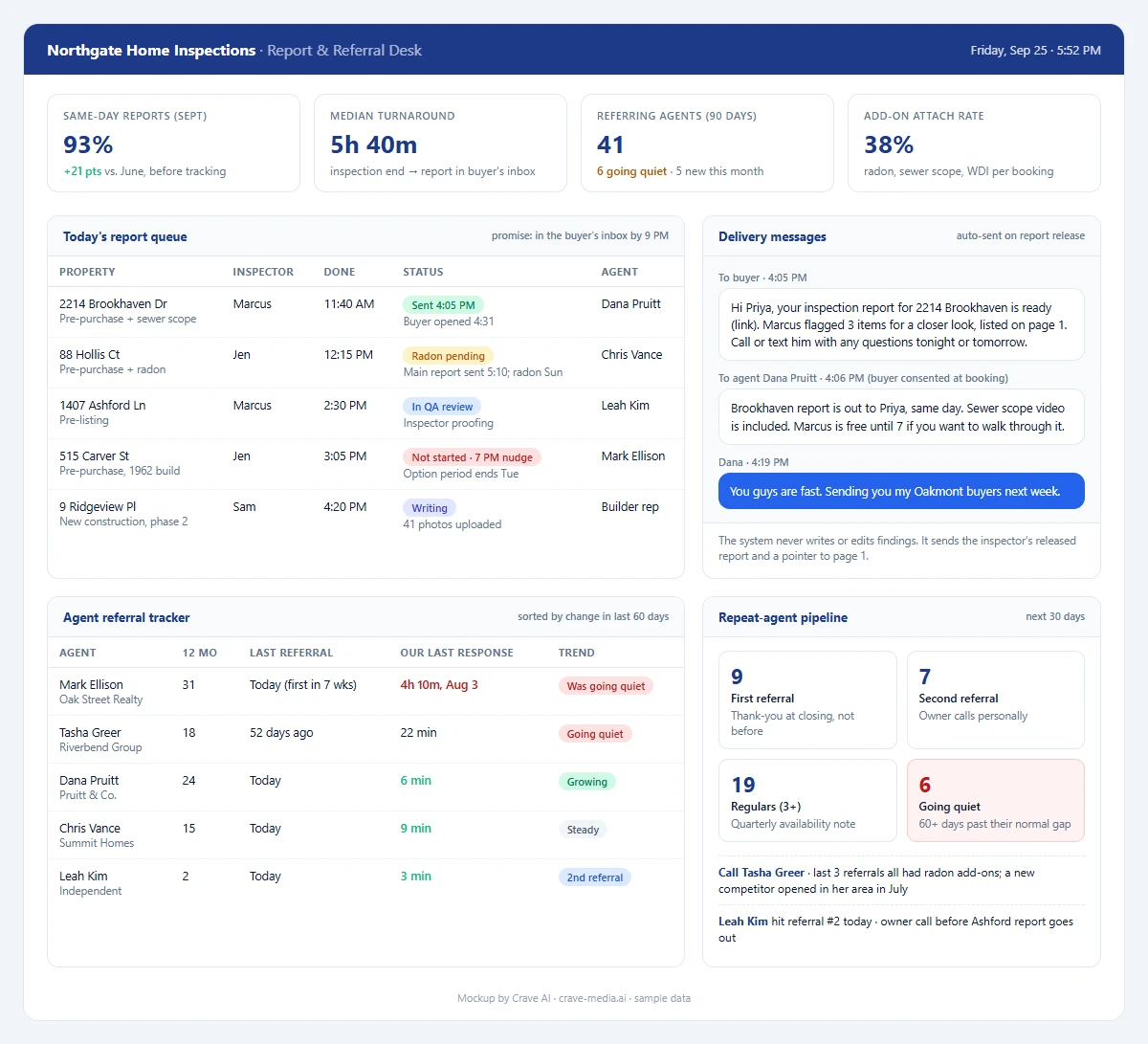
The report and referral desk: today's reports tracked against a 9 PM same-day promise, delivery texts sent the moment a report is released, and every referring agent scored by volume, response time, and whether they've gone quiet. Download as PDF
View interactive version
Same-day reports are the promise agents remember
Ask an agent why they use the inspector they use and you'll hear some version of two answers. "He's thorough but he doesn't scare my buyers." And "I get the report the same day." The first one is about you and it takes years to earn. The second one is a process, and processes can be tracked.
Most inspection companies don't know their real turnaround. They know the goal. They couldn't tell you how often a 3 PM inspection's report slides to the next morning, or whether one inspector runs hours slower than the others on pre-1970 houses. Nobody is timing it, so nobody sees the slip until an agent mentions it, and agents mostly don't mention it.
The report queue on our dashboard is a stopwatch for every job. When the inspector marks the inspection done on site, the clock starts. The board shows each property moving through writing, QA review if you have one, and release, against a promise you set. We used 9 PM in the mockup because "the same day" means the buyer can read it tonight.
At 7 PM, anything that hasn't been started gets a nudge to the inspector. It's a nudge, nothing fancier. A 1962 house with a Tuesday deadline and a report nobody has opened shows up in red, so the owner can decide whether to finish it himself or call the agent with a real time. A two-hour delay you call about is forgivable. A two-hour delay the agent discovers by checking their email at 10 PM is how you lose them.
Lab add-ons get their own status. A radon test can't come back same-day, so the system sends the main report on time and tells the buyer exactly when the radon result lands, instead of holding everything until Sunday.
Over a few months, the board gives you a number you've never had: the percent of reports that hit the promise, by inspector and by house type. In the mockup that's 93% in September against the low 70s in June. That's the number you'd put on your website if it were yours.
What the AI does and doesn't touch
We'd draw a hard line here, and we think it's the right call for this trade: the system never writes a finding, never edits one, and never rewrites a report into something softer for an agent.
It's tempting to build the opposite. Agents want a clean summary, and AI is good at clean summaries. But the report belongs to the buyer. InterNACHI's code of ethics, for one, bars members from releasing inspection information to a third party without the client's explicit prior written consent, and an inspector known for "agent-friendly" summaries has a reputation problem on a timer. The day a softened summary leaves out the foundation crack, you own that.
So the delivery layer does logistics only. When the inspector releases the report, the buyer gets a text and an email with the link and a pointer to the items the inspector put on page one. If the buyer signed off at booking on sharing the report with their agent (put it in the agreement; most buyers check the box), the agent gets a short note that it's out, plus when the inspector is free to walk through it. The words describing the house are all yours.
The AI earns its keep on everything else. It reads the replies. "Can Marcus call me about the electrical panel?" gets routed to Marcus with the report attached. "Do you do sewer scopes?" gets the price and an open slot. "What does the buyer need to do before the radon test?" gets your prep instructions. These are the texts that pile up on an inspector's phone while he's in a crawlspace, and answering them fast is part of the same-day promise.
Scoring every agent like a referral account
A typical home inspection company runs on a surprisingly small group of people. Some agents send you twenty buyers a year. Most send one or two. A few used to send a lot and don't anymore, and you probably can't name them off the top of your head.
That last group is the one that costs you. An agent rarely fires an inspector out loud. They just stop calling. If Mark Ellison sent you 31 inspections over the past year and then nothing for seven weeks, something happened, and it helps a lot to know about it in week five instead of in December.
The referral tracker keeps a row for every agent who has ever sent you a buyer: referrals in the last twelve months, the date of the last one, how long you took to respond to their last request, and a trend flag. Trend does the real work. It compares each agent to their own normal pace, so a high-volume agent who's been silent for three weeks gets flagged before a once-a-quarter agent who's been silent for two months.
Response time sits right beside it, because it's often the cause. In the mockup, Mark's quiet stretch started after a request in August that sat for four hours and ten minutes. The system can't prove that's why he drifted. It can put the two facts next to each other so you can make the call yourself. That's usually a phone call, from you, not a text from a system.
Most inspection software stores the referring agent on each job, so the history is usually already sitting there, unread. We'd pull it into one view and redo the math every night. The same logic runs our post on lead response time for service businesses, except your "leads" are thirty or forty named agents, and losing one of them costs you twenty inspections, not one.
The repeat-agent pipeline
Getting a second referral from a new agent is the hardest step in this business. The first one is often luck: their usual inspector was booked, or a buyer found you on their own. The second one is a decision.
So the pipeline sorts agents into stages and gives each stage a different next move. A first-time agent gets a thank-you after the deal closes, not after the inspection, because that's when they know the inspection didn't blow up their deal. An agent who just sent their second referral gets a personal call from the owner, because that's the moment an agent decides whether you're their inspector or a backup. Regulars get a short quarterly note with your availability and anything new, like adding sewer scopes or a second inspector who covers the north side. Agents who've gone quiet get flagged for a human.
The AI drafts the notes and times them. You approve what goes out, especially early on, until you trust the tone. Nothing in the pipeline should read like marketing. An agent can smell a drip campaign from across a showing.
There's a revenue angle hiding in here too. The tracker records add-on rates by agent. Some agents' buyers almost always add radon or a sewer scope, because the agent recommends it. Others never do. On a $300 to $600 base ticket, an add-on that runs a couple hundred dollars changes the math on every job, and knowing which agents push them tells you who to thank and who might want a one-page explainer on why a sewer scope is worth it on a 60-year-old house.
The whole thing runs on the same lead follow-up layer we build for other trades, pointed at agents instead of homeowners.
Friday with the desk running
It's 10:40 PM Thursday. An agent texts about a buyer whose contingency ends Tuesday. Nobody's awake. The AI confirms a Friday 11 AM slot, sends the buyer the prep checklist and the agreement to sign, and texts the agent that it's booked. In our industry numbers, roughly a quarter of inspection requests land after hours. Before this, that one waits until 7 AM, and by then the agent has texted someone else too.
Friday, five inspections finish between 11:40 AM and 4:20 PM. Brookhaven's report goes out at 4:05 and the buyer opens it twenty-six minutes later. The agent, Dana, replies that she's sending her next buyers over. Hollis Court's radon canister is still running, so the main report ships at 5:10 with a note that radon results come Sunday.
At 7 PM the board goes red on Carver Street: done at 3:05, report not started, Tuesday deadline. Jen gets the nudge. She finishes at 8:40. It's the first referral from Mark Ellison in seven weeks, and it goes out on time.
Monday morning, the owner looks at the pipeline and makes two calls. One to Tasha Greer, 52 days quiet, whose last three buyers all added radon. One to Leah Kim, who just sent her second referral. Neither call takes ten minutes.
When a home inspection business needs these tools
A solo inspector doing 250 inspections a year with a handful of loyal agents doesn't need a dashboard to know who those agents are. You need a same-day habit and a phone that texts back while you're in the attic. A missed-call text-back setup covers a lot of that for very little money, and we'd tell you so.
It changes with a second inspector, or a referral list that's grown past what you can keep in your head. Once two people are writing reports, turnaround stops being one person's habit and becomes something you have to measure. Once you've got forty agents, some of them are drifting and you don't know which.
Winter is the time to build it. Inspection volume follows the housing market, and the slow months give you room to import a year of job history, set your promise time, and have the agent tracker scored before spring listings start. The rest of what we'd build for this trade, including instant booking for agents, is on our AI for home inspection page. The automation underneath is the same custom automation work we do for every trade we write about, including the chimney inspection scheduler from last week.
Agents remember the night you were fast
Nobody chooses an inspector off a website comparison. Agents choose you after the time a report landed at 4 PM when the last guy took two days, or the time you called before they had to chase you. You already have those nights. The desk makes them the default, and it tells you by name which agents haven't had one lately.
If you want to see your own turnaround and your own agent list on a board like this, tell us about your inspection company and we'll sketch it from your job history.

About the author
Zac Spencer is an online marketing specialist and the owner of Crave Media, based in Salt Lake City, Utah. Since 2013 he has managed hundreds of Google Ads accounts across dozens of industries — with budgets from a few hundred dollars to $250K a month — and founded Crave AI to build custom AI tools and automations for local service businesses.