

What AI could do for a lawn care company's recurring routes
Lawn care has the lowest barrier to entry of any trade we work with. The startup cost is a mower and a truck, which means you're competing with every side-hustler and summer-break teenager in your zip code, and plenty of them will mow for less than you can afford to.
So when we think about AI tools for a lawn care business, we skip the parts of the business a solo operator can copy. He can match your price. He can probably match your stripes. What he can't match is an operation: tight routes, recurring accounts that don't quietly disappear, and upsells that arrive the week the lawn needs them. That's the gap between a guy with a mower and a company, and it's exactly the kind of gap software is good at holding open.
This is one of our blueprint posts, so the usual disclaimer applies. This isn't a case study. It's the plan we'd draw up if a lawn care owner walked in the door.
The route is the business
A weekly mow might bill $45. The mowing takes twenty minutes. What decides whether that $45 is profitable is everything around it: how far the crew drove to get there, how many other lawns are on the same street, and whether the account is still active in August.
Run the numbers on two crews doing twelve lawns each. One crew covers 28 miles because their lawns cluster across three neighborhoods. The other covers 47 miles because their route grew one Craigslist customer at a time, wherever the phone rang from. Same trucks, same lawn count, same revenue on paper. The first crew finishes an hour earlier, burns less fuel, and has capacity for two more lawns. Multiply that across a season and the tight route is funding your next truck while the scattered one is barely covering its own payroll.
Most owners feel this in their gut. Almost none of them can see it, because the route sheet lives on a clipboard and the profitability math lives nowhere at all.
What we'd build first, a route and retention dashboard
The first thing we'd put in front of a lawn care owner is a dashboard that reads from the scheduling tool they already use and answers three questions: which routes make money, which accounts are about to leave, and what's in the seasonal upsell pipeline.
The route view maps every recurring account and scores each day's run: lawns served, miles driven, drive minutes between stops, and margin per lawn once drive time is costed in. It flags the scattered customers who are quietly unprofitable, the ones twenty minutes from everything else on the route. Sometimes the answer is to raise their price. Sometimes it's to hand them to a competitor with a smile. Either way, you're deciding instead of guessing.
The same view shows density by neighborhood, which turns your marketing from a shotgun into a rifle. If you have nine lawns in one subdivision, the tenth is nearly pure margin. A postcard drop or a "we mow your neighbors" text campaign aimed at that street is worth more than any amount of general advertising.
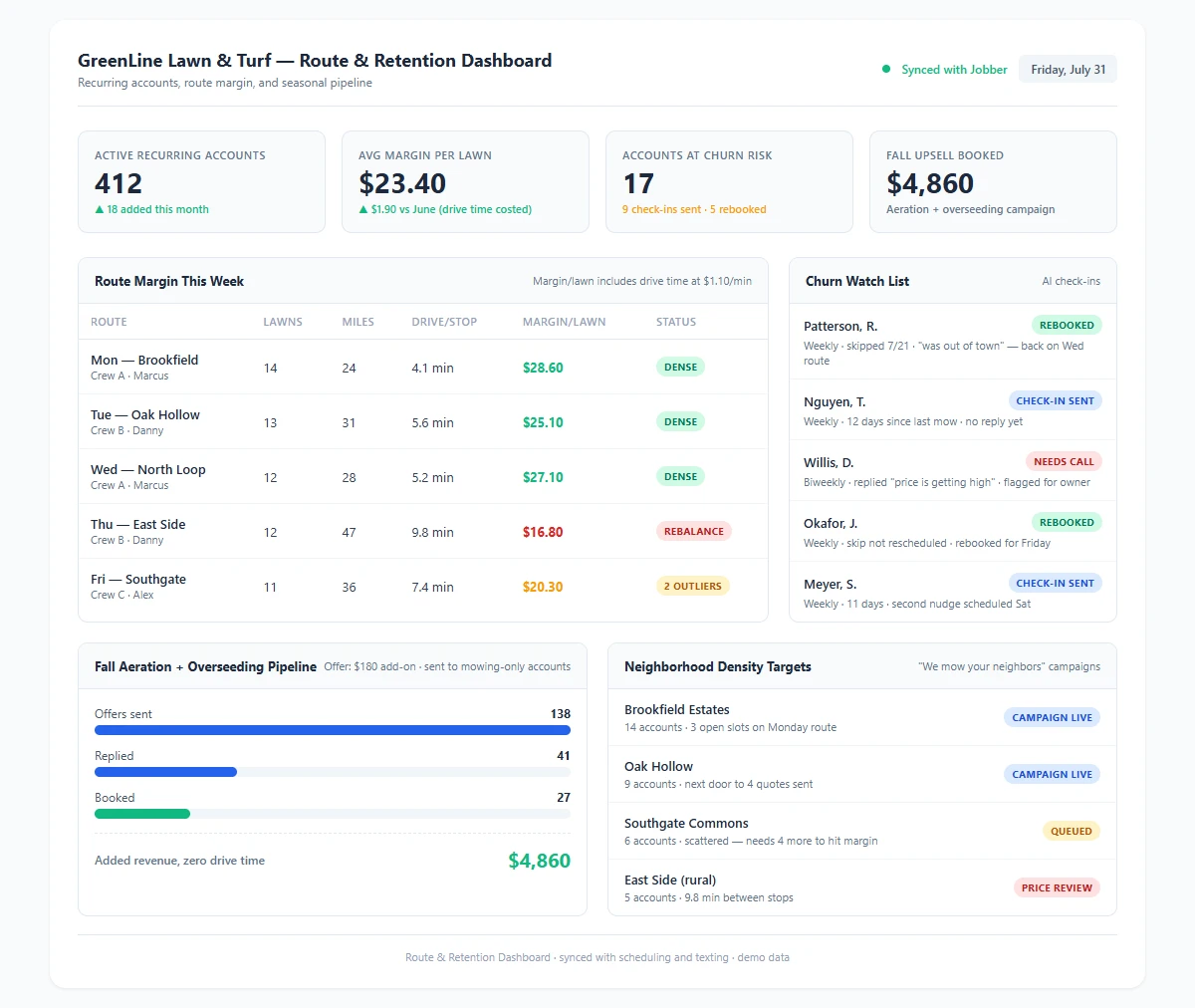
The route and retention dashboard we'd build for a lawn care company: per-route margin with drive time costed in, a churn watch list that catches skipped services, and the fall upsell pipeline. Download as PDF
View interactive version
Catching the cancellation that never calls
Lawn care churn almost never announces itself. Nobody phones to cancel. They skip a week because it's dry, then skip another, then a neighbor kid offers to do it for $30, and by the time you notice the account went quiet it's been gone for a month.
That silence is expensive. A $45 weekly account across a 26-to-30 mow season is $1,200 to $1,350, and replacing it means marketing spend, quoting, and the risk the new lawn is fifteen minutes off your route. Keeping the account you already have costs a text message.
So the second thing we'd build is a churn watch list with automated check-ins. The system knows every account's normal rhythm. When a weekly customer goes ten days without a service, or a skip isn't rescheduled, the AI reaches out: "Hey, we missed you last week. Want to get back on the schedule, or is the lawn holding up okay from the last cut?" Out-of-town customers rebook. Unhappy ones tell you why while the relationship is still fixable. The dashboard tracks every save, and each one is a full season of revenue that didn't leak out the back of the business.
This is the same retention machinery we walked through for pest control companies, and lawn care is arguably a better fit for it. The service is more frequent, the churn is quieter, and the competition is one flyer away.
Upsells that follow the lawn, not the sales push
The profit in a lawn care account grows with the services stacked on it. Mowing gets you the route. Fertilization, weed control, aeration, and overseeding are where the margin lives, and they share a useful trait: each one has a right time of year, and the right time is when the customer says yes.
We'd build the upsell to run on that calendar. In late August, every mowing-only account with cool-season turf gets a text about fall aeration and overseeding, timed a couple of weeks before the window opens: "We'll have the aerator in your neighborhood in September. Since we already mow your lawn, we can add aeration and overseeding for $180. Want us to put you down?" In February it's the pre-emergent pitch before crabgrass season. The AI answers the follow-up questions, offers real slots from the schedule, and books the work.
The crew is already on the property every week, so the added service carries no drive time at all. And because the offer lands when the lawn visibly needs the work, it converts without anyone on your team making a single sales call. The dashboard shows the whole pipeline: offers out, replies, booked jobs, and added revenue per campaign, so you know whether the aeration push earned $4,000 or fizzled.
The front of the funnel gets the same treatment. Spring is when your phone rings most and your crews are busiest, which is precisely when calls go unanswered. A missed call text back flow catches the overflow, asks about the property, and quotes recurring service instead of a one-time cut, because the recurring account is the only one you want.
The winter renewal, locked in January
The recurring model has one more seasonal moment worth automating: renewal. Most lawn companies restart their schedule every spring by calling down last year's list and hoping. We'd flip that. In January, every active account gets a renewal text with last year's pricing honored through a deadline, and prepay customers get a small discount for paying the season up front.
Every account that renews in January is a spring slot you don't have to sell, and prepay cash in February covers the equipment maintenance and hiring you're doing anyway before the season starts. The dashboard tracks renewal rate as its own number, next to a figure most owners have never seen: how much of next season is already committed. We wrote about the general pattern in how to use AI to stay busy during your slow season, and renewals are the lawn care version of it. The season is won in the winter.
How it fits what you already run
None of this asks you to throw out your current setup. If you schedule in Jobber, Yardbook, LawnPro, or a Google Calendar with color coding, the dashboard reads from what's there. The texting runs through your existing business number. Crews keep marking jobs complete exactly the way they do now, and that single tap is what triggers the follow-ups, the churn timers, and the upsell sequences behind the scenes.
That constraint is stricter in lawn care than in most trades, because crews turn over seasonally and training time is short. Any tool that requires the new guy to learn software in April is dead by May. The system has to adapt to the crew, never the other way around. If you want the plumbing details, our automations page covers how these flows connect to the tools you already have.
Where this leaves the guy with just a mower
Nothing here cuts grass better. The solo operator will still undercut your mow price, and some customers will always chase the cheapest cut. Let them.
What this system does is compound everything the solo operator can't: routes that get denser every season because you know which streets to fill, accounts that stay because someone noticed the skipped week, tickets that grow because the aeration offer showed up in the right ten days, and a spring that starts half-sold in January. Most mid-size lawn companies don't run this way either. They're still on clipboards and memory, which is why the operational edge is sitting there unclaimed.
If you want to see what we'd scope for a company your size, the AI for lawn care page breaks down the tools and automations we'd quote. Or reach out and bring last season's route sheets. Most owners who cost out their drive time for the first time find they've been paying for a truck they don't have.

About the author
Zac Spencer is an online marketing specialist and the owner of Crave Media, based in Salt Lake City, Utah. Since 2013 he has managed hundreds of Google Ads accounts across dozens of industries — with budgets from a few hundred dollars to $250K a month — and founded Crave AI to build custom AI tools and automations for local service businesses.