

Do you need AI or just better software?
Every software company is slapping "AI-powered" on their product right now. Your CRM is AI-powered. Your scheduling tool is AI-powered. The invoicing app you've been using since 2019 just added an AI button that nobody on your team has clicked.
If you're a small service business owner trying to figure out whether you need AI, the marketing noise makes it almost impossible to think straight. Half the pitches you see make it sound like you'll be out of business without AI by next year. The other half are selling you the same software you already have, just with a chatbot bolted on.
The truth is simpler and less exciting than either side wants to admit. Some businesses genuinely benefit from AI. Others just need to use their existing tools better, or switch to a tool that fits their workflow. A lot of them need something in between.
We build AI tools for service businesses, so you'd expect us to push AI on everyone. We don't. About half the companies that reach out to us end up with a recommendation to fix their existing software setup instead. That's not generosity, it's self-interest. Building an AI tool for a problem that doesn't need AI wastes everyone's time.
We use a framework to figure out which category a business falls into, and it's the same one we'll walk through here.
What counts as "AI" and what's just marketing
When a software company says their product uses AI, they could mean anything from a chatbot that answers FAQ questions to a system that analyzes three years of your job data and tells you which service calls are most profitable by zip code and time of year.
Those are wildly different things. The chatbot is a feature. The data analysis tool is a business decision engine. Both get called "AI" in marketing emails.
For service businesses, the AI that matters does one of a few things. It might adapt your follow-up sequences based on the type of job quoted, the customer's response history, and the time of year. It might spot patterns in your revenue or close rates that would take you hours to find in a spreadsheet. Or it might look at your data and tell you something you didn't know, like which job types carry the best margins or which leads are most likely to convert.
If a product is calling itself AI but it's really just doing the same thing a good spreadsheet formula would do, you don't need AI. You need a spreadsheet.
Signs you need better software, not AI
A lot of the frustration that small business owners blame on "not having AI" is really a software problem. The tool they're using doesn't fit their workflow, they haven't set it up properly, or they've outgrown it and need to upgrade.
If your scheduling still runs through text messages and a whiteboard, you don't need AI. You need Jobber or Housecall Pro and an afternoon to set it up. Same goes for invoicing. If you're still creating invoices manually in Word, QuickBooks will change your life more than any AI product on the market.
Then there's the CRM problem. A lot of service companies have a CRM that nobody uses because the data entry takes too long. The fix there isn't a smarter tool. It's a different CRM, or even just reconfiguring the one you have so it matches how your team works.
If the problem is organizational, getting systems in place and getting your team to use them, throwing AI at it is like buying a race car to learn how to drive. You'll spend more, it'll be harder to manage, and what you needed was a reliable sedan.
Signs AI might solve your actual problem
AI earns its money when the problem involves judgment, timing, or patterns that a simple if/then rule can't handle.
After-hours lead response is a good example. A plumber gets a call at 11 PM from a homeowner with a burst pipe. A basic autoresponder sends "We'll call you back during business hours." An AI system reads the message, identifies it as an emergency, sends a response that addresses the specific issue, and routes it to whoever is on call. The difference between those two responses is the difference between booking a $600 emergency call and losing it to the next name on Google.
Follow-up sequences are another one. A generic CRM sends the same "just checking in" email to every open quote. An AI system sends different messages based on the job type, the quote amount, and where the customer is in their decision process. A $1,200 bathroom fan install gets a different follow-up cadence than a $7,000 whole-house rewire, because the decision timelines are completely different.
Then there's the data side. If you've been in business for a few years, you're sitting on enough job data to spot patterns that would change how you run your company. Which neighborhoods generate the most repeat business. Which job types carry the best margins. Which lead sources produce customers who actually book versus ones who collect three quotes and ghost. An AI tool can surface those patterns from your existing data. Your CRM can't, because it was built to store contacts, not analyze them.
A quick framework for deciding
We walk businesses through a few questions. The answers usually make the decision obvious.
First: can you describe the problem in one sentence? "We lose quotes because nobody follows up" is a clear problem with a clear fix, and AI is probably part of it. "We need to be more efficient" is too vague for any tool to solve.
Second: is anyone doing this task well right now? If someone on your team handles it fine when they have time, but they just don't have time, automation makes sense. If nobody knows how to do it well even with unlimited time, you have a strategy problem, not a technology problem.
Third: does the solution need to adapt, or just repeat? Sending appointment reminders at a set interval is automation. Adjusting the messaging and timing of follow-up sequences based on customer behavior is AI. If "repeat" gets the job done, save your money.
And last: can you put a dollar amount on the problem? If a pest control company knows they're losing $4,000 a month in churned customers who don't rebook their quarterly service, that's a number worth building a retention system around. If the cost is vague ("we're probably leaving money on the table somewhere"), start with better reporting before you build anything.
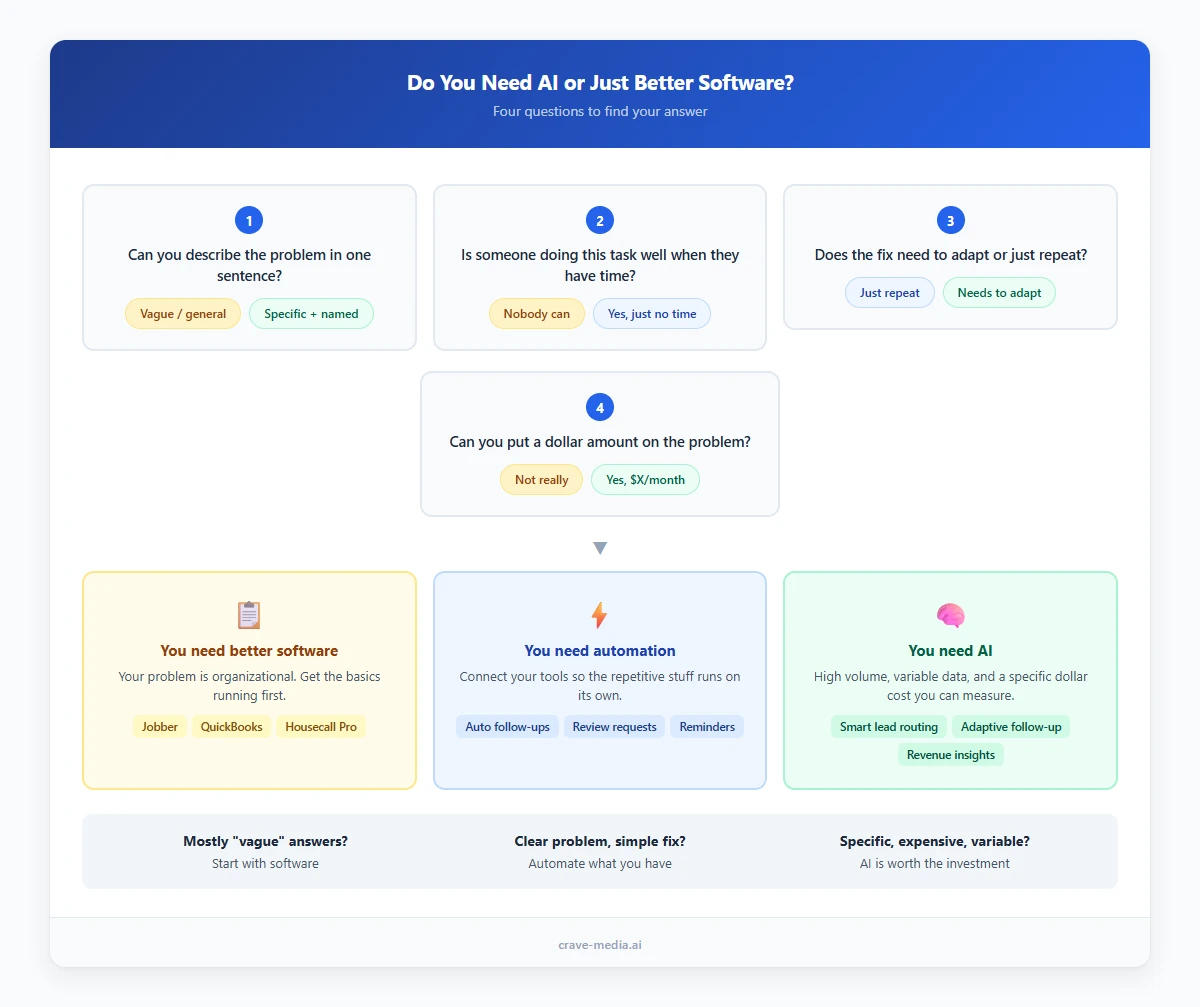
Decision framework for small service businesses: four questions that separate AI-ready problems from software problems. Download as PDF
View interactive version
The middle ground most businesses miss
There's a third option that gets lost in the AI-vs-software debate. You can automate the workflows you already have without building anything fancy.
A landscaping company that sends proposals through Jobber but does all follow-up manually doesn't need an AI system. They probably just need their quoting tool connected to an automated text sequence. That's integration, not AI. Two tools talking to each other so your team doesn't have to copy-paste between them.
We build automations like that alongside our AI tools, and honestly, they solve the problem for a lot of companies. The quote goes out, a follow-up text goes out three days later, another one goes out at day seven. No AI analyzing customer sentiment. No machine learning model predicting close probability. Just a reliable system that does the thing your team keeps forgetting to do.
If that level of automation fixes your problem, you don't need AI yet. You might later, when the basic automation is running and you want it to get smarter. But starting with a system that works and building intelligence on top of it is a better path than jumping straight to AI and discovering you didn't have the foundation in place.
What this looks like by industry
A five-person HVAC company that's booked solid all summer probably doesn't need AI. They need their scheduling software configured properly and maybe a review request system that runs after every completed job. That's a Tuesday afternoon project, not an AI build.
Roofing is a different story. A company that gets 200 leads after a hailstorm and loses 70% of them because they can't respond fast enough has an AI-shaped problem. The volume alone makes manual follow-up impossible, and the variation in lead quality (insurance claim vs. curious neighbor vs. actual damage) means a one-size-fits-all autoresponder will waste half your callbacks.
Then there's the carpet cleaning company that's been around 15 years and has 8,000 past customers sitting in a database doing nothing. A simple email campaign might recover a chunk of that revenue. But the AI version, one that targets the right customers with the right offer based on their service history and timing, will pull more of them back than a generic blast ever could.
Low-volume, straightforward problems need software. High-volume, variable problems need AI. Most businesses land in between and should start with automation, then add intelligence when the numbers justify it.
Skip the hype, start with the problem
The worst reason to buy AI is because everyone else seems to be. The best reason is that you have a specific, expensive problem and you've already tried solving it with simpler tools.
If you're not sure where you land, our free AI readiness audit takes about five minutes and gives you a straight answer. If that answer turns out to be "you just need better software," we'll tell you that too.

About the author
Zac Spencer is an online marketing specialist and the owner of Crave Media, based in Salt Lake City, Utah. Since 2013 he has managed hundreds of Google Ads accounts across dozens of industries — with budgets from a few hundred dollars to $250K a month — and founded Crave AI to build custom AI tools and automations for local service businesses.