

The maintenance reminder machine a septic company needs
Septic work has a memory problem, and it runs in both directions. The homeowner gets their tank pumped, writes the check, and forgets the whole thing ever happened. Three years later the tank is filling toward trouble and they couldn't tell you the name of the company that did the work. They'll google "septic pumping near me" like a brand-new customer, and whoever ranks that day gets the job you already earned.
The AI tools a septic business needs are built around that one fact. A pump-out cycle of three to five years is longer than any customer's memory and longer than most companies' follow-up habits, which is exactly why it's worth automating. This post walks through the maintenance reminder machine we'd build for a septic company: a system that gives every tank a due date, reaches out at the right time with the customer's own history in hand, and catches the emergency calls that come in while your crew is elbow-deep in a drainfield.
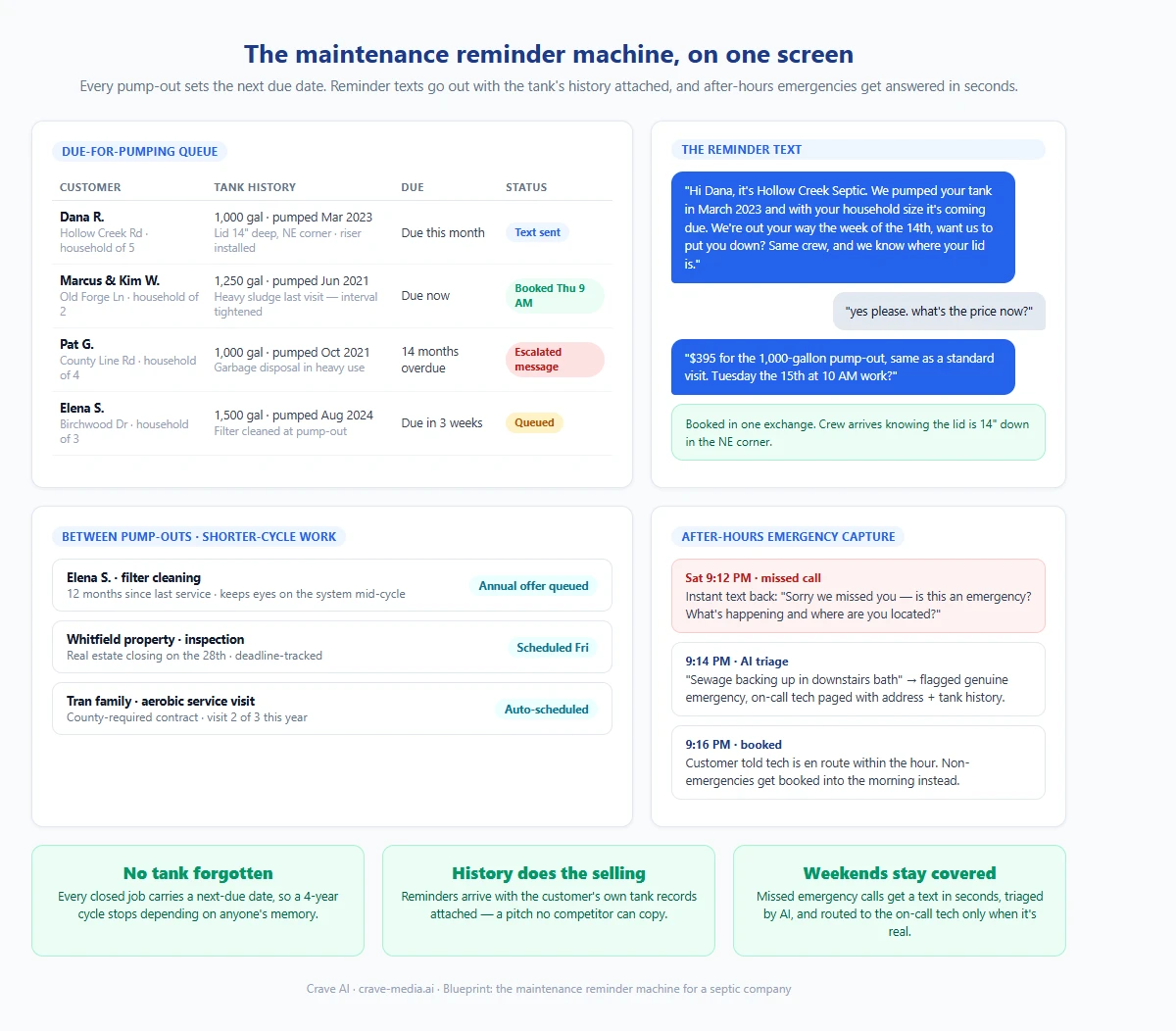
The reminder machine at a glance: every pump-out sets the next due date, reminder texts go out with the customer's tank history attached, filter cleanings fill the years between pump-outs, and after-hours emergencies get answered in seconds. Download as PDF
View interactive version
Three years is too long to be remembered
Most service businesses fight churn. Septic companies fight amnesia. The customer who used you in 2023 isn't unhappy with you. They have simply had a thousand grocery runs and two Christmases since then, and "who pumped the tank" did not survive the purge. When the toilets start gurgling, they start from zero.
That's brutal, because a septic customer list is one of the most predictable revenue assets in the trades. You know when each tank was pumped. You know the tank size and roughly how many people live in the house, which together set the interval. A 1,000-gallon tank serving a family of five needs attention a lot sooner than the same tank under a retired couple. The next due date is sitting right there in your job history, computable the day you finish the work. Almost nobody computes it. The companies that do usually stop at a once-a-year postcard batch, which means the reminder lands whenever the batch went out, not when the tank is due.
Every pump-out gets a due date
The engine runs on one rule: no job is closed until it has a next-due date. Finish a pump-out, and the system sets the clock based on tank size, household size, and what the technician saw. If the sludge level said "this one should've been pumped a year ago," the interval tightens. Garbage disposal in heavy use, tighten again. The default guidance of every three to five years becomes a specific date for a specific tank.
The technician's notes ride along with that date, and this is where a septic company gets an advantage a postcard can never deliver. Lid location, lid depth, whether the riser made access easy, which side of the yard the truck parked on, the filter condition. When the reminder eventually converts to a booking, the crew arrives knowing exactly where to dig. The job runs faster, and the customer gets the small shock of a company that remembers their yard better than they do. That memory is also a quiet sales moat: a competitor quoting the same price still has to find the lid.
The reminder that sounds like a person
When a tank comes due, the customer gets a text:
"Hi Dana, it's Hollow Creek Septic. We pumped your tank in March 2023 and with your household size it's coming due. We're out your way the week of the 14th, want us to put you down? Same crew, and we know where your lid is."
Short, and anchored to their own history. The customer doesn't have to remember anything; the text remembers for them. Replies get handled by the AI layer the way a good dispatcher would handle them. "What's it cost now?" gets a price. "We're on vacation that week" gets the following week offered instead. "We sold the house" closes the record and asks, politely, if the new owner might want the tank's service history. Sometimes that becomes the new owner's first service call. The reply-handling plumbing is the same system we walked through in our appointment reminder automation post, pointed at a much longer calendar.
No response doesn't mean no. The engine nudges once more a few weeks later, then drops to a slower rhythm rather than going silent for another three years. A tank that's overdue by a year gets a different message than one that's freshly due, because at that point the message is about heading off a backup that starts in the hallway bathroom.
We built the same core idea for a mobile detailer in our auto detailing rebooking blueprint, where the comeback cycle is eight weeks. Septic is the extreme version. The longer the interval, the more valuable the machine that never forgets, because the customer's forgetting is guaranteed.
Filling the years in between
A pump-out every four years won't carry a customer relationship on its own, and it doesn't have to. There's legitimate work on shorter cycles that most septic companies never systematically offer. Effluent filters want a cleaning roughly once a year. Homeowners planning an addition or noticing soggy spots need inspections. Real estate transactions need them on a deadline. Aerobic systems in some counties carry required service contracts with scheduled visits.
The engine treats each of these as its own cadence. The pump-out customer from 2024 gets a filter-cleaning offer in 2025, a modest ticket that keeps your name in their phone and gives the technician eyes on the system halfway through the cycle. Half the time that visit surfaces something worth catching early, and to the customer it reads as diligence. By the time the big reminder lands, you're not a forgotten vendor. You're their septic company.
Backups don't wait for business hours
The reminder machine handles the patient revenue. Septic also has the other kind. Sewage backing into a house is a drop-everything emergency, and the homeowner facing one calls down the search results until a human answers. If your line rings out at 9 PM on a Saturday, the second company on the list gets a job worth four figures, and probably the pump-out relationship that follows it.
An after-hours capture layer fixes the leak without putting anyone on call for phones. A missed call triggers an instant text back, the AI asks the two questions that matter (what's happening, and where), flags genuine emergencies for the on-call tech, and books everything else into the morning. We covered the mechanics in our missed call text back post, and septic might be its single best use case, because the calls are rare and expensive to lose. Pair it with the response-speed logic of lead follow-up and the same number that sends your reminders becomes the number that saves your weekends.
What it costs, and when a spreadsheet is enough
Honestly: a small operator with a few hundred past customers can get most of the reminder value from a disciplined spreadsheet and a calendar, if someone owns the habit. The trouble is the habit. Reminders are the first thing dropped in a busy pumping season, and in this business a dropped reminder costs you the whole next cycle, which can be half a decade with that customer.
The build itself sits on your job history, a business texting number, and an AI layer wired to your calendar, the same foundation as most of the custom automations we put together. Figure a few weeks of setup, most of it spent importing old job records and setting honest intervals, then a monthly cost that's mostly messaging volume. The math is friendly because septic tickets are large. A reminder machine that recovers even a handful of forgotten customers a month pays for itself, and unlike an ad budget, it gets stronger every year as the history deepens. There's more on the full picture at our AI for septic service page.
Be the company that remembers
Every septic company is one of two things to a past customer: the name on the paperwork they can't find, or the text that showed up the week the tank came due, knowing the lid depth and the dog's name. The second company keeps the customer for the life of the house, because its machine treats a four-year silence as a schedule, not an ending.
If you want to see what this looks like wired to your own job history, tell us about your septic business and we'll sketch the version that fits it, old paper records and all.

About the author
Zac Spencer is an online marketing specialist and the owner of Crave Media, based in Salt Lake City, Utah. Since 2013 he has managed hundreds of Google Ads accounts across dozens of industries — with budgets from a few hundred dollars to $250K a month — and founded Crave AI to build custom AI tools and automations for local service businesses.