

An AI rebooking engine for a mobile auto detailing business
A full detail is temporary. The customer loves the car for about six weeks, then the kids and the coffee cups and the pollen undo the work, and somewhere around week ten they think "I should get that guy back out here." Most of them never text you. Not because they were unhappy. Because rebooking is a chore, and chores get postponed.
That gap between "should rebook" and "did rebook" is where a mobile detailing business loses most of its easiest revenue. The AI tools an auto detailing business needs are not fancy: a system that knows when each car is due, reaches out at the right moment, and makes saying yes take ten seconds. This post walks through the rebooking engine we'd build for a mobile detailer, plus the two pieces that pair naturally with it: photo-based quoting for new work and route planning that keeps the truck from crisscrossing the county.
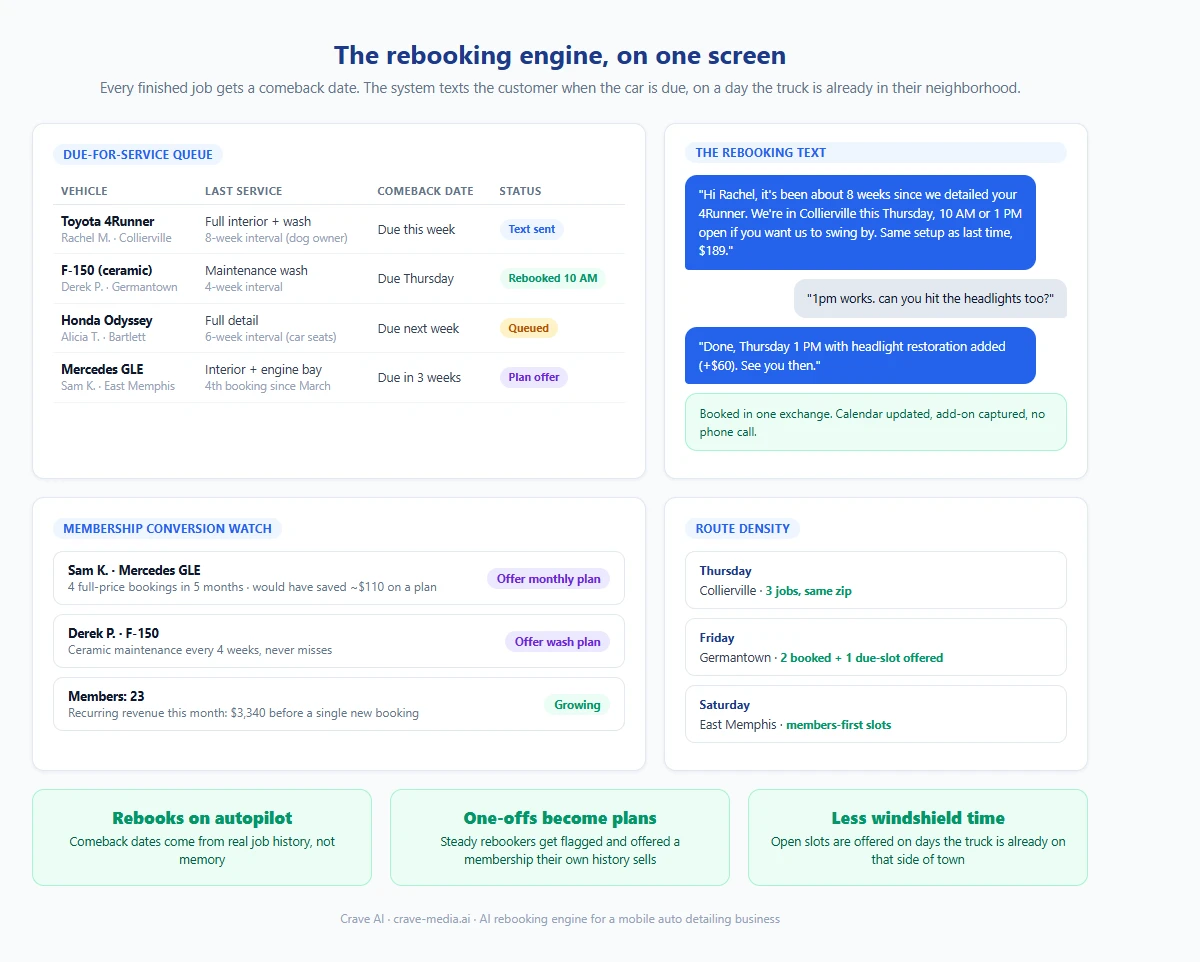
The rebooking engine at a glance: every finished job gets a comeback date, texts fire when cars come due, steady rebookers get offered a membership, and open slots are matched to the neighborhoods the truck is already visiting. Download as PDF
View interactive version
Where detailing revenue leaks
Run the numbers on a detailer doing 80 jobs a month at an average ticket around $200. If even a quarter of those customers would have rebooked with a nudge and didn't get one, that's a few thousand dollars a month that walked away quietly. Meanwhile the ad budget keeps working to replace them with strangers, and a stranger is always more expensive than a customer who already trusts you with their car.
The frustrating part is that detailing has a built-in rebooking rhythm most service businesses would kill for. An interior detail holds up a known number of weeks. Ceramic coatings need maintenance washes on a schedule. Pet owners and parents of toddlers are on a shorter clock than the retiree with the garage-kept sedan. The information is all there in your job history. It's just not doing anything.
The due-for-service queue
The whole engine hangs on one rule: every completed job produces a comeback date. Finish a full interior on a dog owner's SUV and the system sets that vehicle due again in eight weeks. A maintenance wash on a ceramic-coated truck comes due in four. The intervals start as defaults by service type and get adjusted per customer as real behavior comes in, because the customer who rebooks at six weeks like clockwork should be nudged at six weeks, not eight.
When a car comes due, the system sends a text that does the work for the customer:
"Hi Rachel, it's been about 8 weeks since we detailed your 4Runner. We're in Collierville this Thursday and have a 10 AM or a 1 PM open if you want us to swing by. Same setup as last time, $189."
No link to a booking portal with twelve options. The service they had, the price, two time slots, on a day the truck is already nearby. Replying "1pm" is the entire transaction. A reply in any other wording, "can you do Friday instead," "just the inside this time," gets read by the AI layer and handled the way a good office manager would handle it, the same reply-handling approach we walked through in our appointment reminder automation post. The two systems share most of their plumbing, so a detailer rarely builds one without the other.
No reply doesn't mean no. The system waits a week and tries once more with different timing, then goes quiet until the next natural touchpoint. Two texts, spaced out, is persistence. Five is a reputation problem.
Turning regulars into members
Somewhere in your customer list right now is a person who has booked four details in the last year at full price, one at a time. That customer is telling you they want a membership. They just haven't been offered one.
The engine watches for exactly this pattern. When someone hits their second or third rebooking inside a few months, it flags them for a plan offer: a monthly or every-other-month maintenance visit at a lower per-visit price, card on file, priority slots. The pitch goes out as a short text framed around what they're already doing, something like "you've booked three details since March, a plan would've saved you about $90." Their own booking history does the selling.
Memberships change the shape of the business more than any single tool. Recurring revenue smooths out the weather weeks and the slow months, and a member's car stays in the condition that makes each visit faster. The retention mechanics are the same ones we covered for pest control companies, another business where the real money is in the customer who never leaves.
Photo quotes for new work
Rebooking keeps existing customers. For new ones, the biggest friction point in detailing is the quote, because condition varies wildly and nobody wants to commit to a price sight unseen. So quotes turn into phone tag, and phone tag loses jobs.
A photo-quoting flow shortcuts it. The lead texts three or four photos of the car. The AI reads what's actually in them, dog hair through the back seats, water spots, oxidized headlights, a kid-seat situation in row two, and drafts a quote range with the right service package attached. You approve or adjust it from your phone, and the lead has a number within minutes of asking. Speed matters here for the same reason it matters everywhere in lead follow-up: the person texting you photos of their seats is also texting two other detailers, and the first real number usually wins.
Keep a human on the approve button. The AI is good at seeing pet hair; it can't see that the "light scratch" in photo three is through the clear coat. The AI's job is compressing response time from hours to minutes. Pricing judgment stays with you.
Route density is the quiet profit lever
A mobile detailer's costs live in the drive. Three jobs in one neighborhood is a profitable day. The same three jobs spread across thirty miles of suburbs is barely worth running the truck for.
This is why the rebooking texts offer specific slots on specific days instead of "when works for you?" The engine groups upcoming due-dates by area and offers each customer times on the day the truck is already scheduled nearby. Customers experience it as convenience. You experience it as three jobs on one street. We used the same neighborhood-clustering idea in our pressure washing blueprint, and it fits detailing even better because the rebooking cadence gives you a steady supply of schedulable work to cluster.
Density compounds, too. A truck that keeps showing up on the same streets gets seen, and the engine can lean into it: when a member books a Thursday visit, neighbors who inquired before but never booked can get a "we'll be on your street Thursday" text with a small first-visit discount.
What it costs and who shouldn't build it
The build runs on your existing job history, a business texting number, and an AI layer connected to your calendar, the same foundation as most of the custom automations we put together. Expect a couple of weeks of setup, most of it spent encoding your real intervals and prices by service type, then a monthly cost that's mostly messaging volume. For a solo operator doing a handful of jobs a week, a shared calendar and a reminder app cover most of this, and we'd tell you to start there. The engine earns its keep once the customer list is big enough that nobody can hold the comeback dates in their head, usually somewhere north of a couple hundred past customers.
The second visit is the business
Any detailer can sell a first detail. The operators who get to two trucks sell the fourth and fifth visit, on a schedule, to people who stopped thinking of detailing as a splurge and started thinking of it as maintenance. That shift comes from being the company that reaches out at the right moment with a price and a time slot, every time, without anyone in the driver's seat having to remember.
If you want to see what this would look like wired to your job history and your service area, tell us about your detailing business and we'll sketch the version that fits it, including the parts your current booking app already handles.

About the author
Zac Spencer is an online marketing specialist and the owner of Crave Media, based in Salt Lake City, Utah. Since 2013 he has managed hundreds of Google Ads accounts across dozens of industries — with budgets from a few hundred dollars to $250K a month — and founded Crave AI to build custom AI tools and automations for local service businesses.