

AI tools for a handyman business before the holidays
The first week of November, a handyman's phone starts getting a particular kind of text. It's long, it's typed in a hurry, and it reads like a fridge note: "Front door sticks, two holes in the hallway wall, tub needs caulk, the guest room dresser should probably be bolted down since the grandkids are coming, and is a grab bar something you do?" Then, at the bottom: "We're hosting Thanksgiving. Any chance before the 26th?"
Every one of those items is small. Together they're most of a day. And most one- and two-person shops handle that text the same way, by calling back that evening, asking ten questions over the phone, driving out to look, and pricing each item one by one. By the time the quote goes out it's November 12th, and the calendar the customer was hoping for is half gone.
The AI tools we'd build for a handyman business start with that text. The first is a photo-based punch-list quote: the messy list becomes timed line items, and the customer buys a half-day or a full day of your time to fit them into. Behind that sits a schedule grouped by town, a booking cutoff that tells people the truth about Thanksgiving, and a saved list of everything they put off until January.
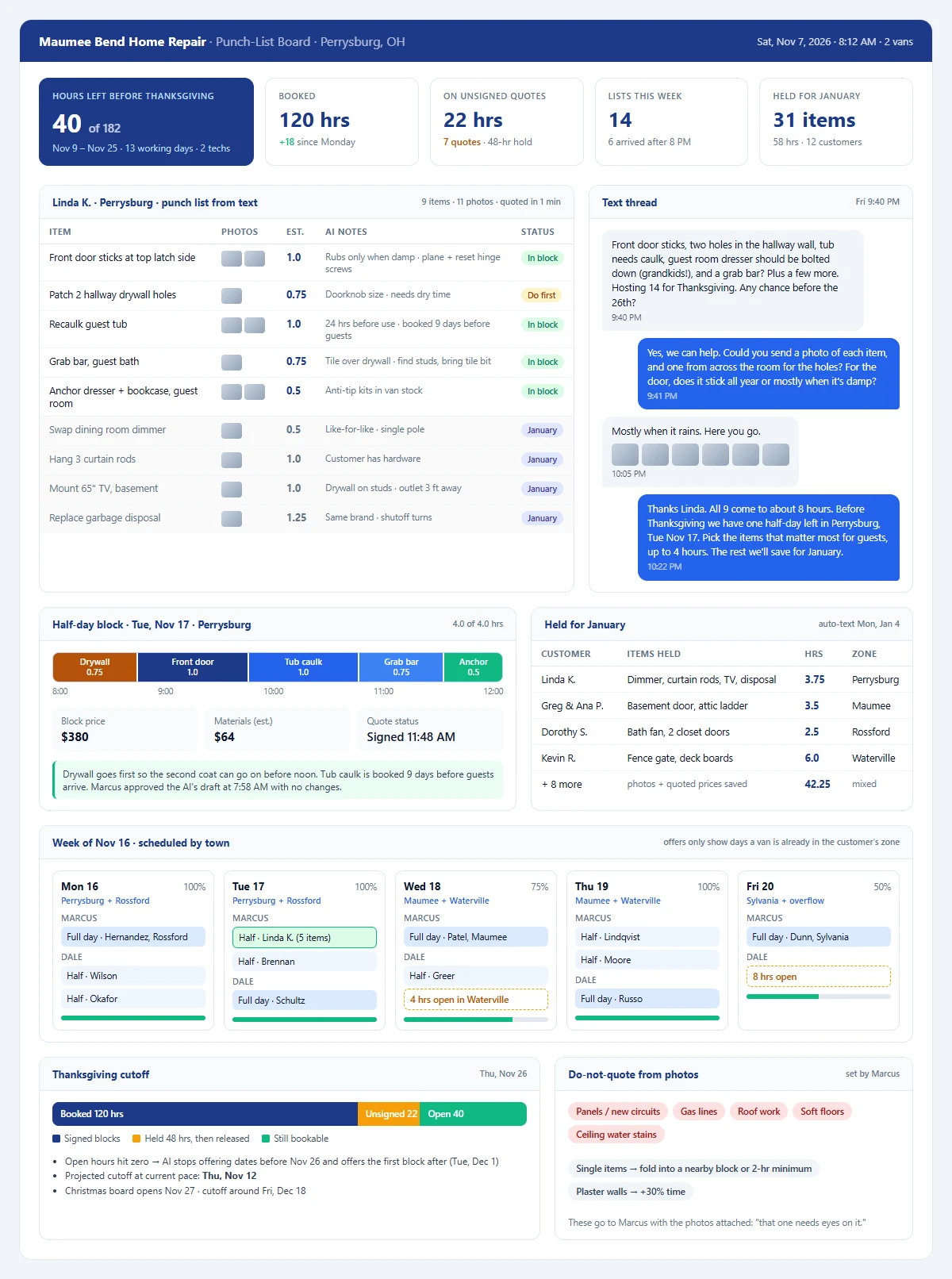
The punch-list board for a two-person handyman business: a customer's list turned into timed items and fit into a half-day block, the items she held for January, how many hours are left before Thanksgiving, and next week's schedule grouped by town so the van isn't crossing the county twice a day. Download as PDF
View interactive version
The holiday punch list problem
Handyman tickets are small. Our industry notes put a typical job somewhere between $75 and $300, which means the money is in volume and in how few hours you lose between jobs. The holidays make both harder at once. Demand jumps, because a lot of people decide in early November that the house has to be presentable by the 26th, and the requests get messier, because nobody sends one item when they can send nine.
The work goes fast. Quoting it is what eats the week. A nine-item list priced the usual way means a callback, a site visit or a long phone call, and a written estimate with nine lines. That's an hour or more of unpaid time per list, and in November you might get thirty lists. Meanwhile, about a third of these requests show up after hours, by our estimate, from someone standing in their hallway at 9 PM looking at the hole the doorknob made.
How the photo punch-list quote works
When a list comes in by text or web form, the AI does what a good office manager would. It splits the message into separate items, then asks for one or two photos of each and a couple of questions specific to that item:
- Door that sticks: which edge rubs, and does it stick all year or only when it's damp?
- Drywall holes: roughly how big, next to a hand or a dollar bill for scale?
- TV mount: screen size, what the wall is made of, and is there an outlet nearby?
- Garbage disposal: is it the same brand going back in, and does the shutoff under the sink still turn?
Each item then gets a time from your own task list. That list is the part only you can write. It says a tub recaulk is about an hour, a grab bar into studs is 45 minutes, a disposal swap is an hour and a quarter, and so on. The AI doesn't invent times. It looks them up, adds a buffer when the photo shows something odd (an old cast-iron drain, plaster instead of drywall), and flags anything it can't size for you to look at.
It also notices order. A drywall patch needs time to dry between coats, so it goes first in the visit. Fresh caulk needs about a day before anyone showers, so the AI won't book a tub recaulk the morning the in-laws arrive.
Our photo quoting system for junk removal works on the same idea, a picture instead of a drive-out. The difference is that junk removal prices one load. A punch list is a dozen tiny scopes, and the pricing has to work differently.
What it won't quote from a photo
You write a do-not-quote list, and the AI sticks to it. Anything that looks like a panel, new circuits, gas, a roof, a soft spot in a floor, or a water stain on a ceiling gets "that one needs eyes on it" and goes to you. Ohio's state licensing board covers commercial electrical and plumbing contractors; residential work is regulated by cities and counties (Ohio Department of Commerce). So in Perrysburg the line might sit somewhere different than in Toledo, and you're the one who knows where.
Sell the block, not the item
This is the part we'd push hardest on, and the part some owners resist. Stop pricing punch lists item by item. Price time.
A half-day block is four hours on site. A full day is eight. The customer sees every item with its estimated time and fills the block, a little like packing a suitcase. If the list comes to 3.5 hours, the AI suggests one more item from their own list, or one of the things you see on every visit (smoke detector batteries, a loose railing). If it comes to 9 hours, it shows which items fit in a full day and which wait.
The customer gets to make the trade-offs herself. She can see that the basement TV is an hour and the curtain rods are an hour, and she knows which one her guests will notice. You get paid for the drive and the setup, which a $65 faucet swap never covered. And quoting a list goes from an evening of phone calls to adding up numbers that are already on your task sheet, which the AI does in about a minute.
Most job software already supports a version of this. Jobber, for example, has optional line items that a client can tick on or off in its client hub before approving, with the total adjusting as they go (on its Grow plan, per Jobber's help docs). So the block quote can live in the system you already use. The AI's job is building the list, timing it, and texting it back fast.
The one-item request still gets an answer. If someone in your Tuesday town wants just a ceiling fan hung, the AI offers to fold it into a nearby block if one has room, or books it as a minimum visit. Nobody gets a $70 quote for a job 25 minutes away.
Schedule by town
The second tool is the schedule. Handyman work lives or dies on drive time, and a punch-list business that says yes to whoever calls first ends up in Waterville at 8, Rossford at 11, and back in Waterville at 2.
So the calendar gets zones. Say Monday and Wednesday are Perrysburg and Rossford, Tuesday and Thursday are Maumee and Waterville, and Friday is Sylvania plus overflow. When a quote is ready, the AI only offers the days your van is already in that customer's town. In our view customers mind this less than owners expect. "We're in Maumee Tuesdays and Thursdays, which works better for you?" sounds like a business that has its act together.
The board shows each day's fill rate by zone, so on Sunday night you can see that Thursday in Maumee has a four-hour hole. That's the day to reach back to the customer who asked about a fence gate last month. We did something similar for lawn care routes, where the jobs repeat; handyman jobs don't repeat, which makes the zones matter more.
The Thanksgiving cutoff
Thanksgiving is Thursday, November 26 this year. Every hour you have before it is countable. Two people, about seven billable hours each, thirteen working days from November 9 through the 25th: roughly 180 hours. The board tracks three numbers against that: hours booked, hours sitting on unsigned quotes, and hours still open.
When open hours run out, the AI stops offering pre-Thanksgiving dates, and it skips the "we'll try to squeeze you in" line that overbooked shops fall back on. The text reads more like this:
"We're booked solid through Thanksgiving, I'm sorry. The first open half-day near you is Tuesday, December 1st, and we still have room before Christmas. If one item really has to happen before your guests come, tell us which, and we'll see if it fits beside a job we already have near you. The rest we can do on the 1st or save for January."
Unsigned quotes hold their slot for 48 hours and then release it. That rule does most of the work. Without it, the calendar fills up with "maybe" customers in the second week of November and the people ready to sign get pushed past the holiday. The same board runs again for Christmas, which falls on a Friday this year, with a cutoff around December 18.
Saving deferred items for January
Every block quote leaves things behind. The customer had nine items, picked five for the half-day before guests arrived, and said "the rest can wait." In most shops, the rest disappears. Nobody writes it down, and in February the customer hires whoever answers first.
Here, the deferred items stay on the customer's record with their photos, times, and the price they were quoted. The first week of January, the AI sends one text:
"Hi Linda, it's Maumee Bend Home Repair. Back in November you held off on the dimmer, the curtain rods, the basement TV, and the disposal. That's about four hours, which fits a half-day. We're in Perrysburg on Mondays and Wednesdays in January. Want one?"
That message works because Linda already said yes to these jobs once. She's looking at her own list, sized and priced, from photos she took herself. Compare that with the usual "anything on your to-do list?" check-in, which asks her to do the remembering. Once a date is set, the same appointment reminder automation we've written about sends the item list the day before, with a note to clear under the sink.
Two weeks at Maumee Bend
Maumee Bend Home Repair is a fictional two-person handyman business in Perrysburg, Ohio. Marcus owns it, and Dale runs the second van.
Friday, November 6, at 9:40 PM, Linda texts the list from the top of this post, plus four more items she thought of while typing. Nine in all, and fourteen people coming for Thanksgiving. The AI splits the list, asks for photos, and by 10:05 she's sent eleven pictures. It times each item from Marcus's task list. The total comes to eight hours, a full day.
Full days in the Perrysburg zone before Thanksgiving are gone. There's one half-day left, Tuesday, November 17. So the AI shows Linda which items fit four hours and lets her choose. She takes the sticking front door, the hallway drywall patches, the tub caulk, the grab bar for her father, and anchoring the guest-room dresser and bookcase for the grandkids. The CPSC has been telling parents to anchor TVs and furniture for years, and it's the kind of job people only think about when small kids are about to visit.
The other four items go on her January list. Marcus reads the quote Saturday morning, changes nothing, and approves it. Linda signs before lunch.
Over the next week, 27 more lists come in. The board shows the pre-Thanksgiving hours filling from 120 booked to 176. On Thursday the 12th, the AI starts offering December 1st instead. Four customers take December dates. Two take nothing. Marcus spends the Wednesday before Thanksgiving on a full day in Rossford, and doesn't drive to Sylvania once that week.
The first Monday in January, nineteen customers get a text listing what they put off. Eleven book, which fills half of January before most of them have taken the tree down.
How it fits what you already use
Nothing here replaces your job software. The pieces we'd connect are your business texting number, your web form, the job software where quotes and the calendar live, and a shared photo folder. The punch-list intake and the January follow-up are automations on top of that. The task-time list is a spreadsheet you fill in once and fix whenever a job runs long.
For the first couple of weeks, the AI drafts every quote and Marcus approves it. That's when the task times get corrected. He'll find his "one hour" door is really an hour and a half on the older homes near downtown, and the AI uses the new number from then on.
If you've read our kitchen remodeling quote system, this is close to the opposite problem. A kitchen is one large, complicated scope. A punch list is twenty easy ones, and the work is in adding them up fast and fitting them into a day.
When it's worth building
A solo handyman with a waiting list and a few regulars doesn't need any of this. If your calendar is full through spring by word of mouth, a notes app and a calculator are fine.
It fits once lists are coming in faster than you can call them back, or once you've added a second person and the schedule has stopped making geographic sense. If you've ever driven 25 minutes for a $70 job in November, or lost a customer because the quote took a week, that's the shop this is for. Our page on AI for handyman businesses covers the year-round side.
Sell the half-day
The intake and the January list are easy to like. The block pricing is the change that matters, and it's the one owners talk themselves out of, because a four-hour minimum feels like it'll scare people off. We'd bet it does the opposite. A customer who sees their own list, timed and packed into a morning, understands what they're buying better than one staring at nine line prices. And you stop working Thanksgiving week at $65 a stop.
If you want to see your own task list and town zones on a board like this, tell us about your handyman business and we'll sketch it from a month of your actual requests.

About the author
Zac Spencer is an online marketing specialist and the owner of Crave Media, based in Salt Lake City, Utah. Since 2013 he has managed hundreds of Google Ads accounts across dozens of industries — with budgets from a few hundred dollars to $250K a month — and founded Crave AI to build custom AI tools and automations for local service businesses.