

Hiring another office person vs buying AI tools
At some point every growing service business hits the same wall. The owner is answering scheduling texts from the truck, invoices go out a week late, and quote follow-up happens whenever somebody remembers. The default fix is the one your dad would have made: hire an office person.
Sometimes that's the right call. But it's a $50,000-a-year decision, and most owners make it without ever writing down what the new hire would spend their day doing. When we talk through the AI vs hiring admin question with small business owners, the answer usually comes down to one thing: how much of that imagined job is repeatable, and how much of it needs judgment.
This post walks through the real math on both sides. Not the "robots will run your office" version, and not the "nothing replaces a human" version either. We build AI tools for a living and we'll still tell you: some of you should just make the hire.
What the hire really costs
The salary is the number you budget for, and it's the smallest part of the surprise. An office admin in most markets runs $38,000 to $48,000 a year. Add payroll taxes, workers' comp, and whatever software seats they need, and the loaded cost lands somewhere around 1.2 to 1.3 times salary. Call it $50,000 a year for a $40,000 hire, give or take.
Then there's the ramp. For the first two or three months, your new admin is a net cost. They're learning your pricing and your customers' quirks, and the person training them is usually you, in the hours you were trying to buy back.
And when they leave (the average tenure in admin roles is a couple of years, less in a tight labor market), you don't just lose the salary you paid. You lose the training, the customer knowledge, and another three months to get the next person up to speed. None of this makes hiring wrong. It just means the real comparison isn't "$40k a year vs some software."
What that admin would spend their day on
Sit down and list what you'd hand this person in week one. For most service businesses the list looks like this: answer the phone, schedule jobs, send appointment reminders, chase overdue invoices, follow up on open quotes, ask happy customers for reviews, and type job details into the CRM.
Now sort that list into two piles. Pile one is work that's the same every time. A reminder text two days before the job is a reminder text, whether a human sends it or a system does. Same with the third polite nudge on an unpaid invoice, the review request after a completed job, and the "just checking in" message on a quote that's been open for five days.
Pile two is work that's different every time. The customer who's angry about a change order. The insurance adjuster who needs three documents in a specific format. The scheduling puzzle where two crews are out sick and the biggest job of the month is tomorrow. That work needs a person, and no tool we build will change that.
In our experience, for a typical office role at a service company, pile one eats half to two-thirds of the week. That's the part you can buy for a lot less than $50,000.
What the tools cost instead
The automation that covers pile one isn't exotic. Appointment reminders that cut no-shows, missed-call text back, quote follow-up sequences, review requests, invoice nudges. We walked through the pricing in detail in our what custom AI tools cost breakdown, but the short version: a focused automation build is a one-time cost of a few thousand dollars, and even a stack of them comes in well under one year of a loaded admin salary. Off-the-shelf tools are cheaper still, if they fit how you work.
The comparison gets lopsided when you look past year one. The hire costs $50,000 again next year. The automation mostly just keeps running.
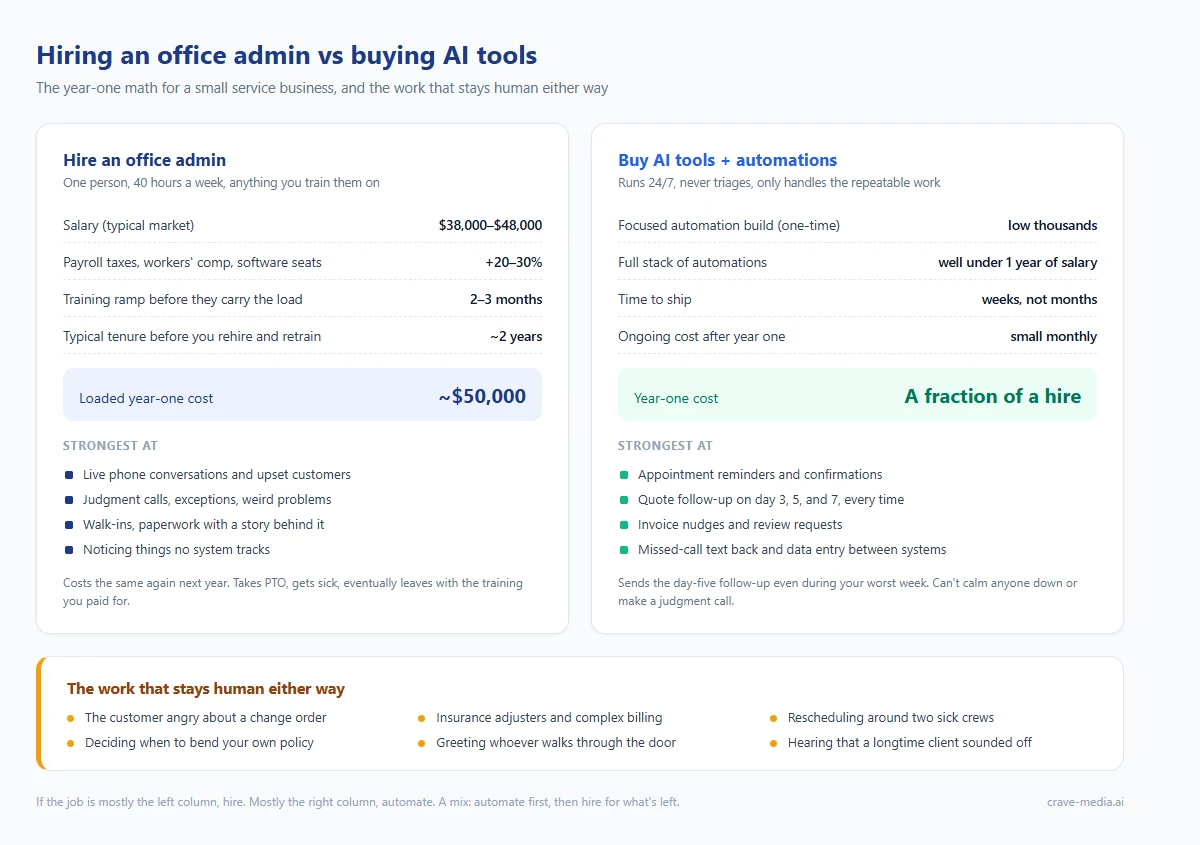
The year-one math on hiring an office admin vs buying AI tools, plus the work that stays human either way. Download as PDF
View interactive version
There's a second difference that doesn't show up on the price tag. The system sends the day-five quote follow-up every single time, including the week everything goes sideways. A human, even a great one, triages. Follow-up is the first thing that slips when the office gets busy, and it's quietly one of the most expensive things to let slip.
What still needs a human
We'd be selling you something dishonest if we stopped there, so let's talk about pile two properly.
A tool can't calm down a customer who feels burned. It can't notice that a longtime client sounded off on the phone and mention it to you. It can't make the judgment call to bump a small job for a big one without burning the small customer, or decide that this particular complaint deserves a free service call even though the policy says otherwise. It can't greet a walk-in.
If your business runs on that kind of work, a front desk with a real person at it, complex insurance billing, a phone that needs a live answer because your customers are 70 and won't text, then hire. Buy the automation later, or never. A restoration company whose phone rings with panicked homeowners at 2 AM needs both a human on call and a system that catches what the human can't, but the human comes first.
The mistake isn't hiring. The mistake is hiring a person to do robot work. If your new admin spends five hours a week copying job details from one system to another and sending identical reminder texts, you bought the most expensive automation on the market, and it takes PTO.
The order matters more than the choice
For most businesses this was never a real either-or. The question is which one comes first, and the order changes what kind of hire you eventually make.
Automate first, and when you do hire, the job posting looks different. Instead of a data-entry role, you're hiring someone for the work that deserves a salary: handling customers, keeping crews unstuck, chasing the weird problems. Those hires stick around longer too, because the job is a job and not a copy-paste loop.
Hire first, and there's a decent chance you end up automating anyway in a year, once you watch what the person spends their time on. We covered a version of this in do you need AI or just better software, and the same rule applies: the tool should absorb the repeatable work so the humans can do the human work. It's the same reason a plumber doesn't hire a second dispatcher before fixing the scheduling board everyone ignores.
One more scenario: if you're at the size where the owner is still doing all the office work personally, and it's costing you evenings, the fastest relief is usually a small automation build, because it ships in weeks and doesn't need onboarding. Hiring well takes months. Software doesn't solve loneliness at the top, but it does give you your Tuesday nights back while you figure out the org chart.
Make the list before you make the hire
Before you post the job or buy anything, spend two weeks writing down every office task as it happens, with a rough time estimate. It's tedious. Do it anyway.
At the end you'll have the actual job description, and the split will usually make the decision for you. Mostly repeatable tasks: automate, and skip the hire for now. Mostly judgment calls and phone conversations: hire, and don't feel behind for doing it. A real mix: automate the repeatable half first, then hire for the half that's left.
If you want a second opinion on which pile your list falls into, send it our way. We'll tell you what we'd automate, what we'd hire for, and if the answer is "just hire someone," you'll hear that too.

About the author
Zac Spencer is an online marketing specialist and the owner of Crave Media, based in Salt Lake City, Utah. Since 2013 he has managed hundreds of Google Ads accounts across dozens of industries — with budgets from a few hundred dollars to $250K a month — and founded Crave AI to build custom AI tools and automations for local service businesses.